Bhagavad Gita · Chapter 2: Sankhya Yoga · Speaker: Krishna
Bhagavad Gita 2.19: Ya enam vetti hantaram
Krishna says that anyone who thinks the self kills, and anyone who thinks the self is killed, both fail to understand.
Bhagavad Gita 2.19
य एनं वेत्ति हन्तारं यश्चैनं मन्यते हतम् ।उभौ तौ न विजानीतो नायं हन्ति न हन्यते ॥
Ya enam vetti hantaram yashchainam manyate hatam
Ubhau tau na vijanito nayam hanti na hanyate
ya enaṃ vetti hantāraṃ yaścainaṃ manyate hatam |
ubhau tau na vijānīto nāyaṃ hanti na hanyate ||
Our meaning Krishna says that anyone who thinks the self kills, and anyone who thinks the self is killed, both fail to understand. The self does not kill and is not killed.
हिंदी अर्थ कृष्ण कहते हैं कि जो आत्मा को मारने वाली समझता है और जो उसे मरी हुई मानता है, दोनों ही नहीं जानते। आत्मा न किसी को मारती है, न मारी जाती है।
Word by word
Every word, with its dictionary page
Word by word
- यः yaḥ who (pronoun (masculine), nominative singular) Dictionary: yad, Monier-Williams 1899, p. 844, col. 2
who, which, what, whichever, whatever, that
- एनम् enam this (Self) (pronoun (masculine), accusative singular) Dictionary: 1. ena, Monier-Williams 1899, p. 232, col. 1
he, she, it; this, that
- वेत्ति vetti knows, takes to be (present, 3rd person singular) Dictionary: 1. vid, Monier-Williams 1899, p. 963, col. 2
to know, understand, perceive, learn
- हन्तारम् hantāram a killer (noun (masculine), accusative singular) Dictionary: hantṛ, Monier-Williams 1899, p. 1288, col. 1
slaying, killing, a slayer, killer
- यः yaḥ who (pronoun (masculine), nominative singular) Dictionary: yad, Monier-Williams 1899, p. 844, col. 2
who, which, what, whichever, whatever, that
- च ca and (indeclinable) Dictionary: 2. ca, Monier-Williams 1899, p. 380, col. 1
ind. and, both, also, moreover, as well as
- एनम् enam this (pronoun (masculine), accusative singular) Dictionary: 1. ena, Monier-Williams 1899, p. 232, col. 1
he, she, it; this, that
- मन्यते manyate thinks (present, 3rd person singular) Dictionary: man, Monier-Williams 1899, p. 783, col. 1
to think, believe, imagine, suppose, conjecture
- हतम् hatam killed (past participle (masculine), accusative singular) Dictionary: hata, Monier-Williams 1899, p. 1287, col. 2
smitten, killed, slain
- उभौ ubhau both (pronoun (masculine), nominative dual) Dictionary: ubha, Monier-Williams 1899, p. 216, col. 2
both
- तौ tau they (pronoun (masculine), nominative dual) Dictionary: tad, Monier-Williams 1899, p. 434, col. 1
m. he, f. she, n. it, that, this
- न na not (indeclinable) Dictionary: 2. na, Monier-Williams 1899, p. 523, col. 1
ind. not, no, nor, neither
- विजानीतः vijānītaḥ know, understand (present, 3rd person dual) Dictionary: vi-jñā, Monier-Williams 1899, p. 961, col. 1
to distinguish, discern, observe, investigate, recognize, ascertain, know, understand
- न na not (indeclinable) Dictionary: 2. na, Monier-Williams 1899, p. 523, col. 1
ind. not, no, nor, neither
- अयम् ayam this (Self) (pronoun (masculine), nominative singular) Dictionary: 1. idam, Monier-Williams 1899, p. 165, col. 2
- हन्ति hanti kills (present, 3rd person singular) Dictionary: 1. han, Monier-Williams 1899, p. 1287, col. 2
to smite, slay, hit, kill, mar, destroy
- न na not (indeclinable) Dictionary: 2. na, Monier-Williams 1899, p. 523, col. 1
ind. not, no, nor, neither
- हन्यते hanyate is killed (present passive, 3rd person singular) Dictionary: 1. han, Monier-Williams 1899, p. 1287, col. 2
to smite, slay, hit, kill, mar, destroy
Public-domain translations
Kashinath Trimbak Telang, 1882. Public domain. Page 44–45.
He who thinks it to be the killer and he who thinks it to be killed, both know nothing. It kills not, is not killed1.
Footnotes (the translator’s own) - Cf. Katha-upanishad, p. 104. ↩
Compare 3 translations
Kashinath Trimbak Telang, 1882. Public domain. Page 44–45.
He who thinks it to be the killer and he who thinks it to be killed, both know nothing. It kills not, is not killed1.
Footnotes (the translator’s own) - Cf. Katha-upanishad, p. 104. ↩
You are reading this one
Annie Besant, 1895. Public domain. Page 28.
He who regardeth This1 as a slayer, and he who thinketh It is slain, both of them are ignorant. It slayeth not, nor is It slain.
Footnotes (the translator’s own) - The Dweller in the body. ↩
You are reading this one
Swami Swarupananda, 1909 (first printed 1907). Public domain. Page 35.
He who takes the Self to be the slayer, he who takes It to be the slain, neither of these knows. It does not slay, nor is It slain.
You are reading this one
Share
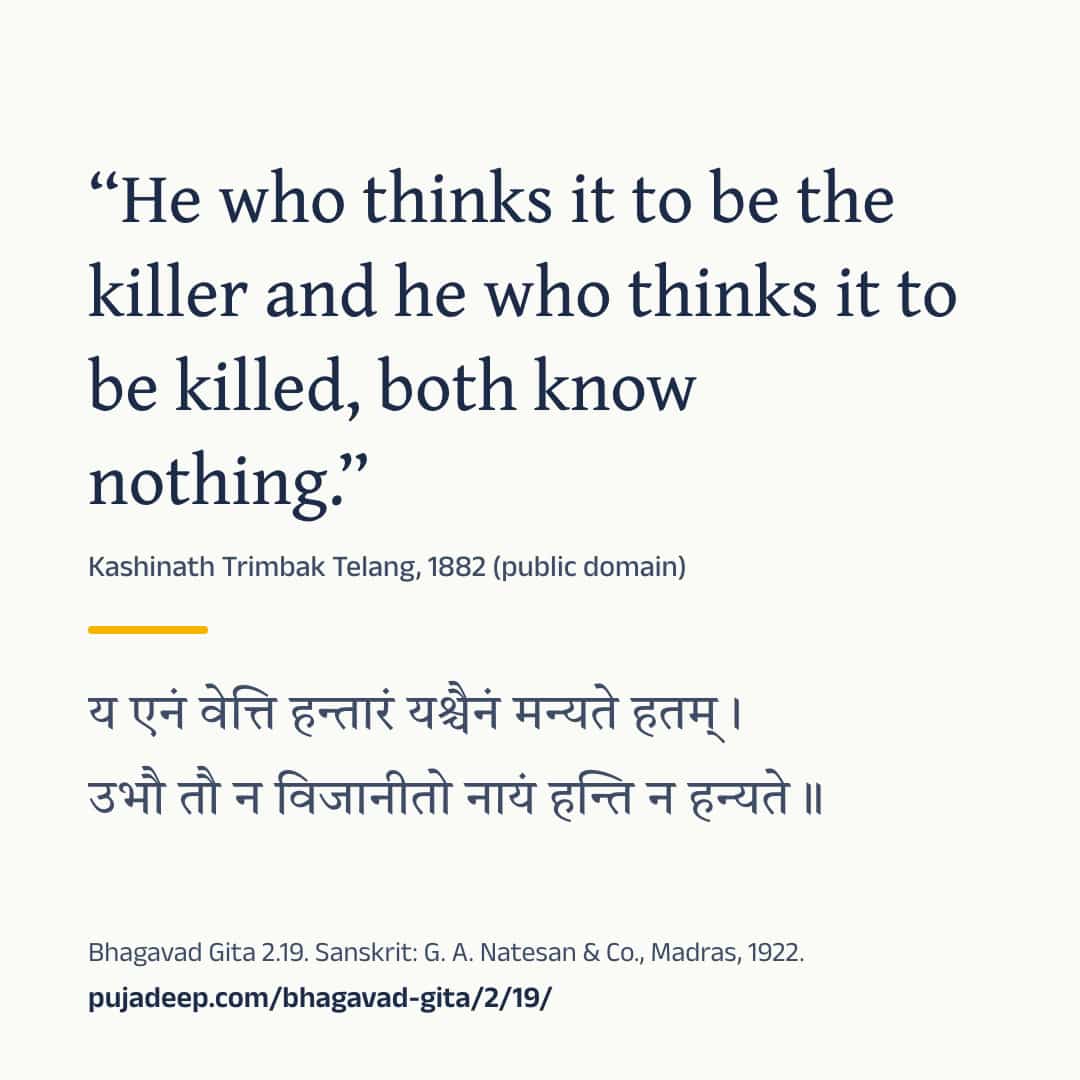
Send one picture or the text to one chat. The picture names its source and the address of this page.
Send as text
The words and the link only. Many elders prefer this.
Bhagavad Gita 2.19

य एनं वेत्ति हन्तारं यश्चैनं मन्यते हतम् ।
उभौ तौ न विजानीतो नायं हन्ति न हन्यते ॥

“He who thinks it to be the killer and he who thinks it to be killed, both know nothing. It kills not, is not killed.”
(Kashinath Trimbak Telang, 1882, public domain)

“He who regardeth This as a slayer, and he who thinketh It is slain, both of them are ignorant. It slayeth not, nor is It slain.”
(Annie Besant, 1895, public domain)

“He who takes the Self to be the slayer, he who takes It to be the slain, neither of these knows. It does not slay, nor is It slain.”
(Swami Swarupananda, 1909 (first printed 1907), public domain)

Sanskrit: G. A. Natesan & Co., Madras, 1922.
https://pujadeep.com/bhagavad-gita/2/19/?s=copy Nothing is sent from this site. Your own app sends it, to the chat you choose. The picture quotes Telang (1882). If you chose another translation above, the text quotes yours and no picture is offered.
Sanskrit text: The Bhagavad-Gita, or The Lord's Song, with the text in Devanagari and an English translation, 1922. Meanings: written for Pujadeep with AI help and reviewed. Source and changes
Questions families ask
Who speaks Bhagavad Gita 2.19?
Krishna speaks this verse, in chapter 2 (Sankhya Yoga).
Where does the Sanskrit text come from?
Sanskrit text: The Bhagavad-Gita, or The Lord's Song, with the text in Devanagari and an English translation, 1922. Meanings: written for Pujadeep with AI help and reviewed. See the source
Is the meaning on this page a translation?
Explanation written for this site with AI help from the sources listed here, and reviewed. It is not a translation and not the only way to read the text. Free to quote with credit.
Source and licence
- Sanskrit text
- The Bhagavad-Gita, or The Lord's Song, with the text in Devanagari and an English translation (Annie Besant, G. A. Natesan & Co., Madras, 1922). Public domain. The Sanskrit on these pages was read from this printing’s page images.
- Translation
- The Bhagavadgîtâ with the Sanatsugâtîya and the Anugîtâ, translated by Kâshinâth Trimbak Telang (The Sacred Books of the East, vol. VIII, ed. F. Max Müller) (Kashinath Trimbak Telang, F. Max Müller, Clarendon Press, Oxford, 1882). Public domain. Shown verbatim, as printed.
- Translation
- The Bhagavad Gîtâ, or The Lord's Song, translated by Annie Besant (Annie Besant, Theosophical Publishing Society, London, 1895). Public domain. Shown verbatim, as printed.
- Sanskrit text
- Srimad-Bhagavad-Gita, with Sanskrit Text; Paraphrase with Word-by-word Literal Translation; English Rendering and Comments, Index, &c., by the Swami Swarupananda (Himalayan Series, No. XX) (Swami Swarupananda, The Editors and Publishers, Advaita Ashrama, Mayavati, Prabuddha Bharata Press, Mayavati, Almora, Himalayas, 1909). Public domain. Used only to date the text. The Devanagari on this page is a reading text and is not copied from this printing.
- Common wording
- In this text, 32 words follow today's common wording, checked against sanskritdocuments.org; Sanskrit Wikisource; Gita Press, Gorakhpur; GRETIL, Göttingen and Bhaktivedanta Book Trust.
- Our explanation
- Explanation written for this site with AI help from the sources listed here, and reviewed. It is not a translation and not the only way to read the text. Free to quote with credit.
- Review
- AI review: 2 independent reviews against the cited edition, October 15, 2026.