Bhagavad Gita · Chapter 2: Sankhya Yoga · Speaker: Krishna
Bhagavad Gita 2.30: Dehi nityamavadhyoyam dehe
Krishna says that the one who lives in every body can never be killed, so Arjuna should not grieve for any living being.
Bhagavad Gita 2.30
देही नित्यमवध्योऽयं देहे सर्वस्य भारत ।तस्मात्सर्वाणि भूतानि न त्वं शोचितुमर्हसि ॥
Dehi nityamavadhyoyam dehe sarvasya bharata
Tasmatsarvani bhutani na tvam shochitumarhasi
dehī nityamavadhyo’yaṃ dehe sarvasya bhārata |
tasmātsarvāṇi bhūtāni na tvaṃ śocitumarhasi ||
Our meaning Krishna says that the one who lives in every body can never be killed, so Arjuna should not grieve for any living being.
हिंदी अर्थ कृष्ण कहते हैं कि हर शरीर में रहने वाली आत्मा का कभी वध नहीं हो सकता, इसलिए अर्जुन को किसी भी प्राणी के लिए शोक नहीं करना चाहिए।
Word by word
Every word, with its dictionary page
Word by word
- देही dehī the embodied one (noun (masculine), nominative singular) Dictionary: dehin, Monier-Williams 1899, p. 497, col. 1
m. the spirit, soul
- नित्यम् nityam always (adverb) Dictionary: nitya, Monier-Williams 1899, p. 547, col. 2
continual, perpetual, eternal
- अवध्यः avadhyaḥ cannot be killed (gerundive (to be done) (masculine), nominative singular) Dictionary: a-vadhya, Monier-Williams 1899, p. 99, col. 3
not to be killed, inviolable
- अयम् ayam this (pronoun (masculine), nominative singular) Dictionary: 1. idam, Monier-Williams 1899, p. 165, col. 2
- देहे dehe in the body (noun (masculine), locative singular) Dictionary: deha, Monier-Williams 1899, p. 496, col. 3
the body
- सर्वस्य sarvasya of everyone (pronoun (masculine), genitive singular) Dictionary: sarva, Monier-Williams 1899, p. 1184, col. 3
whole, entire, all, every
- भारत bhārata O Bharata (Arjuna) (noun (masculine), vocative singular) Dictionary: bhārata, Monier-Williams 1899, p. 753, col. 1
- तस्मात् tasmāt therefore (indeclinable) Dictionary: tasmāt, Monier-Williams 1899, p. 441, col. 2
from that, on that account, therefore
- सर्वाणि sarvāṇi all (pronoun (neuter), accusative plural) Dictionary: sarva, Monier-Williams 1899, p. 1184, col. 3
whole, entire, all, every
- भूतानि bhūtāni beings (noun (neuter), accusative plural) Dictionary: bhūta, Monier-Williams 1899, p. 761, col. 3
that which is or exists, any living being
- न na not (indeclinable) Dictionary: 2. na, Monier-Williams 1899, p. 523, col. 1
ind. not, no, nor, neither
- त्वम् tvam you (pronoun, nominative singular) Dictionary: 2. tva, Monier-Williams 1899, p. 463, col. 2
base of the 2nd personal pron.
- शोचितुम् śocitum to grieve (infinitive (to do)) Dictionary: 1. śuc, Monier-Williams 1899, p. 1081, col. 1
be sorrowful or afflicted, grieve, mourn at or for
- अर्हसि arhasi you ought (present, 2nd person singular) Dictionary: arh, Monier-Williams 1899, p. 93, col. 3
to be able
Public-domain translations
Kashinath Trimbak Telang, 1882. Public domain. Page 46.
This embodied (self), O descendant of Bharata! within every one's body is ever indestructible. Therefore you ought not to grieve for any being.
Compare 3 translations
Kashinath Trimbak Telang, 1882. Public domain. Page 46.
This embodied (self), O descendant of Bharata! within every one's body is ever indestructible. Therefore you ought not to grieve for any being.
You are reading this one
Annie Besant, 1895. Public domain. Page 30.
This Dweller in the body of everyone is ever invulnerable, O Bhârata; therefore thou shouldst not grieve for any creature.
You are reading this one
Swami Swarupananda, 1909 (first printed 1907). Public domain. Page 40.
This, the Indweller in the bodies of all, is ever indestructible, O descendant of Bharata. Wherefore thou oughtest not to mourn for any creature.
You are reading this one
Share
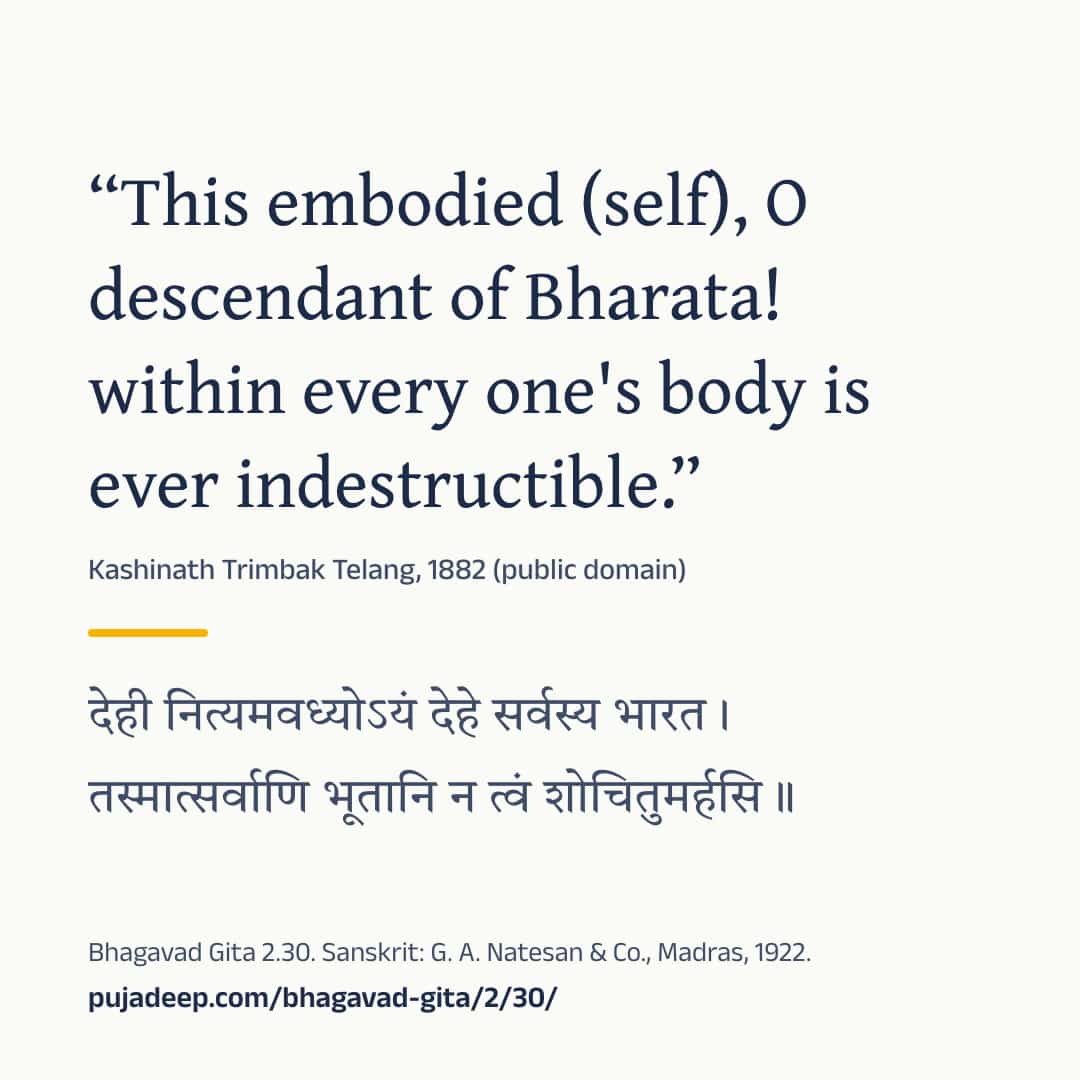
Send one picture or the text to one chat. The picture names its source and the address of this page.
Send as text
The words and the link only. Many elders prefer this.
Bhagavad Gita 2.30

देही नित्यमवध्योऽयं देहे सर्वस्य भारत ।
तस्मात्सर्वाणि भूतानि न त्वं शोचितुमर्हसि ॥

“This embodied (self), O descendant of Bharata! within every one's body is ever indestructible. Therefore you ought not to grieve for any being.”
(Kashinath Trimbak Telang, 1882, public domain)

“This Dweller in the body of everyone is ever invulnerable, O Bhârata; therefore thou shouldst not grieve for any creature.”
(Annie Besant, 1895, public domain)

“This, the Indweller in the bodies of all, is ever indestructible, O descendant of Bharata. Wherefore thou oughtest not to mourn for any creature.”
(Swami Swarupananda, 1909 (first printed 1907), public domain)

Sanskrit: G. A. Natesan & Co., Madras, 1922.
https://pujadeep.com/bhagavad-gita/2/30/?s=copy Nothing is sent from this site. Your own app sends it, to the chat you choose. The picture quotes Telang (1882). If you chose another translation above, the text quotes yours and no picture is offered.
Sanskrit text: The Bhagavad-Gita, or The Lord's Song, with the text in Devanagari and an English translation, 1922. Meanings: written for Pujadeep with AI help and reviewed. Source and changes
Questions families ask
Who speaks Bhagavad Gita 2.30?
Krishna speaks this verse, in chapter 2 (Sankhya Yoga).
Where does the Sanskrit text come from?
Sanskrit text: The Bhagavad-Gita, or The Lord's Song, with the text in Devanagari and an English translation, 1922. Meanings: written for Pujadeep with AI help and reviewed. See the source
Is the meaning on this page a translation?
Explanation written for this site with AI help from the sources listed here, and reviewed. It is not a translation and not the only way to read the text. Free to quote with credit.
Source and licence
- Sanskrit text
- The Bhagavad-Gita, or The Lord's Song, with the text in Devanagari and an English translation (Annie Besant, G. A. Natesan & Co., Madras, 1922). Public domain. The Sanskrit on these pages was read from this printing’s page images.
- Translation
- The Bhagavadgîtâ with the Sanatsugâtîya and the Anugîtâ, translated by Kâshinâth Trimbak Telang (The Sacred Books of the East, vol. VIII, ed. F. Max Müller) (Kashinath Trimbak Telang, F. Max Müller, Clarendon Press, Oxford, 1882). Public domain. Shown verbatim, as printed.
- Translation
- The Bhagavad Gîtâ, or The Lord's Song, translated by Annie Besant (Annie Besant, Theosophical Publishing Society, London, 1895). Public domain. Shown verbatim, as printed.
- Sanskrit text
- Srimad-Bhagavad-Gita, with Sanskrit Text; Paraphrase with Word-by-word Literal Translation; English Rendering and Comments, Index, &c., by the Swami Swarupananda (Himalayan Series, No. XX) (Swami Swarupananda, The Editors and Publishers, Advaita Ashrama, Mayavati, Prabuddha Bharata Press, Mayavati, Almora, Himalayas, 1909). Public domain. Used only to date the text. The Devanagari on this page is a reading text and is not copied from this printing.
- Common wording
- In this text, 32 words follow today's common wording, checked against sanskritdocuments.org; Sanskrit Wikisource; Gita Press, Gorakhpur; GRETIL, Göttingen and Bhaktivedanta Book Trust.
- Our explanation
- Explanation written for this site with AI help from the sources listed here, and reviewed. It is not a translation and not the only way to read the text. Free to quote with credit.
- Review
- AI review: 2 independent reviews against the cited edition, October 15, 2026.