Bhagavad Gita · Chapter 2: Sankhya Yoga · Speaker: Krishna
Bhagavad Gita 2.32: Yadrichchhaya chopapannam
Krishna says that fortunate warriors get such a war without seeking it.
Bhagavad Gita 2.32
यदृच्छया चोपपन्नं स्वर्गद्वारमपावृतम् ।सुखिनः क्षत्रियाः पार्थ लभन्ते युद्धमीदृशम् ॥
Yadrichchhaya chopapannam svargadvaramapavritam
Sukhinah kshatriyah partha labhante yuddhamidrisham
yadṛcchayā copapannaṃ svargadvāramapāvṛtam |
sukhinaḥ kṣatriyāḥ pārtha labhante yuddhamīdṛśam ||
Our meaning Krishna says that fortunate warriors get such a war without seeking it. It comes to them like an open door to heaven.
हिंदी अर्थ कृष्ण कहते हैं कि ऐसा युद्ध भाग्यशाली क्षत्रियों को अपने-आप मिलता है, मानो स्वर्ग का खुला द्वार।
Word by word
Every word, with its dictionary page
Word by word
- यदृच्छया yadṛcchayā by chance, unsought (noun (feminine), instrumental singular) Dictionary: yad-ṛcchā, Monier-Williams 1899, p. 844, col. 3
self-will, spontaneity, accident, chance
- च ca and (indeclinable) Dictionary: 2. ca, Monier-Williams 1899, p. 380, col. 1
ind. and, both, also, moreover, as well as
- उपपन्नम् upapannam come of itself (past participle (neuter), accusative singular) Dictionary: upa-panna, Monier-Williams 1899, p. 201, col. 3
obtained, reached, gained
- स्वर्गद्वारम् svargadvāram the door of heaven (compound (neuter), accusative singular) Dictionary: svarga-dvāra, Monier-Williams 1899, p. 1281, col. 3
heaven's gate
- अपावृतम् apāvṛtam open (past participle (neuter), accusative singular) Dictionary: apā-vṛta, Monier-Williams 1899, p. 54, col. 3
open, laid open
- सुखिनः sukhinaḥ happy, fortunate (adjective (masculine), nominative plural) Dictionary: sukhin, Monier-Williams 1899, p. 1222, col. 1
possessing or causing happiness or pleasure, happy, joyful
- क्षत्रियाः kṣatriyāḥ kshatriyas (warriors) (noun (masculine), nominative plural) Dictionary: kṣatriya, Monier-Williams 1899, p. 325, col. 2
governing, endowed with sovereignty
- पार्थ pārtha O Partha (noun (masculine), vocative singular) Dictionary: 2. pārtha, Monier-Williams 1899, p. 621, col. 3
- लभन्ते labhante get (present, 3rd person plural) Dictionary: labh, Monier-Williams 1899, p. 896, col. 2
to gain possession of, obtain, receive
- युद्धम् yuddham a battle (noun (neuter), accusative singular) Dictionary: yuddha, Monier-Williams 1899, p. 854, col. 3
battle, fight, war
- ईदृशम् īdṛśam such (adjective (neuter), accusative singular) Dictionary: īdṛśa, Monier-Williams 1899, p. 170, col. 2
endowed with such qualities, such
Public-domain translations
Kashinath Trimbak Telang, 1882. Public domain. Page 46.
Happy those Kshatriyas, O son of Prithâ! who can find such a battle (to fight)—come of itself1—an open door to heaven!
Footnotes (the translator’s own) - Without any effort, that is to say, of one's own. ↩
Compare 3 translations
Kashinath Trimbak Telang, 1882. Public domain. Page 46.
Happy those Kshatriyas, O son of Prithâ! who can find such a battle (to fight)—come of itself1—an open door to heaven!
Footnotes (the translator’s own) - Without any effort, that is to say, of one's own. ↩
You are reading this one
Annie Besant, 1895. Public domain. Page 30.
Happy the Kshattriyas, O Pârtha, who obtain such a fight, spontaneously offered as an open door to Svarga.
You are reading this one
Swami Swarupananda, 1909 (first printed 1907). Public domain. Page 41.
Fortunate certainly are the Kshatriyas, O son of Prithâ, who are called to fight in such a battle, that comes unsought as an open gate to heaven.
You are reading this one
Share
Send one picture or the text to one chat. The picture names its source and the address of this page.
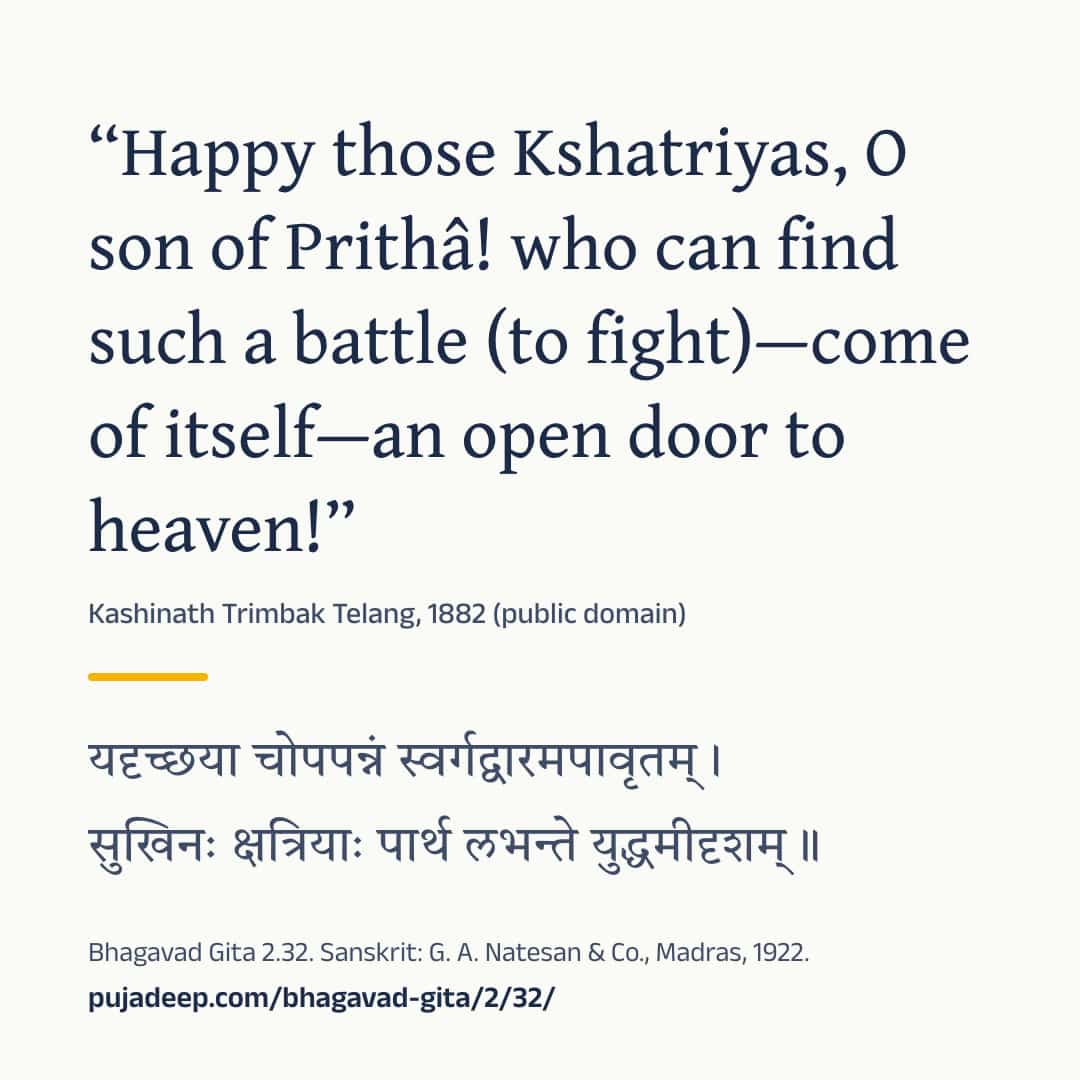
Send as text
The words and the link only. Many elders prefer this.
Bhagavad Gita 2.32

यदृच्छया चोपपन्नं स्वर्गद्वारमपावृतम् ।
सुखिनः क्षत्रियाः पार्थ लभन्ते युद्धमीदृशम् ॥

“Happy those Kshatriyas, O son of Prithâ! who can find such a battle (to fight)—come of itself—an open door to heaven!”
(Kashinath Trimbak Telang, 1882, public domain)

“Happy the Kshattriyas, O Pârtha, who obtain such a fight, spontaneously offered as an open door to Svarga.”
(Annie Besant, 1895, public domain)

“Fortunate certainly are the Kshatriyas, O son of Prithâ, who are called to fight in such a battle, that comes unsought as an open gate to heaven.”
(Swami Swarupananda, 1909 (first printed 1907), public domain)

Sanskrit: G. A. Natesan & Co., Madras, 1922.
https://pujadeep.com/bhagavad-gita/2/32/?s=copy Nothing is sent from this site. Your own app sends it, to the chat you choose. The picture quotes Telang (1882). If you chose another translation above, the text quotes yours and no picture is offered.
Sanskrit text: The Bhagavad-Gita, or The Lord's Song, with the text in Devanagari and an English translation, 1922. Meanings: written for Pujadeep with AI help and reviewed. Source and changes
Questions families ask
Who speaks Bhagavad Gita 2.32?
Krishna speaks this verse, in chapter 2 (Sankhya Yoga).
Where does the Sanskrit text come from?
Sanskrit text: The Bhagavad-Gita, or The Lord's Song, with the text in Devanagari and an English translation, 1922. Meanings: written for Pujadeep with AI help and reviewed. See the source
Is the meaning on this page a translation?
Explanation written for this site with AI help from the sources listed here, and reviewed. It is not a translation and not the only way to read the text. Free to quote with credit.
Source and licence
- Sanskrit text
- The Bhagavad-Gita, or The Lord's Song, with the text in Devanagari and an English translation (Annie Besant, G. A. Natesan & Co., Madras, 1922). Public domain. The Sanskrit on these pages was read from this printing’s page images.
- Translation
- The Bhagavadgîtâ with the Sanatsugâtîya and the Anugîtâ, translated by Kâshinâth Trimbak Telang (The Sacred Books of the East, vol. VIII, ed. F. Max Müller) (Kashinath Trimbak Telang, F. Max Müller, Clarendon Press, Oxford, 1882). Public domain. Shown verbatim, as printed.
- Translation
- The Bhagavad Gîtâ, or The Lord's Song, translated by Annie Besant (Annie Besant, Theosophical Publishing Society, London, 1895). Public domain. Shown verbatim, as printed.
- Sanskrit text
- Srimad-Bhagavad-Gita, with Sanskrit Text; Paraphrase with Word-by-word Literal Translation; English Rendering and Comments, Index, &c., by the Swami Swarupananda (Himalayan Series, No. XX) (Swami Swarupananda, The Editors and Publishers, Advaita Ashrama, Mayavati, Prabuddha Bharata Press, Mayavati, Almora, Himalayas, 1909). Public domain. Used only to date the text. The Devanagari on this page is a reading text and is not copied from this printing.
- Common wording
- In this text, 32 words follow today's common wording, checked against sanskritdocuments.org; Sanskrit Wikisource; Gita Press, Gorakhpur; GRETIL, Göttingen and Bhaktivedanta Book Trust.
- Our explanation
- Explanation written for this site with AI help from the sources listed here, and reviewed. It is not a translation and not the only way to read the text. Free to quote with credit.
- Review
- AI review: 2 independent reviews against the cited edition, October 15, 2026.