Bhagavad Gita · Chapter 2: Sankhya Yoga · Speaker: Krishna
Bhagavad Gita 2.45: Traigunyavishaya veda
Krishna says the Vedas deal with the world of the three gunas (the qualities of nature).
Bhagavad Gita 2.45
त्रैगुण्यविषया वेदा निस्त्रैगुण्यो भवार्जुन ।निर्द्वन्द्वो नित्यसत्त्वस्थो निर्योगक्षेम आत्मवान् ॥
Traigunyavishaya veda nistraigunyo bhavarjuna
Nirdvandvo nityasattvastho niryogakshema atmavan
traiguṇyaviṣayā vedā nistraiguṇyo bhavārjuna |
nirdvandvo nityasattvastho niryogakṣema ātmavān ||
Our meaning Krishna says the Vedas deal with the world of the three gunas (the qualities of nature). He asks Arjuna to rise above the three gunas and above the pairs of opposites, to stay always in sattva (purity), to be free of worry about getting and keeping, and to be centred in the self.
हिंदी अर्थ कृष्ण कहते हैं कि वेद तीनों गुणों (प्रकृति के गुण) के क्षेत्र की बात करते हैं। वे अर्जुन से कहते हैं कि वे तीनों गुणों और द्वंद्वों से ऊपर उठें, सदा सत्त्व में स्थित रहें, पाने और बचाने की चिंता छोड़ें, और आत्मा में स्थित रहें।
Word by word
Every word, with its dictionary page
Word by word
- त्रैगुण्यविषयाः traiguṇyaviṣayāḥ dealing with the three gunas (compound (masculine), nominative plural) Dictionary: traiguṇya, Monier-Williams 1899, p. 462, col. 1
the 3 Guṇas
; viṣaya, Monier-Williams 1899, p. 997, col. 1sphere (of influence or activity)
- वेदाः vedāḥ the Vedas (noun (masculine), nominative plural) Dictionary: 1. veda, Monier-Williams 1899, p. 1015, col. 1
knowledge, true or sacred knowledge or lore
- निस्त्रैगुण्यः nistraiguṇyaḥ beyond the three gunas (compound (masculine), nominative singular) Dictionary: nis-traiguṇya, Monier-Williams 1899, p. 543, col. 3
destitute of the three Guṇas
- भव bhava be (imperative, 2nd person singular) Dictionary: 1. bhū, Monier-Williams 1899, p. 760, col. 2
arise, come into being, exist
- अर्जुन arjuna O Arjuna (noun (masculine), vocative singular) Dictionary: arjuna, Monier-Williams 1899, p. 90, col. 1
- निर्द्वन्द्वः nirdvandvaḥ free from the pairs of opposites (compound (masculine), nominative singular) Dictionary: nir-dvaṃdva, Monier-Williams 1899, p. 541, col. 2
indifferent to the alternatives or opposite pairs
- नित्यसत्त्वस्थः nityasattvasthaḥ always established in sattva (compound (masculine), nominative singular) Dictionary: nitya, Monier-Williams 1899, p. 547, col. 2
continual, perpetual, eternal
; sat-tva, Monier-Williams 1899, p. 1135, col. 2the quality of purity or goodness
; stha, Monier-Williams 1899, p. 1262, col. 3standing, staying, abiding, being situated in
- निर्योगक्षेमः niryogakṣemaḥ free from getting and keeping (compound (masculine), nominative singular) Dictionary: nis, Monier-Williams 1899, p. 543, col. 2
out, forth, away
; yoga-kṣema, Monier-Williams 1899, p. 856, col. 3the security or secure possession of what has been acquired
- आत्मवान् ātmavān self-possessed (adjective (masculine), nominative singular) Dictionary: ātma-vat, Monier-Williams 1899, p. 135, col. 3
self-possessed, composed, prudent
Public-domain translations
Kashinath Trimbak Telang, 1882. Public domain. Page 48.
The Vedas (merely) relate to the effects of the three qualities1; do you, O Arguna! rise above those effects of the three qualities, and be free from the pairs of opposites2, always preserve courage3, be free from anxiety for new acquisitions or protection of old acquisitions, and be self-controlled4.
Footnotes (the translator’s own) Compare 3 translations
Kashinath Trimbak Telang, 1882. Public domain. Page 48.
The Vedas (merely) relate to the effects of the three qualities1; do you, O Arguna! rise above those effects of the three qualities, and be free from the pairs of opposites2, always preserve courage3, be free from anxiety for new acquisitions or protection of old acquisitions, and be self-controlled4.
Footnotes (the translator’s own) You are reading this one
Annie Besant, 1895. Public domain. Page 33.
The Vedas deal with the three attributes;1 be thou without these three attributes, O Arjuna; without the pairs of opposites, ever steadfast in Sattva, careless of possessions, full of the SELF.
Footnotes (the translator’s own) - Gunas=attributes, or forms of energy. They are Sattva, purity, Rajas, activity or passion, Tama, inertness or darkness. ↩
You are reading this one
Swami Swarupananda, 1909 (first printed 1907). Public domain. Page 48.
The Vedas deal with the three Gunas. Be thou free, O Arjuna, from the triad of the Gunas, free from the pairs of opposites, ever-balanced, free from (the thought of) getting and keeping, and established in the Self.
You are reading this one
Share
Send one picture or the text to one chat. The picture names its source and the address of this page.
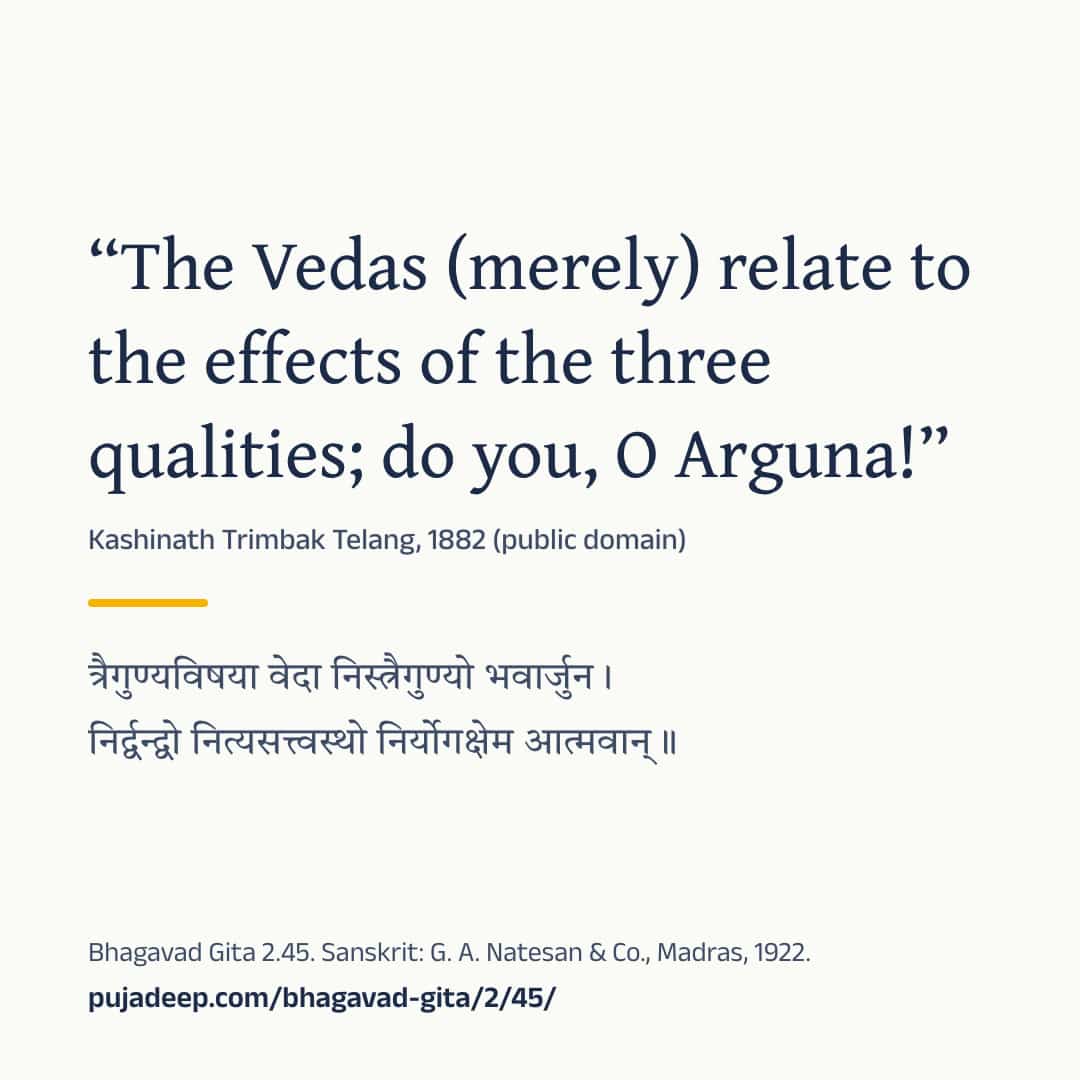
Send as text
The words and the link only. Many elders prefer this.
Bhagavad Gita 2.45

त्रैगुण्यविषया वेदा निस्त्रैगुण्यो भवार्जुन ।
निर्द्वन्द्वो नित्यसत्त्वस्थो निर्योगक्षेम आत्मवान् ॥

“The Vedas (merely) relate to the effects of the three qualities; do you, O Arguna! rise above those effects of the three qualities, and be free from the pairs of opposites, always preserve courage, be free from anxiety for new acquisitions or protection of old acquisitions, and be self-controlled.”
(Kashinath Trimbak Telang, 1882, public domain)

“The Vedas deal with the three attributes; be thou without these three attributes, O Arjuna; without the pairs of opposites, ever steadfast in Sattva, careless of possessions, full of the SELF.”
(Annie Besant, 1895, public domain)

“The Vedas deal with the three Gunas. Be thou free, O Arjuna, from the triad of the Gunas, free from the pairs of opposites, ever-balanced, free from (the thought of) getting and keeping, and established in the Self.”
(Swami Swarupananda, 1909 (first printed 1907), public domain)

Sanskrit: G. A. Natesan & Co., Madras, 1922.
https://pujadeep.com/bhagavad-gita/2/45/?s=copy Nothing is sent from this site. Your own app sends it, to the chat you choose. The picture quotes Telang (1882). If you chose another translation above, the text quotes yours and no picture is offered.
Sanskrit text: The Bhagavad-Gita, or The Lord's Song, with the text in Devanagari and an English translation, 1922. Meanings: written for Pujadeep with AI help and reviewed. Source and changes
Questions families ask
Who speaks Bhagavad Gita 2.45?
Krishna speaks this verse, in chapter 2 (Sankhya Yoga).
Where does the Sanskrit text come from?
Sanskrit text: The Bhagavad-Gita, or The Lord's Song, with the text in Devanagari and an English translation, 1922. Meanings: written for Pujadeep with AI help and reviewed. See the source
Is the meaning on this page a translation?
Explanation written for this site with AI help from the sources listed here, and reviewed. It is not a translation and not the only way to read the text. Free to quote with credit.
Source and licence
- Sanskrit text
- The Bhagavad-Gita, or The Lord's Song, with the text in Devanagari and an English translation (Annie Besant, G. A. Natesan & Co., Madras, 1922). Public domain. The Sanskrit on these pages was read from this printing’s page images.
- Translation
- The Bhagavadgîtâ with the Sanatsugâtîya and the Anugîtâ, translated by Kâshinâth Trimbak Telang (The Sacred Books of the East, vol. VIII, ed. F. Max Müller) (Kashinath Trimbak Telang, F. Max Müller, Clarendon Press, Oxford, 1882). Public domain. Shown verbatim, as printed.
- Translation
- The Bhagavad Gîtâ, or The Lord's Song, translated by Annie Besant (Annie Besant, Theosophical Publishing Society, London, 1895). Public domain. Shown verbatim, as printed.
- Sanskrit text
- Srimad-Bhagavad-Gita, with Sanskrit Text; Paraphrase with Word-by-word Literal Translation; English Rendering and Comments, Index, &c., by the Swami Swarupananda (Himalayan Series, No. XX) (Swami Swarupananda, The Editors and Publishers, Advaita Ashrama, Mayavati, Prabuddha Bharata Press, Mayavati, Almora, Himalayas, 1909). Public domain. Used only to date the text. The Devanagari on this page is a reading text and is not copied from this printing.
- Common wording
- In this text, 32 words follow today's common wording, checked against sanskritdocuments.org; Sanskrit Wikisource; Gita Press, Gorakhpur; GRETIL, Göttingen and Bhaktivedanta Book Trust.
- Our explanation
- Explanation written for this site with AI help from the sources listed here, and reviewed. It is not a translation and not the only way to read the text. Free to quote with credit.
- Review
- AI review: 2 independent reviews against the cited edition, October 15, 2026.