Bhagavad Gita · Chapter 2: Sankhya Yoga · Speaker: Krishna
Bhagavad Gita 2.72: Esha brahmi sthitih partha
Krishna says this is the state of Brahman (brāhmī sthiti).
Bhagavad Gita 2.72
एषा ब्राह्मी स्थितिः पार्थ नैनां प्राप्य विमुह्यति ।स्थित्वाऽस्यामन्तकालेऽपि ब्रह्म निर्वाणमृच्छति ॥
Esha brahmi sthitih partha nainam prapya vimuhyati
Sthitvasyamantakalepi brahma nirvanamrichchhati
eṣā brāhmī sthitiḥ pārtha naināṃ prāpya vimuhyati |
sthitvā’syāmantakāle’pi brahma nirvāṇamṛcchati ||
Our meaning Krishna says this is the state of Brahman (brāhmī sthiti). Having reached it, a person is no longer confused. Whoever is established in it, even at the end of life, reaches brahma-nirvāṇa, the peace of Brahman. The schools explain brahma-nirvāṇa in their own ways.
हिंदी अर्थ कृष्ण कहते हैं कि यह ब्राह्मी स्थिति है। इसे पाकर मनुष्य फिर मोह में नहीं पड़ता। जो अंत समय में भी इसमें स्थित रहता है, वह ब्रह्मनिर्वाण (ब्रह्म की शांति) को पाता है। अलग-अलग परंपराएँ ब्रह्मनिर्वाण को अपने ढंग से समझाती हैं।
Word by word
Every word, with its dictionary page
Word by word
- एषा eṣā this (pronoun (feminine), nominative singular) Dictionary: etad, Monier-Williams 1899, p. 231, col. 2
this, this here, here
- ब्राह्मी brāhmī of Brahman (adjective (feminine), nominative singular) Dictionary: brāhma, Monier-Williams 1899, p. 741, col. 1
relating to Brahmă or Brahmā, holy, sacred, divine
- स्थितिः sthitiḥ state (noun (feminine), nominative singular) Dictionary: sthiti, Monier-Williams 1899, p. 1264, col. 2
standing, staying, remaining, abiding
- पार्थ pārtha O Partha (noun (masculine), vocative singular) Dictionary: 2. pārtha, Monier-Williams 1899, p. 621, col. 3
- न na not (indeclinable) Dictionary: 2. na, Monier-Williams 1899, p. 523, col. 1
ind. not, no, nor, neither
- एनाम् enām this (pronoun (feminine), accusative singular) Dictionary: 1. ena, Monier-Williams 1899, p. 232, col. 1
he, she, it; this, that
- प्राप्य prāpya having reached (absolutive (having done)) Dictionary: prāp, Monier-Williams 1899, p. 707, col. 2
to attain to, reach, arrive at, meet with, find
- विमुह्यति vimuhyati is deluded (present, 3rd person singular) Dictionary: vi-muh, Monier-Williams 1899, p. 980, col. 3
to be confused, become bewildered or stupefied
- स्थित्वा sthitvā being established (absolutive (having done)) Dictionary: 1. sthā, Monier-Williams 1899, p. 1262, col. 2
to stand, stand firmly, station one's self
- अस्याम् asyām in this (pronoun (feminine), locative singular) Dictionary: 1. idam, Monier-Williams 1899, p. 165, col. 2
- अन्तकाले antakāle at the time of death (compound (masculine), locative singular) Dictionary: anta-kāla, Monier-Williams 1899, p. 42, col. 3
time of death, death
- अपि api even (indeclinable) Dictionary: api, Monier-Williams 1899, p. 55, col. 1
in the sense of even, also, very
- ब्रह्मनिर्वाणम् brahmanirvāṇam the nirvana of Brahman (compound (neuter), accusative singular) Dictionary: brahma-nirvāṇa, Monier-Williams 1899, p. 739, col. 1
extinction in Brahmă, absorption into the one self-existent Spirit
- ऋच्छति ṛcchati reaches (present, 3rd person singular) Dictionary: ṛ, Monier-Williams 1899, p. 223, col. 2
to move or go towards
1 printing differs
Public-domain translations
Kashinath Trimbak Telang, 1882. Public domain. Page 52.
This, O son of Prithâ! is the Brahmic1 state; attaining to this, one is never deluded; and remaining in it in (one's) last moments, one attains (brahma-nirvâna) the Brahmic bliss2.
Footnotes (the translator’s own) Compare 3 translations
Kashinath Trimbak Telang, 1882. Public domain. Page 52.
This, O son of Prithâ! is the Brahmic1 state; attaining to this, one is never deluded; and remaining in it in (one's) last moments, one attains (brahma-nirvâna) the Brahmic bliss2.
Footnotes (the translator’s own) You are reading this one
Annie Besant, 1895. Public domain. Page 39.
This is the Brahman state, O son of Prithâ. Having attained thereto none is bewildered. Who at the death-hour is established therein, he too goeth to the Nirvâna of Brahman.
You are reading this one
Swami Swarupananda, 1909 (first printed 1907). Public domain. Page 138.
This is to have one's being in Brahman, O son of Pritha. None, attaining to this, becomes deluded. Being established therein, even at the end of life, a man attains to oneness with Brahman.
You are reading this one
Share
Send one picture or the text to one chat. The picture names its source and the address of this page.
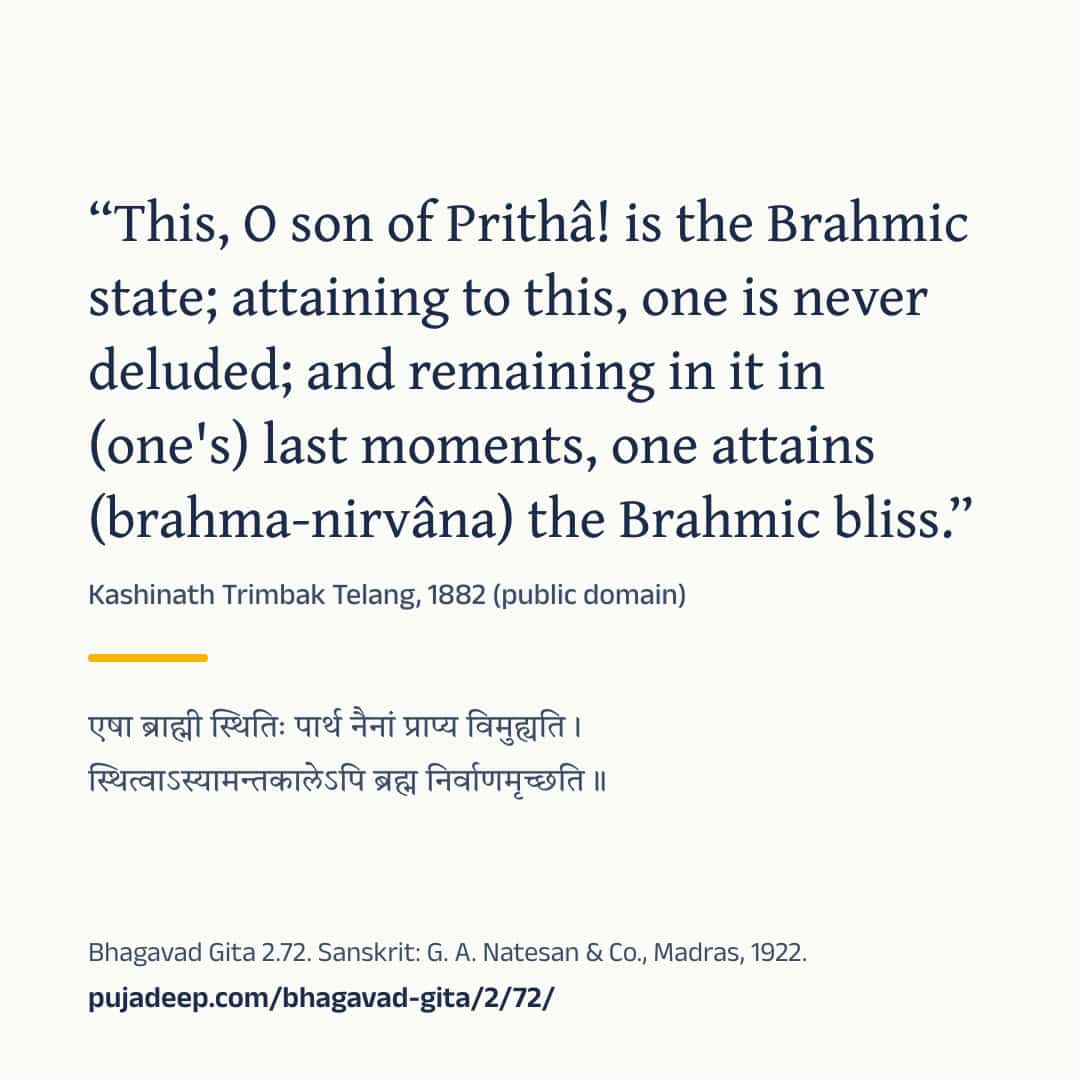
Send as text
The words and the link only. Many elders prefer this.
Bhagavad Gita 2.72

एषा ब्राह्मी स्थितिः पार्थ नैनां प्राप्य विमुह्यति ।
स्थित्वाऽस्यामन्तकालेऽपि ब्रह्म निर्वाणमृच्छति ॥

“This, O son of Prithâ! is the Brahmic state; attaining to this, one is never deluded; and remaining in it in (one's) last moments, one attains (brahma-nirvâna) the Brahmic bliss.”
(Kashinath Trimbak Telang, 1882, public domain)

“This is the Brahman state, O son of Prithâ. Having attained thereto none is bewildered. Who at the death-hour is established therein, he too goeth to the Nirvâna of Brahman.”
(Annie Besant, 1895, public domain)

“This is to have one's being in Brahman, O son of Pritha. None, attaining to this, becomes deluded. Being established therein, even at the end of life, a man attains to oneness with Brahman.”
(Swami Swarupananda, 1909 (first printed 1907), public domain)

Sanskrit: G. A. Natesan & Co., Madras, 1922.
https://pujadeep.com/bhagavad-gita/2/72/?s=copy Nothing is sent from this site. Your own app sends it, to the chat you choose. The picture quotes Telang (1882). If you chose another translation above, the text quotes yours and no picture is offered.
Sanskrit text: The Bhagavad-Gita, or The Lord's Song, with the text in Devanagari and an English translation, 1922. Meanings: written for Pujadeep with AI help and reviewed. Source and changes
Questions families ask
Who speaks Bhagavad Gita 2.72?
Krishna speaks this verse, in chapter 2 (Sankhya Yoga).
Where does the Sanskrit text come from?
Sanskrit text: The Bhagavad-Gita, or The Lord's Song, with the text in Devanagari and an English translation, 1922. Meanings: written for Pujadeep with AI help and reviewed. See the source
Is the meaning on this page a translation?
Explanation written for this site with AI help from the sources listed here, and reviewed. It is not a translation and not the only way to read the text. Free to quote with credit.
Source and licence
- Sanskrit text
- The Bhagavad-Gita, or The Lord's Song, with the text in Devanagari and an English translation (Annie Besant, G. A. Natesan & Co., Madras, 1922). Public domain. The Sanskrit on these pages was read from this printing’s page images.
- Translation
- The Bhagavadgîtâ with the Sanatsugâtîya and the Anugîtâ, translated by Kâshinâth Trimbak Telang (The Sacred Books of the East, vol. VIII, ed. F. Max Müller) (Kashinath Trimbak Telang, F. Max Müller, Clarendon Press, Oxford, 1882). Public domain. Shown verbatim, as printed.
- Translation
- The Bhagavad Gîtâ, or The Lord's Song, translated by Annie Besant (Annie Besant, Theosophical Publishing Society, London, 1895). Public domain. Shown verbatim, as printed.
- Sanskrit text
- Srimad-Bhagavad-Gita, with Sanskrit Text; Paraphrase with Word-by-word Literal Translation; English Rendering and Comments, Index, &c., by the Swami Swarupananda (Himalayan Series, No. XX) (Swami Swarupananda, The Editors and Publishers, Advaita Ashrama, Mayavati, Prabuddha Bharata Press, Mayavati, Almora, Himalayas, 1909). Public domain. Used only to date the text. The Devanagari on this page is a reading text and is not copied from this printing.
- Common wording
- In this text, 32 words follow today's common wording, checked against sanskritdocuments.org; Sanskrit Wikisource; Gita Press, Gorakhpur; GRETIL, Göttingen and Bhaktivedanta Book Trust.
- Our explanation
- Explanation written for this site with AI help from the sources listed here, and reviewed. It is not a translation and not the only way to read the text. Free to quote with credit.
- Review
- AI review: 2 independent reviews against the cited edition, October 15, 2026.