Bhagavad Gita · Chapter 2: Sankhya Yoga · Speaker: Krishna
Bhagavad Gita 2.13: Dehinosminyatha dehe kaumaram
Krishna explains: the one who lives in the body passes through childhood, youth and old age in this body.
Bhagavad Gita 2.13
देहिनोऽस्मिन्यथा देहे कौमारं यौवनं जरा ।तथा देहान्तरप्राप्तिर्धीरस्तत्र न मुह्यति ॥
Dehinosminyatha dehe kaumaram yauvanam jara
Tatha dehantarapraptirdhirastatra na muhyati
dehino’sminyathā dehe kaumāraṃ yauvanaṃ jarā |
tathā dehāntaraprāptirdhīrastatra na muhyati ||
Our meaning Krishna explains: the one who lives in the body passes through childhood, youth and old age in this body. In the same way it passes on to another body. A steady, wise person is not confused by this.
हिंदी अर्थ कृष्ण समझाते हैं कि जैसे देह में रहने वाली आत्मा इसी शरीर में बचपन, जवानी और बुढ़ापा पाती है, वैसे ही वह दूसरा शरीर भी पाती है। धीर व्यक्ति इससे मोह में नहीं पड़ता।
Word by word
Every word, with its dictionary page
Word by word
- देहिनः dehinaḥ of the embodied one (noun (masculine), genitive singular) Dictionary: dehin, Monier-Williams 1899, p. 497, col. 1
m. the spirit, soul
- अस्मिन् asmin in this (pronoun (masculine), locative singular) Dictionary: 1. idam, Monier-Williams 1899, p. 165, col. 2
- यथा yathā as (indeclinable) Dictionary: yathā, Monier-Williams 1899, p. 841, col. 2
in which manner or way, according as, as, like
- देहे dehe in the body (noun (masculine), locative singular) Dictionary: deha, Monier-Williams 1899, p. 496, col. 3
the body
- कौमारम् kaumāram childhood (noun (neuter), nominative singular) Dictionary: kaumāra, Monier-Williams 1899, p. 316, col. 2
juvenile, youthful, belonging to a youth
- यौवनम् yauvanam youth (noun (neuter), nominative singular) Dictionary: yauvana, Monier-Williams 1899, p. 859, col. 2
youth
- जरा jarā old age (noun (feminine), nominative singular) Dictionary: jarā, Monier-Williams 1899, p. 413, col. 3
the act of becoming old, old age
- तथा tathā so, in the same way (indeclinable) Dictionary: tathā, Monier-Williams 1899, p. 433, col. 3
in that manner, so, thus
- देहान्तरप्राप्तिः dehāntaraprāptiḥ gaining another body (compound (feminine), nominative singular) Dictionary: dehāntara-prāpti, Monier-Williams 1899, p. 497, col. 1
obtaining another b°, transmigration
- धीरः dhīraḥ the steady, wise person (noun (masculine), nominative singular) Dictionary: 2. dhīra, Monier-Williams 1899, p. 517, col. 1
steady, constant, firm, resolute, brave
- तत्र tatra in that (indeclinable) Dictionary: tatra, Monier-Williams 1899, p. 433, col. 2
in that, therein, in that case
- न na not (indeclinable) Dictionary: 2. na, Monier-Williams 1899, p. 523, col. 1
ind. not, no, nor, neither
- मुह्यति muhyati is bewildered (present, 3rd person singular) Dictionary: 1. muh, Monier-Williams 1899, p. 825, col. 1
to become stupefied or unconscious, be bewildered or perplexed
Public-domain translations
Kashinath Trimbak Telang, 1882. Public domain. Page 44.
As in this body, infancy and youth and old age (come) to the embodied (self)1, so does the acquisition of another body; a sensible man is not deceived about that.
Footnotes (the translator’s own) - A common word in the Gîtâ, that which presides over each individual body. ↩
Compare 3 translations
Kashinath Trimbak Telang, 1882. Public domain. Page 44.
As in this body, infancy and youth and old age (come) to the embodied (self)1, so does the acquisition of another body; a sensible man is not deceived about that.
Footnotes (the translator’s own) - A common word in the Gîtâ, that which presides over each individual body. ↩
You are reading this one
Annie Besant, 1895. Public domain. Page 27.
As the Dweller in the body seeketh in the body childhood, youth and old age, so passeth he on to another body; the well-balanced grieveth not thereat.
You are reading this one
Swami Swarupananda, 1909 (first printed 1907). Public domain. Page 79.
As are childhood, youth, and old age, in this body, to the Indweller, so also is the reaching forth to another body. Recollected souls are not deluded thereat.
You are reading this one
Share
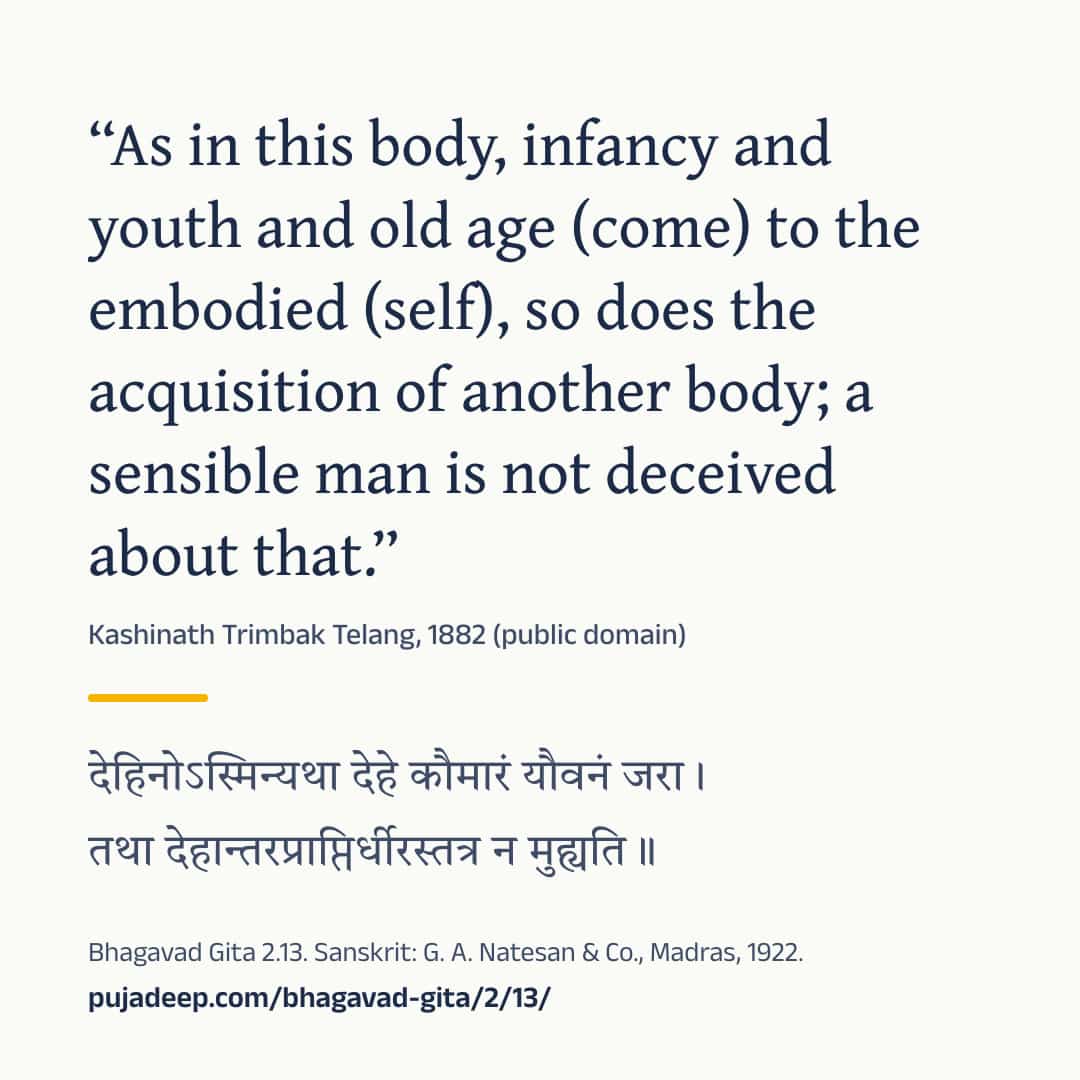
Send one picture or the text to one chat. The picture names its source and the address of this page.
Send as text
The words and the link only. Many elders prefer this.
Bhagavad Gita 2.13

देहिनोऽस्मिन्यथा देहे कौमारं यौवनं जरा ।
तथा देहान्तरप्राप्तिर्धीरस्तत्र न मुह्यति ॥

“As in this body, infancy and youth and old age (come) to the embodied (self), so does the acquisition of another body; a sensible man is not deceived about that.”
(Kashinath Trimbak Telang, 1882, public domain)

“As the Dweller in the body seeketh in the body childhood, youth and old age, so passeth he on to another body; the well-balanced grieveth not thereat.”
(Annie Besant, 1895, public domain)

“As are childhood, youth, and old age, in this body, to the Indweller, so also is the reaching forth to another body. Recollected souls are not deluded thereat.”
(Swami Swarupananda, 1909 (first printed 1907), public domain)

Sanskrit: G. A. Natesan & Co., Madras, 1922.
https://pujadeep.com/bhagavad-gita/2/13/?s=copy Nothing is sent from this site. Your own app sends it, to the chat you choose. The picture quotes Telang (1882). If you chose another translation above, the text quotes yours and no picture is offered.
Sanskrit text: The Bhagavad-Gita, or The Lord's Song, with the text in Devanagari and an English translation, 1922. Meanings: written for Pujadeep with AI help and reviewed. Source and changes
Questions families ask
Who speaks Bhagavad Gita 2.13?
Krishna speaks this verse, in chapter 2 (Sankhya Yoga).
Where does the Sanskrit text come from?
Sanskrit text: The Bhagavad-Gita, or The Lord's Song, with the text in Devanagari and an English translation, 1922. Meanings: written for Pujadeep with AI help and reviewed. See the source
Is the meaning on this page a translation?
Explanation written for this site with AI help from the sources listed here, and reviewed. It is not a translation and not the only way to read the text. Free to quote with credit.
Source and licence
- Sanskrit text
- The Bhagavad-Gita, or The Lord's Song, with the text in Devanagari and an English translation (Annie Besant, G. A. Natesan & Co., Madras, 1922). Public domain. The Sanskrit on these pages was read from this printing’s page images.
- Translation
- The Bhagavadgîtâ with the Sanatsugâtîya and the Anugîtâ, translated by Kâshinâth Trimbak Telang (The Sacred Books of the East, vol. VIII, ed. F. Max Müller) (Kashinath Trimbak Telang, F. Max Müller, Clarendon Press, Oxford, 1882). Public domain. Shown verbatim, as printed.
- Translation
- The Bhagavad Gîtâ, or The Lord's Song, translated by Annie Besant (Annie Besant, Theosophical Publishing Society, London, 1895). Public domain. Shown verbatim, as printed.
- Sanskrit text
- Srimad-Bhagavad-Gita, with Sanskrit Text; Paraphrase with Word-by-word Literal Translation; English Rendering and Comments, Index, &c., by the Swami Swarupananda (Himalayan Series, No. XX) (Swami Swarupananda, The Editors and Publishers, Advaita Ashrama, Mayavati, Prabuddha Bharata Press, Mayavati, Almora, Himalayas, 1909). Public domain. Used only to date the text. The Devanagari on this page is a reading text and is not copied from this printing.
- Common wording
- In this text, 32 words follow today's common wording, checked against sanskritdocuments.org; Sanskrit Wikisource; Gita Press, Gorakhpur; GRETIL, Göttingen and Bhaktivedanta Book Trust.
- Our explanation
- Explanation written for this site with AI help from the sources listed here, and reviewed. It is not a translation and not the only way to read the text. Free to quote with credit.
- Review
- AI review: 2 independent reviews against the cited edition, October 15, 2026.