Bhagavad Gita · Chapter 2: Sankhya Yoga · Speaker: Krishna
Bhagavad Gita 2.14: Matrasparshastu kaunteya
Krishna says that when the senses meet their objects, a person feels cold and heat, pleasure and pain.
Bhagavad Gita 2.14
मात्रास्पर्शास्तु कौन्तेय शीतोष्णसुखदुःखदाः ।आगमापायिनोऽनित्यास्तांस्तितिक्षस्व भारत ॥
Matrasparshastu kaunteya shitoshnasukhaduhkhadah
Agamapayinonityastanstitikshasva bharata
mātrāsparśāstu kaunteya śītoṣṇasukhaduḥkhadāḥ |
āgamāpāyino’nityāstāṃstitikṣasva bhārata ||
Our meaning Krishna says that when the senses meet their objects, a person feels cold and heat, pleasure and pain. These come and go; none of them lasts. He asks Arjuna to bear them patiently.
हिंदी अर्थ कृष्ण कहते हैं कि इंद्रियों का विषयों से संपर्क ही सर्दी-गर्मी और सुख-दुःख देता है। ये आते-जाते रहते हैं, टिकते नहीं। वे अर्जुन से इन्हें धैर्य से सहने को कहते हैं।
Word by word
Every word, with its dictionary page
Word by word
- मात्रास्पर्शाः mātrāsparśāḥ the senses' contacts with objects (compound (masculine), nominative plural) Dictionary: mātrā-sparśa, Monier-Williams 1899, p. 804, col. 3
material contact, the concurrence of material elements
- तु tu but (indeclinable) Dictionary: 2. tu, Monier-Williams 1899, p. 449, col. 3
but
- कौन्तेय kaunteya O son of Kunti (noun (masculine), vocative singular) Dictionary: kaunteya, Monier-Williams 1899, p. 316, col. 2
metron. fr. Kuntī
- शीतोष्णसुखदुःखदाः śītoṣṇasukhaduḥkhadāḥ giving cold, heat, pleasure, pain (compound (masculine), nominative plural) Dictionary: śītoṣṇa, Monier-Williams 1899, p. 1078, col. 1
cold and hot
; sukha, Monier-Williams 1899, p. 1221, col. 1ease, easiness, comfort, prosperity, pleasure, happiness
; 1. duḥkha, Monier-Williams 1899, p. 483, col. 2uneasiness, pain, sorrow, trouble, difficulty
; 2. da, Monier-Williams 1899, p. 464, col. 3giving, granting, offering, effecting, producing
- आगमापायिनः āgamāpāyinaḥ coming and going (compound (masculine), nominative plural) Dictionary: ā-gama, Monier-Williams 1899, p. 129, col. 3
arrival, coming, approach
; apāyin, Monier-Williams 1899, p. 56, col. 2going away, departing, vanishing, perishable
- अनित्याः anityāḥ not lasting (adjective (masculine), nominative plural) Dictionary: a-nitya, Monier-Williams 1899, p. 29, col. 2
not everlasting, transient
- तान् tān them (pronoun (masculine), accusative plural) Dictionary: tad, Monier-Williams 1899, p. 434, col. 1
m. he, f. she, n. it, that, this
- तितिक्षस्व titikṣasva bear, endure (desiderative, imperative, 2nd person singular) Dictionary: tij, Monier-Williams 1899, p. 446, col. 1
to bear with firmness, suffer with courage or patience, endure
- भारत bhārata O Bharata (Arjuna) (noun (masculine), vocative singular) Dictionary: bhārata, Monier-Williams 1899, p. 753, col. 1
Public-domain translations
Kashinath Trimbak Telang, 1882. Public domain. Page 44.
The contacts of the senses1, O son of Kuntî! which produce cold and heat, pleasure and pain, are not permanent, they are ever coming and going. Bear them, O descendant of Bharata!
Footnotes (the translator’s own) - Scil. with external objects. ↩
Compare 3 translations
Kashinath Trimbak Telang, 1882. Public domain. Page 44.
The contacts of the senses1, O son of Kuntî! which produce cold and heat, pleasure and pain, are not permanent, they are ever coming and going. Bear them, O descendant of Bharata!
Footnotes (the translator’s own) - Scil. with external objects. ↩
You are reading this one
Annie Besant, 1895. Public domain. Page 27.
The contacts of the senses, O son of Kuntî, giving cold and heat, pleasure and pain, they come and go, impermanent; endure them bravely, O Bhârata.
You are reading this one
Swami Swarupananda, 1909 (first printed 1907). Public domain. Page 32.
Notions of heat and cold, of pain and pleasure, are born, O son of Kunti, only of the contact of the senses with their objects. They have a beginning and an end. They are impermanent in their nature. Bear them patiently, O descendant of Bharata.
You are reading this one
Share
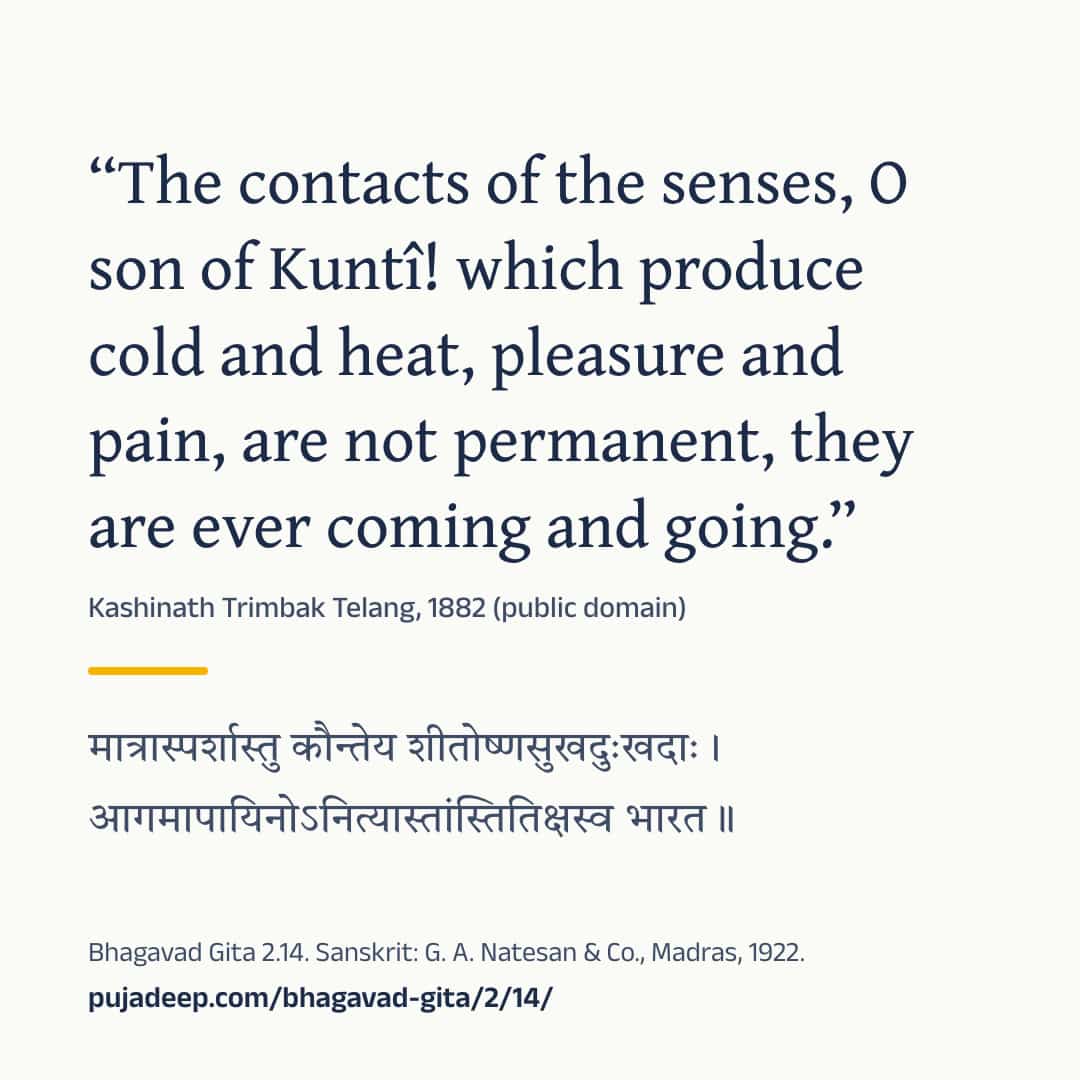
Send one picture or the text to one chat. The picture names its source and the address of this page.
Send as text
The words and the link only. Many elders prefer this.
Bhagavad Gita 2.14

मात्रास्पर्शास्तु कौन्तेय शीतोष्णसुखदुःखदाः ।
आगमापायिनोऽनित्यास्तांस्तितिक्षस्व भारत ॥

“The contacts of the senses, O son of Kuntî! which produce cold and heat, pleasure and pain, are not permanent, they are ever coming and going. Bear them, O descendant of Bharata!”
(Kashinath Trimbak Telang, 1882, public domain)

“The contacts of the senses, O son of Kuntî, giving cold and heat, pleasure and pain, they come and go, impermanent; endure them bravely, O Bhârata.”
(Annie Besant, 1895, public domain)

“Notions of heat and cold, of pain and pleasure, are born, O son of Kunti, only of the contact of the senses with their objects. They have a beginning and an end. They are impermanent in their nature. Bear them patiently, O descendant of Bharata.”
(Swami Swarupananda, 1909 (first printed 1907), public domain)

Sanskrit: G. A. Natesan & Co., Madras, 1922.
https://pujadeep.com/bhagavad-gita/2/14/?s=copy Nothing is sent from this site. Your own app sends it, to the chat you choose. The picture quotes Telang (1882). If you chose another translation above, the text quotes yours and no picture is offered.
Sanskrit text: The Bhagavad-Gita, or The Lord's Song, with the text in Devanagari and an English translation, 1922. Meanings: written for Pujadeep with AI help and reviewed. Source and changes
Questions families ask
Who speaks Bhagavad Gita 2.14?
Krishna speaks this verse, in chapter 2 (Sankhya Yoga).
Where does the Sanskrit text come from?
Sanskrit text: The Bhagavad-Gita, or The Lord's Song, with the text in Devanagari and an English translation, 1922. Meanings: written for Pujadeep with AI help and reviewed. See the source
Is the meaning on this page a translation?
Explanation written for this site with AI help from the sources listed here, and reviewed. It is not a translation and not the only way to read the text. Free to quote with credit.
Source and licence
- Sanskrit text
- The Bhagavad-Gita, or The Lord's Song, with the text in Devanagari and an English translation (Annie Besant, G. A. Natesan & Co., Madras, 1922). Public domain. The Sanskrit on these pages was read from this printing’s page images.
- Translation
- The Bhagavadgîtâ with the Sanatsugâtîya and the Anugîtâ, translated by Kâshinâth Trimbak Telang (The Sacred Books of the East, vol. VIII, ed. F. Max Müller) (Kashinath Trimbak Telang, F. Max Müller, Clarendon Press, Oxford, 1882). Public domain. Shown verbatim, as printed.
- Translation
- The Bhagavad Gîtâ, or The Lord's Song, translated by Annie Besant (Annie Besant, Theosophical Publishing Society, London, 1895). Public domain. Shown verbatim, as printed.
- Sanskrit text
- Srimad-Bhagavad-Gita, with Sanskrit Text; Paraphrase with Word-by-word Literal Translation; English Rendering and Comments, Index, &c., by the Swami Swarupananda (Himalayan Series, No. XX) (Swami Swarupananda, The Editors and Publishers, Advaita Ashrama, Mayavati, Prabuddha Bharata Press, Mayavati, Almora, Himalayas, 1909). Public domain. Used only to date the text. The Devanagari on this page is a reading text and is not copied from this printing.
- Common wording
- In this text, 32 words follow today's common wording, checked against sanskritdocuments.org; Sanskrit Wikisource; Gita Press, Gorakhpur; GRETIL, Göttingen and Bhaktivedanta Book Trust.
- Our explanation
- Explanation written for this site with AI help from the sources listed here, and reviewed. It is not a translation and not the only way to read the text. Free to quote with credit.
- Review
- AI review: 2 independent reviews against the cited edition, October 15, 2026.