Bhagavad Gita · Chapter 2: Sankhya Yoga · Speaker: Krishna
Bhagavad Gita 2.21: Vedavinashinam nityam
Krishna asks: if a person knows the self to be indestructible, eternal, unborn and unchanging, how can that person kill anyone, or make anyone kill?
Bhagavad Gita 2.21
वेदाऽविनाशिनं नित्यं य एनमजमव्ययम् ।कथं स पुरुषः पार्थ कं घातयति हन्ति कम् ॥
Vedavinashinam nityam ya enamajamavyayam
Katham sa purushah partha kam ghatayati hanti kam
vedā’vināśinaṃ nityaṃ ya enamajamavyayam |
kathaṃ sa puruṣaḥ pārtha kaṃ ghātayati hanti kam ||
Our meaning Krishna asks: if a person knows the self to be indestructible, eternal, unborn and unchanging, how can that person kill anyone, or make anyone kill?
हिंदी अर्थ कृष्ण पूछते हैं कि जो व्यक्ति आत्मा को अविनाशी, नित्य, अजन्मा और अव्यय जानता है, वह किसी को कैसे मारे या किसी से कैसे मरवाए?
Word by word
Every word, with its dictionary page
Word by word
- वेद veda knows (perfect with present sense, 3rd person singular) Dictionary: 1. vid, Monier-Williams 1899, p. 963, col. 2
to know, understand, perceive, learn
- अविनाशिनम् avināśinam indestructible (adjective (masculine), accusative singular) Dictionary: a-vināśin, Monier-Williams 1899, p. 109, col. 1
imperishable
- नित्यम् nityam eternal (adjective (masculine), accusative singular) Dictionary: nitya, Monier-Williams 1899, p. 547, col. 2
continual, perpetual, eternal
- यः yaḥ who (pronoun (masculine), nominative singular) Dictionary: yad, Monier-Williams 1899, p. 844, col. 2
who, which, what, whichever, whatever, that
- एनम् enam this (Self) (pronoun (masculine), accusative singular) Dictionary: 1. ena, Monier-Williams 1899, p. 232, col. 1
he, she, it; this, that
- अजम् ajam unborn (adjective (masculine), accusative singular) Dictionary: 2. a-ja, Monier-Williams 1899, p. 9, col. 3
not born, existing from all eternity
- अव्ययम् avyayam imperishable (adjective (masculine), accusative singular) Dictionary: 2. a-vyaya, Monier-Williams 1899, p. 111, col. 3
not liable to change, imperishable, undecaying
- कथम् katham how (indeclinable) Dictionary: katham, Monier-Williams 1899, p. 247, col. 2
how? in what manner?
- सः saḥ that (pronoun (masculine), nominative singular) Dictionary: tad, Monier-Williams 1899, p. 434, col. 1
m. he, f. she, n. it, that, this
- पुरुषः puruṣaḥ person (noun (masculine), nominative singular) Dictionary: puruṣa, Monier-Williams 1899, p. 637, col. 1
a person
- पार्थ pārtha O Partha (noun (masculine), vocative singular) Dictionary: 2. pārtha, Monier-Williams 1899, p. 621, col. 3
- कम् kam whom (pronoun (masculine), accusative singular) Dictionary: kim, Monier-Williams 1899, p. 282, col. 2
what? how? whence? wherefore? why?
- घातयति ghātayati causes to kill (causative, present, 3rd person singular) Dictionary: 1. han, Monier-Williams 1899, p. 1287, col. 2
to smite, slay, hit, kill, mar, destroy
- हन्ति hanti kills (present, 3rd person singular) Dictionary: 1. han, Monier-Williams 1899, p. 1287, col. 2
to smite, slay, hit, kill, mar, destroy
- कम् kam whom (pronoun (masculine), accusative singular) Dictionary: kim, Monier-Williams 1899, p. 282, col. 2
what? how? whence? wherefore? why?
1 printing differs
Public-domain translations
Kashinath Trimbak Telang, 1882. Public domain. Page 45.
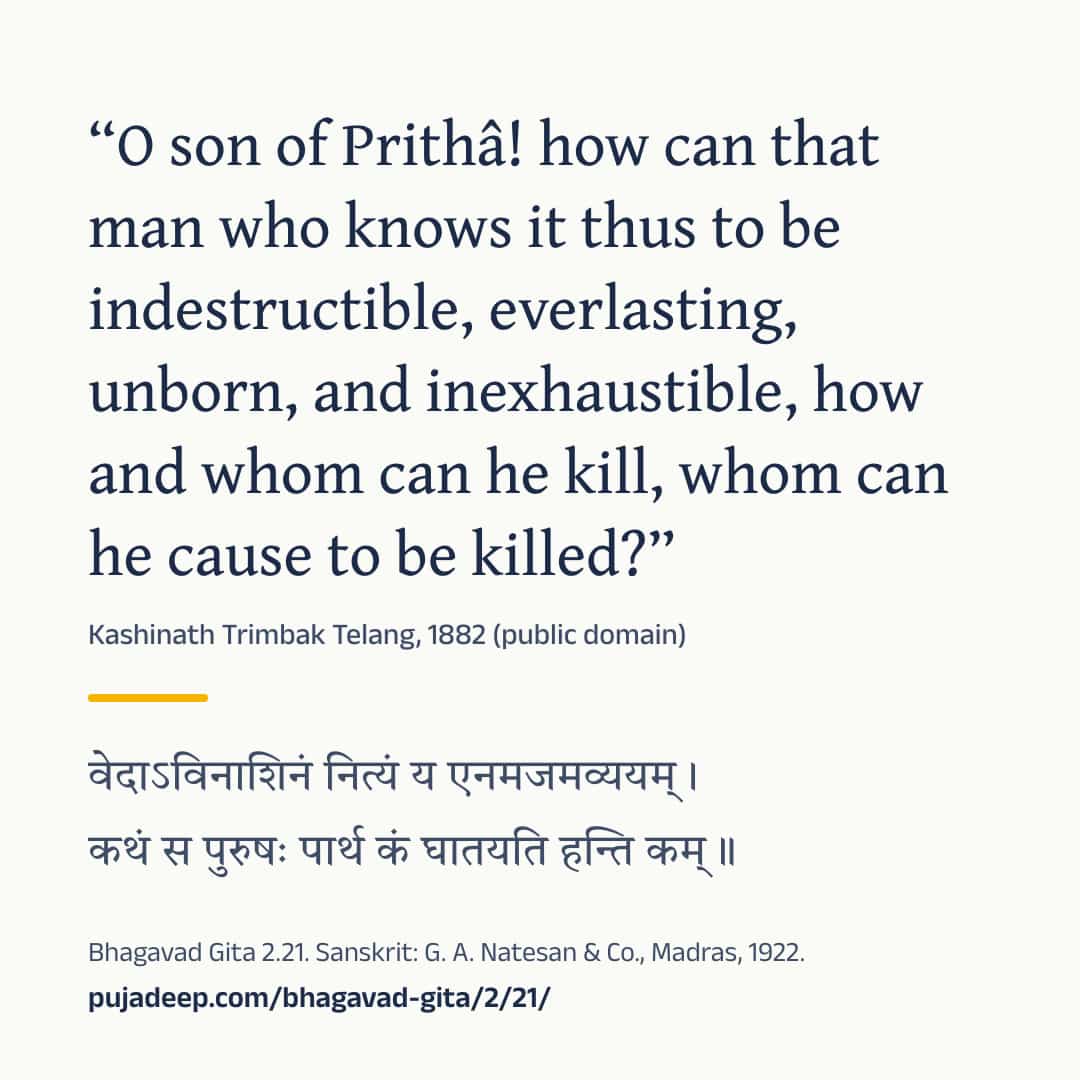
O son of Prithâ! how can that man who knows it thus to be indestructible, everlasting, unborn, and inexhaustible, how and whom can he kill, whom can he cause to be killed?
Compare 3 translations
Kashinath Trimbak Telang, 1882. Public domain. Page 45.
O son of Prithâ! how can that man who knows it thus to be indestructible, everlasting, unborn, and inexhaustible, how and whom can he kill, whom can he cause to be killed?
You are reading this one
Annie Besant, 1895. Public domain. Page 28.
Who knoweth It indestructible, perpetual, unborn, undiminishing, how can that man slay, O Pârtha, or cause to be slain?
You are reading this one
Swami Swarupananda, 1909 (first printed 1907). Public domain. Page 36.
He that knows This to be indestructible, changeless, without birth, and immutable, how is he, O son of Prithà, to slay or cause the slaying of another?
You are reading this one
Share
Send one picture or the text to one chat. The picture names its source and the address of this page.
Send as text
The words and the link only. Many elders prefer this.
Bhagavad Gita 2.21

वेदाऽविनाशिनं नित्यं य एनमजमव्ययम् ।
कथं स पुरुषः पार्थ कं घातयति हन्ति कम् ॥

“O son of Prithâ! how can that man who knows it thus to be indestructible, everlasting, unborn, and inexhaustible, how and whom can he kill, whom can he cause to be killed?”
(Kashinath Trimbak Telang, 1882, public domain)

“Who knoweth It indestructible, perpetual, unborn, undiminishing, how can that man slay, O Pârtha, or cause to be slain?”
(Annie Besant, 1895, public domain)

“He that knows This to be indestructible, changeless, without birth, and immutable, how is he, O son of Prithà, to slay or cause the slaying of another?”
(Swami Swarupananda, 1909 (first printed 1907), public domain)

Sanskrit: G. A. Natesan & Co., Madras, 1922.
https://pujadeep.com/bhagavad-gita/2/21/?s=copy Nothing is sent from this site. Your own app sends it, to the chat you choose. The picture quotes Telang (1882). If you chose another translation above, the text quotes yours and no picture is offered.
Sanskrit text: The Bhagavad-Gita, or The Lord's Song, with the text in Devanagari and an English translation, 1922. Meanings: written for Pujadeep with AI help and reviewed. Source and changes
Questions families ask
Who speaks Bhagavad Gita 2.21?
Krishna speaks this verse, in chapter 2 (Sankhya Yoga).
Where does the Sanskrit text come from?
Sanskrit text: The Bhagavad-Gita, or The Lord's Song, with the text in Devanagari and an English translation, 1922. Meanings: written for Pujadeep with AI help and reviewed. See the source
Is the meaning on this page a translation?
Explanation written for this site with AI help from the sources listed here, and reviewed. It is not a translation and not the only way to read the text. Free to quote with credit.
Source and licence
- Sanskrit text
- The Bhagavad-Gita, or The Lord's Song, with the text in Devanagari and an English translation (Annie Besant, G. A. Natesan & Co., Madras, 1922). Public domain. The Sanskrit on these pages was read from this printing’s page images.
- Translation
- The Bhagavadgîtâ with the Sanatsugâtîya and the Anugîtâ, translated by Kâshinâth Trimbak Telang (The Sacred Books of the East, vol. VIII, ed. F. Max Müller) (Kashinath Trimbak Telang, F. Max Müller, Clarendon Press, Oxford, 1882). Public domain. Shown verbatim, as printed.
- Translation
- The Bhagavad Gîtâ, or The Lord's Song, translated by Annie Besant (Annie Besant, Theosophical Publishing Society, London, 1895). Public domain. Shown verbatim, as printed.
- Sanskrit text
- Srimad-Bhagavad-Gita, with Sanskrit Text; Paraphrase with Word-by-word Literal Translation; English Rendering and Comments, Index, &c., by the Swami Swarupananda (Himalayan Series, No. XX) (Swami Swarupananda, The Editors and Publishers, Advaita Ashrama, Mayavati, Prabuddha Bharata Press, Mayavati, Almora, Himalayas, 1909). Public domain. Used only to date the text. The Devanagari on this page is a reading text and is not copied from this printing.
- Common wording
- In this text, 32 words follow today's common wording, checked against sanskritdocuments.org; Sanskrit Wikisource; Gita Press, Gorakhpur; GRETIL, Göttingen and Bhaktivedanta Book Trust.
- Our explanation
- Explanation written for this site with AI help from the sources listed here, and reviewed. It is not a translation and not the only way to read the text. Free to quote with credit.
- Review
- AI review: 2 independent reviews against the cited edition, October 15, 2026.