Bhagavad Gita · Chapter 2: Sankhya Yoga · Speaker: Krishna
Bhagavad Gita 2.22: Vasansi jirnani yatha vihaya
Krishna gives an image.
Bhagavad Gita 2.22
वासांसि जीर्णानि यथा विहाय नवानि गृह्णाति नरोऽपराणि ।तथा शरीराणि विहाय जीर्णान्यन्यानि संयाति नवानि देही ॥
Vasansi jirnani yatha vihaya navani grihnati naroparani
Tatha sharirani vihaya jirnanyanyani sanyati navani dehi
vāsāṃsi jīrṇāni yathā vihāya navāni gṛhṇāti naro’parāṇi |
tathā śarīrāṇi vihāya jīrṇānyanyāni saṃyāti navāni dehī ||
Our meaning Krishna gives an image. Just as a person throws away worn-out clothes and puts on new ones, the one who lives in the body leaves worn-out bodies and enters new ones.
हिंदी अर्थ कृष्ण उदाहरण देते हैं: जैसे मनुष्य पुराने कपड़े छोड़कर नए कपड़े पहन लेता है, वैसे ही देह में रहने वाली आत्मा पुराने शरीर छोड़कर नए शरीरों में चली जाती है।
Word by word
Every word, with its dictionary page
Word by word
- वासांसि vāsāṃsi clothes (noun (neuter), accusative plural) Dictionary: 1. vāsas, Monier-Williams 1899, p. 947, col. 2
cloth, clothes, dress, a garment
- जीर्णानि jīrṇāni worn out (past participle (neuter), accusative plural) Dictionary: jīrṇa, Monier-Williams 1899, p. 422, col. 2
old, worn out, withered, wasted, decayed
- यथा yathā as (indeclinable) Dictionary: yathā, Monier-Williams 1899, p. 841, col. 2
in which manner or way, according as, as, like
- विहाय vihāya having cast off (absolutive (having done)) Dictionary: vi-hā, Monier-Williams 1899, p. 1003, col. 1
to leave behind, relinquish, quit, abandon
- नवानि navāni new (adjective (neuter), accusative plural) Dictionary: 1. nava, Monier-Williams 1899, p. 530, col. 3
new, fresh, recent, young, modern
- गृह्णाति gṛhṇāti takes (present, 3rd person singular) Dictionary: grah, Monier-Williams 1899, p. 371, col. 3
to seize, take
- नरः naraḥ a man (noun (masculine), nominative singular) Dictionary: nara, Monier-Williams 1899, p. 528, col. 3
a man, a male, a person
- अपराणि aparāṇi others (adjective (neuter), accusative plural) Dictionary: 2. apara, Monier-Williams 1899, p. 50, col. 3
other, another
- तथा tathā so (indeclinable) Dictionary: tathā, Monier-Williams 1899, p. 433, col. 3
in that manner, so, thus
- शरीराणि śarīrāṇi bodies (noun (neuter), accusative plural) Dictionary: śarīra, Monier-Williams 1899, p. 1057, col. 3
the body, bodily frame
- विहाय vihāya having cast off (absolutive (having done)) Dictionary: vi-hā, Monier-Williams 1899, p. 1003, col. 1
to leave behind, relinquish, quit, abandon
- जीर्णानि jīrṇāni worn out (past participle (neuter), accusative plural) Dictionary: jīrṇa, Monier-Williams 1899, p. 422, col. 2
old, worn out, withered, wasted, decayed
- अन्यानि anyāni other (pronoun (neuter), accusative plural) Dictionary: 2. anya, Monier-Williams 1899, p. 45, col. 2
other, different
- संयाति saṃyāti passes into (present, 3rd person singular) Dictionary: saṃ-yā, Monier-Williams 1899, p. 1112, col. 1
to come to or into, attain
- नवानि navāni new (adjective (neuter), accusative plural) Dictionary: 1. nava, Monier-Williams 1899, p. 530, col. 3
new, fresh, recent, young, modern
- देही dehī the embodied one (noun (masculine), nominative singular) Dictionary: dehin, Monier-Williams 1899, p. 497, col. 1
m. the spirit, soul
Public-domain translations
Kashinath Trimbak Telang, 1882. Public domain. Page 45.
As a man, casting off old clothes, puts on others and new ones, so the embodied (self) casting off old bodies, goes to others and new ones.
Compare 3 translations
Kashinath Trimbak Telang, 1882. Public domain. Page 45.
As a man, casting off old clothes, puts on others and new ones, so the embodied (self) casting off old bodies, goes to others and new ones.
You are reading this one
Annie Besant, 1895. Public domain. Page 28–29.
As a man, casting off worn-out garments, taketh new ones, so the Dweller in the body, casting off worn-out bodies, entereth into others that are new.
You are reading this one
Swami Swarupananda, 1909 (first printed 1907). Public domain. Page 36.
Even as man casts off worn-out clothes, and puts on others which are new, so the embodied casts off worn-out bodies, and enters into others which are new.
You are reading this one
Share
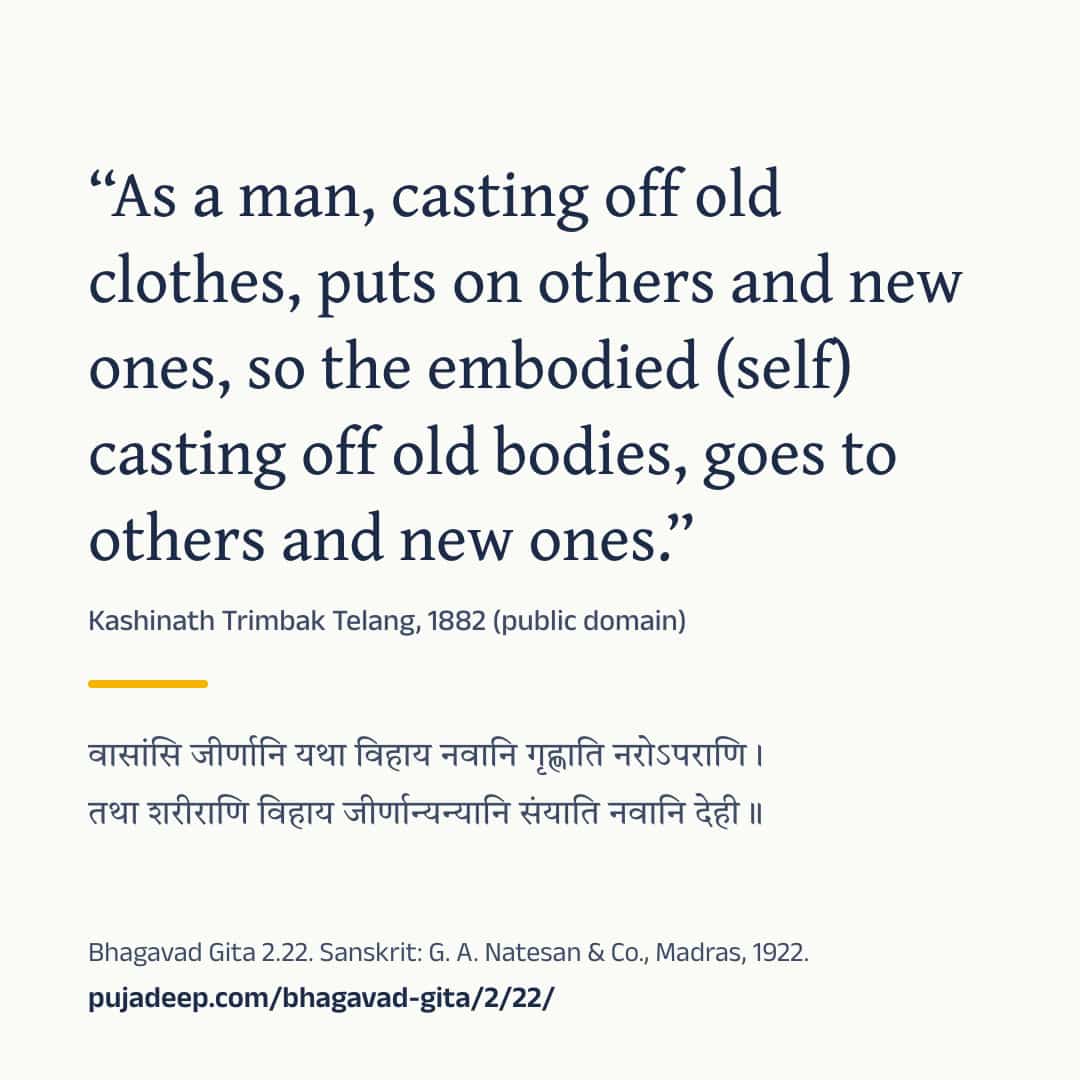
Send one picture or the text to one chat. The picture names its source and the address of this page.
Send as text
The words and the link only. Many elders prefer this.
Bhagavad Gita 2.22

वासांसि जीर्णानि यथा विहाय नवानि गृह्णाति नरोऽपराणि ।
तथा शरीराणि विहाय जीर्णान्यन्यानि संयाति नवानि देही ॥

“As a man, casting off old clothes, puts on others and new ones, so the embodied (self) casting off old bodies, goes to others and new ones.”
(Kashinath Trimbak Telang, 1882, public domain)

“As a man, casting off worn-out garments, taketh new ones, so the Dweller in the body, casting off worn-out bodies, entereth into others that are new.”
(Annie Besant, 1895, public domain)

“Even as man casts off worn-out clothes, and puts on others which are new, so the embodied casts off worn-out bodies, and enters into others which are new.”
(Swami Swarupananda, 1909 (first printed 1907), public domain)

Sanskrit: G. A. Natesan & Co., Madras, 1922.
https://pujadeep.com/bhagavad-gita/2/22/?s=copy Nothing is sent from this site. Your own app sends it, to the chat you choose. The picture quotes Telang (1882). If you chose another translation above, the text quotes yours and no picture is offered.
Sanskrit text: The Bhagavad-Gita, or The Lord's Song, with the text in Devanagari and an English translation, 1922. Meanings: written for Pujadeep with AI help and reviewed. Source and changes
Questions families ask
Who speaks Bhagavad Gita 2.22?
Krishna speaks this verse, in chapter 2 (Sankhya Yoga).
Where does the Sanskrit text come from?
Sanskrit text: The Bhagavad-Gita, or The Lord's Song, with the text in Devanagari and an English translation, 1922. Meanings: written for Pujadeep with AI help and reviewed. See the source
Is the meaning on this page a translation?
Explanation written for this site with AI help from the sources listed here, and reviewed. It is not a translation and not the only way to read the text. Free to quote with credit.
Source and licence
- Sanskrit text
- The Bhagavad-Gita, or The Lord's Song, with the text in Devanagari and an English translation (Annie Besant, G. A. Natesan & Co., Madras, 1922). Public domain. The Sanskrit on these pages was read from this printing’s page images.
- Translation
- The Bhagavadgîtâ with the Sanatsugâtîya and the Anugîtâ, translated by Kâshinâth Trimbak Telang (The Sacred Books of the East, vol. VIII, ed. F. Max Müller) (Kashinath Trimbak Telang, F. Max Müller, Clarendon Press, Oxford, 1882). Public domain. Shown verbatim, as printed.
- Translation
- The Bhagavad Gîtâ, or The Lord's Song, translated by Annie Besant (Annie Besant, Theosophical Publishing Society, London, 1895). Public domain. Shown verbatim, as printed.
- Sanskrit text
- Srimad-Bhagavad-Gita, with Sanskrit Text; Paraphrase with Word-by-word Literal Translation; English Rendering and Comments, Index, &c., by the Swami Swarupananda (Himalayan Series, No. XX) (Swami Swarupananda, The Editors and Publishers, Advaita Ashrama, Mayavati, Prabuddha Bharata Press, Mayavati, Almora, Himalayas, 1909). Public domain. Used only to date the text. The Devanagari on this page is a reading text and is not copied from this printing.
- Common wording
- In this text, 32 words follow today's common wording, checked against sanskritdocuments.org; Sanskrit Wikisource; Gita Press, Gorakhpur; GRETIL, Göttingen and Bhaktivedanta Book Trust.
- Our explanation
- Explanation written for this site with AI help from the sources listed here, and reviewed. It is not a translation and not the only way to read the text. Free to quote with credit.
- Review
- AI review: 2 independent reviews against the cited edition, October 15, 2026.