Bhagavad Gita · Chapter 2: Sankhya Yoga · Speaker: Krishna
Bhagavad Gita 2.27: Jatasya hi dhruvo
Krishna says that death is certain for whoever is born, and birth is certain for whoever dies.
Bhagavad Gita 2.27
जातस्य हि ध्रुवो मृत्युर्ध्रुवं जन्म मृतस्य च ।तस्मादपरिहार्येऽर्थे न त्वं शोचितुमर्हसि ॥
Jatasya hi dhruvo mrityurdhruvam janma mritasya cha
Tasmadapariharyerthe na tvam shochitumarhasi
jātasya hi dhruvo mṛtyurdhruvaṃ janma mṛtasya ca |
tasmādaparihārye’rthe na tvaṃ śocitumarhasi ||
Our meaning Krishna says that death is certain for whoever is born, and birth is certain for whoever dies. So, he says, Arjuna should not grieve over what cannot be avoided.
हिंदी अर्थ कृष्ण कहते हैं कि जो जन्मा है उसकी मृत्यु निश्चित है, और जो मरा है उसका जन्म निश्चित है। इसलिए, वे कहते हैं, जिस बात को टाला नहीं जा सकता, उस पर अर्जुन को शोक नहीं करना चाहिए।
Word by word
Every word, with its dictionary page
Word by word
- जातस्य jātasya of one who is born (past participle (masculine), genitive singular) Dictionary: jāta, Monier-Williams 1899, p. 417, col. 2
born, brought into existence
- हि hi for (indeclinable) Dictionary: 2. hi, Monier-Williams 1899, p. 1297, col. 3
for, because, on account of
- ध्रुवः dhruvaḥ certain (adjective (masculine), nominative singular) Dictionary: dhruva, Monier-Williams 1899, p. 521, col. 2
fixed, firm, immovable, unchangeable, constant, lasting
- मृत्युः mṛtyuḥ death (noun (masculine), nominative singular) Dictionary: mṛtyu, Monier-Williams 1899, p. 827, col. 3
death, dying
- ध्रुवम् dhruvam certain (adjective (neuter), nominative singular) Dictionary: dhruva, Monier-Williams 1899, p. 521, col. 2
fixed, firm, immovable, unchangeable, constant, lasting
- जन्म janma birth (noun (neuter), nominative singular) Dictionary: janman, Monier-Williams 1899, p. 411, col. 3
birth, production
- मृतस्य mṛtasya of one who has died (past participle (masculine), genitive singular) Dictionary: mṛta, Monier-Williams 1899, p. 827, col. 2
dead, deceased
- च ca and (indeclinable) Dictionary: 2. ca, Monier-Williams 1899, p. 380, col. 1
ind. and, both, also, moreover, as well as
- तस्मात् tasmāt therefore (indeclinable) Dictionary: tasmāt, Monier-Williams 1899, p. 441, col. 2
from that, on that account, therefore
- अपरिहार्ये aparihārye unavoidable (gerundive (to be done) (masculine), locative singular) Dictionary: a-parihārya, Monier-Williams 1899, p. 51, col. 2
- अर्थे arthe in a matter (noun (masculine), locative singular) Dictionary: artha, Monier-Williams 1899, p. 90, col. 3
aim, purpose
- न na not (indeclinable) Dictionary: 2. na, Monier-Williams 1899, p. 523, col. 1
ind. not, no, nor, neither
- त्वम् tvam you (pronoun, nominative singular) Dictionary: 2. tva, Monier-Williams 1899, p. 463, col. 2
base of the 2nd personal pron.
- शोचितुम् śocitum to grieve (infinitive (to do)) Dictionary: 1. śuc, Monier-Williams 1899, p. 1081, col. 1
be sorrowful or afflicted, grieve, mourn at or for
- अर्हसि arhasi you ought (present, 2nd person singular) Dictionary: arh, Monier-Williams 1899, p. 93, col. 3
to be able
Public-domain translations
Kashinath Trimbak Telang, 1882. Public domain. Page 45–46.
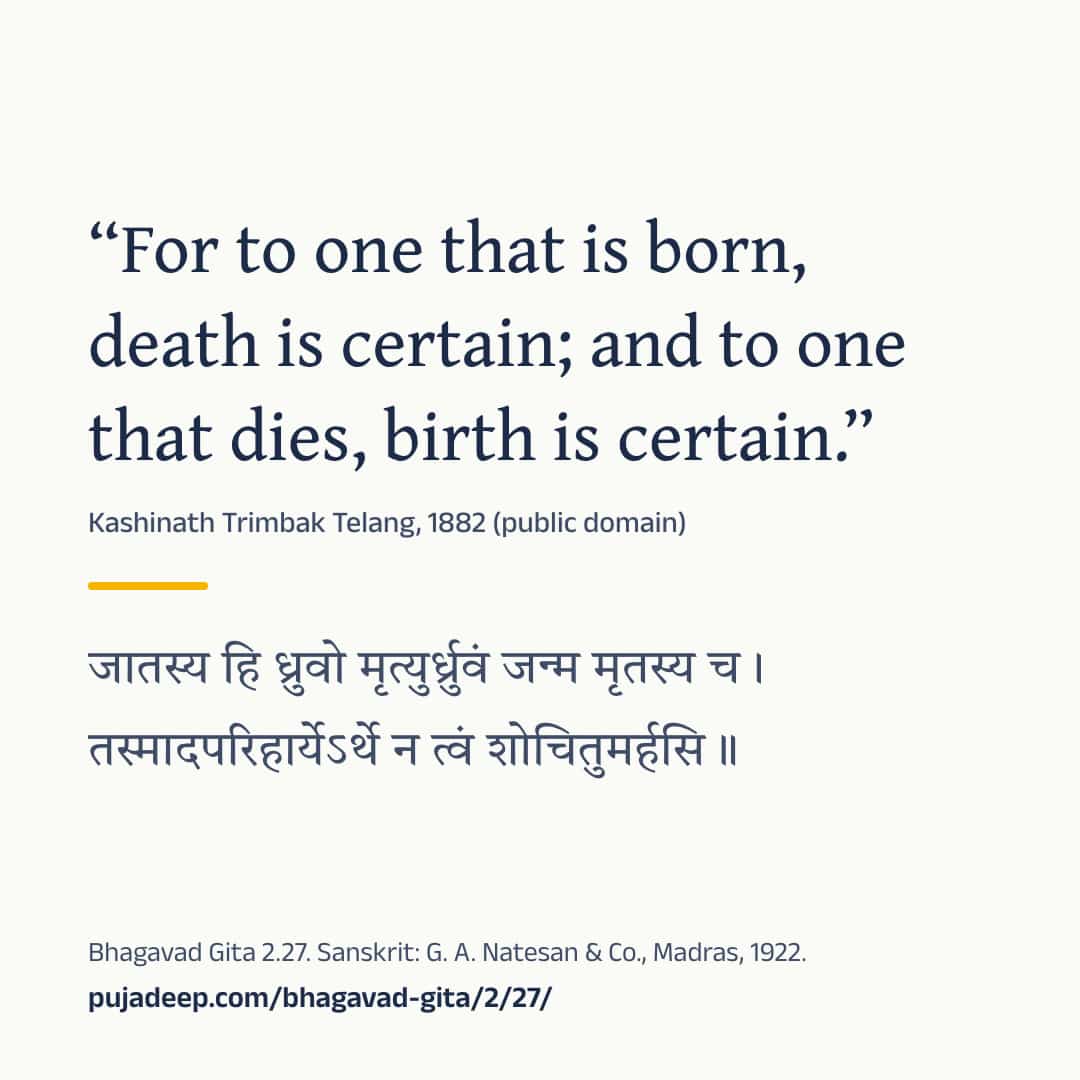
For to one that is born, death is certain; and to one that dies, birth is certain1. Therefore about (this) unavoidable thing, you ought not to grieve.
Footnotes (the translator’s own) - Cf. the following from the Sutta Nipâta (Sir M. C. Swamy's translation), pp. 124, 125: 'There is, indeed, no means by which those born could be prevented from dying.' 'Even thus the world is afflicted with death and decay; therefore wise men, knowing the course of things in the world, do not give way to grief.' ↩
Compare 3 translations
Kashinath Trimbak Telang, 1882. Public domain. Page 45–46.
For to one that is born, death is certain; and to one that dies, birth is certain1. Therefore about (this) unavoidable thing, you ought not to grieve.
Footnotes (the translator’s own) - Cf. the following from the Sutta Nipâta (Sir M. C. Swamy's translation), pp. 124, 125: 'There is, indeed, no means by which those born could be prevented from dying.' 'Even thus the world is afflicted with death and decay; therefore wise men, knowing the course of things in the world, do not give way to grief.' ↩
You are reading this one
Annie Besant, 1895. Public domain. Page 29.
For sure is the death of him that is born, and sure the birth of him that is dead; therefore over the inevitable thou shouldst not grieve.
You are reading this one
Swami Swarupananda, 1909 (first printed 1907). Public domain. Page 39.
Of that which is born, death is certain, of that which is dead, birth is certain. Over the unavoidable, therefore, thou oughtest not to grieve.
You are reading this one
Share
Send one picture or the text to one chat. The picture names its source and the address of this page.
Send as text
The words and the link only. Many elders prefer this.
Bhagavad Gita 2.27

जातस्य हि ध्रुवो मृत्युर्ध्रुवं जन्म मृतस्य च ।
तस्मादपरिहार्येऽर्थे न त्वं शोचितुमर्हसि ॥

“For to one that is born, death is certain; and to one that dies, birth is certain. Therefore about (this) unavoidable thing, you ought not to grieve.”
(Kashinath Trimbak Telang, 1882, public domain)

“For sure is the death of him that is born, and sure the birth of him that is dead; therefore over the inevitable thou shouldst not grieve.”
(Annie Besant, 1895, public domain)

“Of that which is born, death is certain, of that which is dead, birth is certain. Over the unavoidable, therefore, thou oughtest not to grieve.”
(Swami Swarupananda, 1909 (first printed 1907), public domain)

Sanskrit: G. A. Natesan & Co., Madras, 1922.
https://pujadeep.com/bhagavad-gita/2/27/?s=copy Nothing is sent from this site. Your own app sends it, to the chat you choose. The picture quotes Telang (1882). If you chose another translation above, the text quotes yours and no picture is offered.
Sanskrit text: The Bhagavad-Gita, or The Lord's Song, with the text in Devanagari and an English translation, 1922. Meanings: written for Pujadeep with AI help and reviewed. Source and changes
Questions families ask
Who speaks Bhagavad Gita 2.27?
Krishna speaks this verse, in chapter 2 (Sankhya Yoga).
Where does the Sanskrit text come from?
Sanskrit text: The Bhagavad-Gita, or The Lord's Song, with the text in Devanagari and an English translation, 1922. Meanings: written for Pujadeep with AI help and reviewed. See the source
Is the meaning on this page a translation?
Explanation written for this site with AI help from the sources listed here, and reviewed. It is not a translation and not the only way to read the text. Free to quote with credit.
Source and licence
- Sanskrit text
- The Bhagavad-Gita, or The Lord's Song, with the text in Devanagari and an English translation (Annie Besant, G. A. Natesan & Co., Madras, 1922). Public domain. The Sanskrit on these pages was read from this printing’s page images.
- Translation
- The Bhagavadgîtâ with the Sanatsugâtîya and the Anugîtâ, translated by Kâshinâth Trimbak Telang (The Sacred Books of the East, vol. VIII, ed. F. Max Müller) (Kashinath Trimbak Telang, F. Max Müller, Clarendon Press, Oxford, 1882). Public domain. Shown verbatim, as printed.
- Translation
- The Bhagavad Gîtâ, or The Lord's Song, translated by Annie Besant (Annie Besant, Theosophical Publishing Society, London, 1895). Public domain. Shown verbatim, as printed.
- Sanskrit text
- Srimad-Bhagavad-Gita, with Sanskrit Text; Paraphrase with Word-by-word Literal Translation; English Rendering and Comments, Index, &c., by the Swami Swarupananda (Himalayan Series, No. XX) (Swami Swarupananda, The Editors and Publishers, Advaita Ashrama, Mayavati, Prabuddha Bharata Press, Mayavati, Almora, Himalayas, 1909). Public domain. Used only to date the text. The Devanagari on this page is a reading text and is not copied from this printing.
- Common wording
- In this text, 32 words follow today's common wording, checked against sanskritdocuments.org; Sanskrit Wikisource; Gita Press, Gorakhpur; GRETIL, Göttingen and Bhaktivedanta Book Trust.
- Our explanation
- Explanation written for this site with AI help from the sources listed here, and reviewed. It is not a translation and not the only way to read the text. Free to quote with credit.
- Review
- AI review: 2 independent reviews against the cited edition, October 15, 2026.