Bhagavad Gita · Chapter 2: Sankhya Yoga · Speaker: Krishna
Bhagavad Gita 2.28: Avyaktadini bhutani
Krishna says that beings are unseen before birth, seen in the middle of their life, and unseen again after death, and he asks what there is to mourn.
Bhagavad Gita 2.28
अव्यक्तादीनि भूतानि व्यक्तमध्यानि भारत ।अव्यक्तनिधनान्येव तत्र का परिदेवना ॥
Avyaktadini bhutani vyaktamadhyani bharata
Avyaktanidhananyeva tatra ka paridevana
avyaktādīni bhūtāni vyaktamadhyāni bhārata |
avyaktanidhanānyeva tatra kā paridevanā ||
Our meaning Krishna says that beings are unseen before birth, seen in the middle of their life, and unseen again after death, and he asks what there is to mourn.
हिंदी अर्थ कृष्ण कहते हैं कि प्राणी जन्म से पहले अव्यक्त होते हैं, बीच में व्यक्त होते हैं, और मृत्यु के बाद फिर अव्यक्त हो जाते हैं; वे पूछते हैं कि इसमें शोक की क्या बात है।
Word by word
Every word, with its dictionary page
Word by word
- अव्यक्तादीनि avyaktādīni unmanifest at the beginning (compound (neuter), nominative plural) Dictionary: a-vyakta, Monier-Williams 1899, p. 111, col. 2
undeveloped, not manifest, unapparent, indistinct, invisible
; 1. ādi, Monier-Williams 1899, p. 136, col. 3beginning, commencement
- भूतानि bhūtāni beings (noun (neuter), nominative plural) Dictionary: bhūta, Monier-Williams 1899, p. 761, col. 3
that which is or exists, any living being
- व्यक्तमध्यानि vyaktamadhyāni manifest in the middle (compound (neuter), nominative plural) Dictionary: vy-akta, Monier-Williams 1899, p. 1029, col. 2
caused to appear, manifested, apparent, visible, evident
; madhya, Monier-Williams 1899, p. 781, col. 3middle
- भारत bhārata O Bharata (Arjuna) (noun (masculine), vocative singular) Dictionary: bhārata, Monier-Williams 1899, p. 753, col. 1
- अव्यक्तनिधनानि avyaktanidhanāni unmanifest at the end (compound (neuter), nominative plural) Dictionary: a-vyakta, Monier-Williams 1899, p. 111, col. 2
undeveloped, not manifest, unapparent, indistinct, invisible
; 2. ni-dhana, Monier-Williams 1899, p. 548, col. 3conclusion, end, death, destruction
- एव eva again, indeed (indeclinable) Dictionary: 1. eva, Monier-Williams 1899, p. 232, col. 2
just, exactly, very, same, only, even, alone, merely
- तत्र tatra in that case (indeclinable) Dictionary: tatra, Monier-Williams 1899, p. 433, col. 2
in that, therein, in that case
- का kā what (pronoun (feminine), nominative singular) Dictionary: kim, Monier-Williams 1899, p. 282, col. 2
what? how? whence? wherefore? why?
- परिदेवना paridevanā lamenting (noun (feminine), nominative singular) Dictionary: pari-devana, Monier-Williams 1899, p. 595, col. 3
lamentation, bewailing, complaint
Public-domain translations
Kashinath Trimbak Telang, 1882. Public domain. Page 46.
The source of things, O descendant of Bharata! is unperceived; their middle state is perceived; and their end again is unperceived. What (occasion is there for any) lamentation regarding them1?
Footnotes (the translator’s own) - Cf. Sutta Nipâta, p. 125. 'In vain do you grieve, not knowing well the two ends of him whose manner either of coming or going you know not.' ↩
Compare 3 translations
Kashinath Trimbak Telang, 1882. Public domain. Page 46.
The source of things, O descendant of Bharata! is unperceived; their middle state is perceived; and their end again is unperceived. What (occasion is there for any) lamentation regarding them1?
Footnotes (the translator’s own) - Cf. Sutta Nipâta, p. 125. 'In vain do you grieve, not knowing well the two ends of him whose manner either of coming or going you know not.' ↩
You are reading this one
Annie Besant, 1895. Public domain. Page 29–30.
Beings are unmanifest in their origin, manifest in their midmost state, O Bhârata, unmanifest also are they in dissolution. What room then for lamentation?
You are reading this one
Swami Swarupananda, 1909 (first printed 1907). Public domain. Page 39.
All beings are unmanifested in their beginning, O Bhârata, manifested in their middle-state and unmanifested again in their end. What is there then to grieve about?
You are reading this one
Share
Send one picture or the text to one chat. The picture names its source and the address of this page.
Send as text
The words and the link only. Many elders prefer this.
Bhagavad Gita 2.28

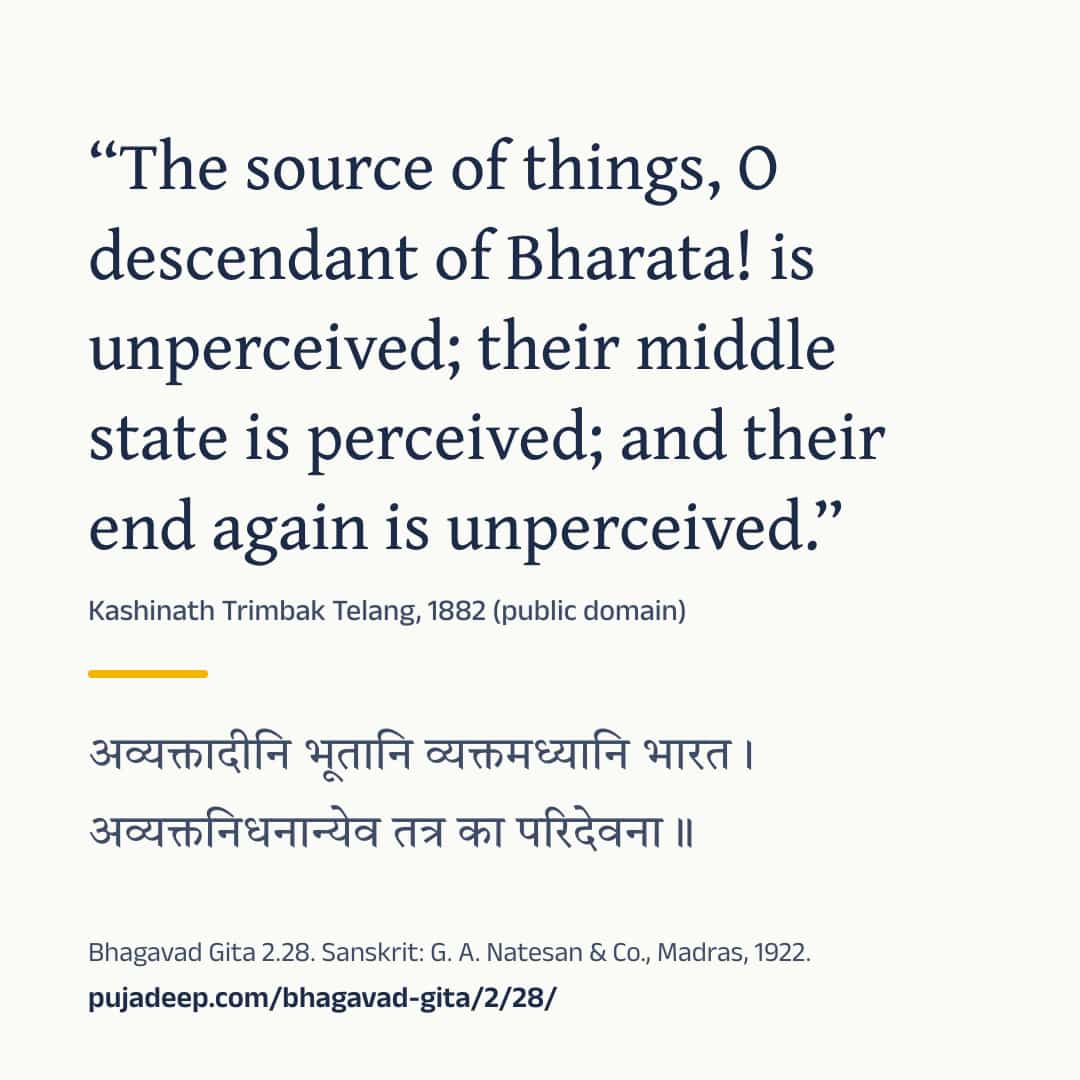
अव्यक्तादीनि भूतानि व्यक्तमध्यानि भारत ।
अव्यक्तनिधनान्येव तत्र का परिदेवना ॥

“The source of things, O descendant of Bharata! is unperceived; their middle state is perceived; and their end again is unperceived. What (occasion is there for any) lamentation regarding them?”
(Kashinath Trimbak Telang, 1882, public domain)

“Beings are unmanifest in their origin, manifest in their midmost state, O Bhârata, unmanifest also are they in dissolution. What room then for lamentation?”
(Annie Besant, 1895, public domain)

“All beings are unmanifested in their beginning, O Bhârata, manifested in their middle-state and unmanifested again in their end. What is there then to grieve about?”
(Swami Swarupananda, 1909 (first printed 1907), public domain)

Sanskrit: G. A. Natesan & Co., Madras, 1922.
https://pujadeep.com/bhagavad-gita/2/28/?s=copy Nothing is sent from this site. Your own app sends it, to the chat you choose. The picture quotes Telang (1882). If you chose another translation above, the text quotes yours and no picture is offered.
Sanskrit text: The Bhagavad-Gita, or The Lord's Song, with the text in Devanagari and an English translation, 1922. Meanings: written for Pujadeep with AI help and reviewed. Source and changes
Questions families ask
Who speaks Bhagavad Gita 2.28?
Krishna speaks this verse, in chapter 2 (Sankhya Yoga).
Where does the Sanskrit text come from?
Sanskrit text: The Bhagavad-Gita, or The Lord's Song, with the text in Devanagari and an English translation, 1922. Meanings: written for Pujadeep with AI help and reviewed. See the source
Is the meaning on this page a translation?
Explanation written for this site with AI help from the sources listed here, and reviewed. It is not a translation and not the only way to read the text. Free to quote with credit.
Source and licence
- Sanskrit text
- The Bhagavad-Gita, or The Lord's Song, with the text in Devanagari and an English translation (Annie Besant, G. A. Natesan & Co., Madras, 1922). Public domain. The Sanskrit on these pages was read from this printing’s page images.
- Translation
- The Bhagavadgîtâ with the Sanatsugâtîya and the Anugîtâ, translated by Kâshinâth Trimbak Telang (The Sacred Books of the East, vol. VIII, ed. F. Max Müller) (Kashinath Trimbak Telang, F. Max Müller, Clarendon Press, Oxford, 1882). Public domain. Shown verbatim, as printed.
- Translation
- The Bhagavad Gîtâ, or The Lord's Song, translated by Annie Besant (Annie Besant, Theosophical Publishing Society, London, 1895). Public domain. Shown verbatim, as printed.
- Sanskrit text
- Srimad-Bhagavad-Gita, with Sanskrit Text; Paraphrase with Word-by-word Literal Translation; English Rendering and Comments, Index, &c., by the Swami Swarupananda (Himalayan Series, No. XX) (Swami Swarupananda, The Editors and Publishers, Advaita Ashrama, Mayavati, Prabuddha Bharata Press, Mayavati, Almora, Himalayas, 1909). Public domain. Used only to date the text. The Devanagari on this page is a reading text and is not copied from this printing.
- Common wording
- In this text, 32 words follow today's common wording, checked against sanskritdocuments.org; Sanskrit Wikisource; Gita Press, Gorakhpur; GRETIL, Göttingen and Bhaktivedanta Book Trust.
- Our explanation
- Explanation written for this site with AI help from the sources listed here, and reviewed. It is not a translation and not the only way to read the text. Free to quote with credit.
- Review
- AI review: 2 independent reviews against the cited edition, October 15, 2026.