Bhagavad Gita · Chapter 2: Sankhya Yoga · Speaker: Krishna
Bhagavad Gita 2.3: Klaibyam ma sma gamah partha
Krishna tells Arjuna not to give in to this unmanly weakness, because it does not suit him.
Bhagavad Gita 2.3
क्लैब्यं मा स्म गमः पार्थ नैतत्त्वय्युपपद्यते ।क्षुद्रं हृदयदौर्बल्यं त्यक्त्वोत्तिष्ठ परन्तप ॥
Klaibyam ma sma gamah partha naitattvayyupapadyate
Kshudram hridayadaurbalyam tyaktvottishtha parantapa
klaibyaṃ mā sma gamaḥ pārtha naitattvayyupapadyate |
kṣudraṃ hṛdayadaurbalyaṃ tyaktvottiṣṭha parantapa ||
Our meaning Krishna tells Arjuna not to give in to this unmanly weakness, because it does not suit him. He asks him to throw off this small weakness of heart and stand up, as the warrior who scorches his foes (parantapa).
हिंदी अर्थ कृष्ण अर्जुन से कहते हैं कि वे इस कायरता के वश में न हों, क्योंकि यह उन्हें शोभा नहीं देती। वे कहते हैं कि हे परंतप (शत्रुओं को तपाने वाले), हृदय की इस तुच्छ दुर्बलता को छोड़कर खड़े हो जाओ।
Word by word
Every word, with its dictionary page
Word by word
- क्लैब्यम् klaibyam unmanliness, faint-heartedness (noun (neuter), accusative singular) Dictionary: klaibya, Monier-Williams 1899, p. 324, col. 1
unmanliness, weakness, timidity, cowardice
- मा mā do not (indeclinable) Dictionary: 1. mā, Monier-Williams 1899, p. 804, col. 1
a particle of prohibition or negation
- स्म sma ever (with mā: never) (indeclinable) Dictionary: sma, Monier-Williams 1899, p. 1271, col. 2
a particle perhaps originally equivalent to ‘ever,’ ‘always;’
- गमः gamaḥ go to, yield to (aorist (with mā: do not), 2nd person singular) Dictionary: 1. gam, Monier-Williams 1899, p. 347, col. 1
to go to any state or condition, undergo
- पार्थ pārtha O Partha (son of Pritha) (noun (masculine), vocative singular) Dictionary: 2. pārtha, Monier-Williams 1899, p. 621, col. 3
- न na not (indeclinable) Dictionary: 2. na, Monier-Williams 1899, p. 523, col. 1
ind. not, no, nor, neither
- एतत् etat this (pronoun (neuter), nominative singular) Dictionary: etad, Monier-Williams 1899, p. 231, col. 2
this, this here, here
- त्वयि tvayi in you (pronoun, locative singular) Dictionary: 2. tva, Monier-Williams 1899, p. 463, col. 2
base of the 2nd personal pron.
- उपपद्यते upapadyate is fitting (present, 3rd person singular) Dictionary: upa-pad, Monier-Williams 1899, p. 201, col. 3
to be fit for or adequate to (with loc.)
- क्षुद्रम् kṣudram petty, mean (adjective (neuter), accusative singular) Dictionary: kṣudra, Monier-Williams 1899, p. 330, col. 2
minute, diminutive, tiny, very small, little, trifling
- हृदयदौर्बल्यम् hṛdayadaurbalyam weakness of heart (compound (neuter), accusative singular) Dictionary: hṛdaya, Monier-Williams 1899, p. 1302, col. 3
the heart
; daur-balya, Monier-Williams 1899, p. 499, col. 2weakness, impotence
- त्यक्त्वा tyaktvā having given up (absolutive (having done)) Dictionary: 1. tyaj, Monier-Williams 1899, p. 456, col. 3
to leave, abandon, quit
- उत्तिष्ठ uttiṣṭha stand up, arise (imperative, 2nd person singular) Dictionary: ut-thā, Monier-Williams 1899, p. 179, col. 3
to stand up, spring up, rise
- परन्तप parantapa O scorcher of foes (noun (masculine), vocative singular) Dictionary: param-tapa, Monier-Williams 1899, p. 586, col. 3
destroying foes (said of heroes)
Public-domain translations
Kashinath Trimbak Telang, 1882. Public domain. Page 42.
Be not effeminate, O son of Prithâ! it is not worthy of you. Cast off this base weakness of heart, and arise, O terror of (your) foes!
Compare 3 translations
Kashinath Trimbak Telang, 1882. Public domain. Page 42.
Be not effeminate, O son of Prithâ! it is not worthy of you. Cast off this base weakness of heart, and arise, O terror of (your) foes!
You are reading this one
Annie Besant, 1895. Public domain. Page 24.
Yield not to impotence, O Pârtha! it doth not befit thee. Shake off this paltry faint-heartedness! Stand up, Parantapa!1
Footnotes (the translator’s own) - Conqueror of foes. ↩
You are reading this one
Swami Swarupananda, 1909 (first printed 1907). Public domain. Page 25.
Yield not to unmanliness, O son of Prithá! Ill doth it become thee. Cast off this mean faintheartedness and arise, O scorcher of thine enemies!
You are reading this one
Share
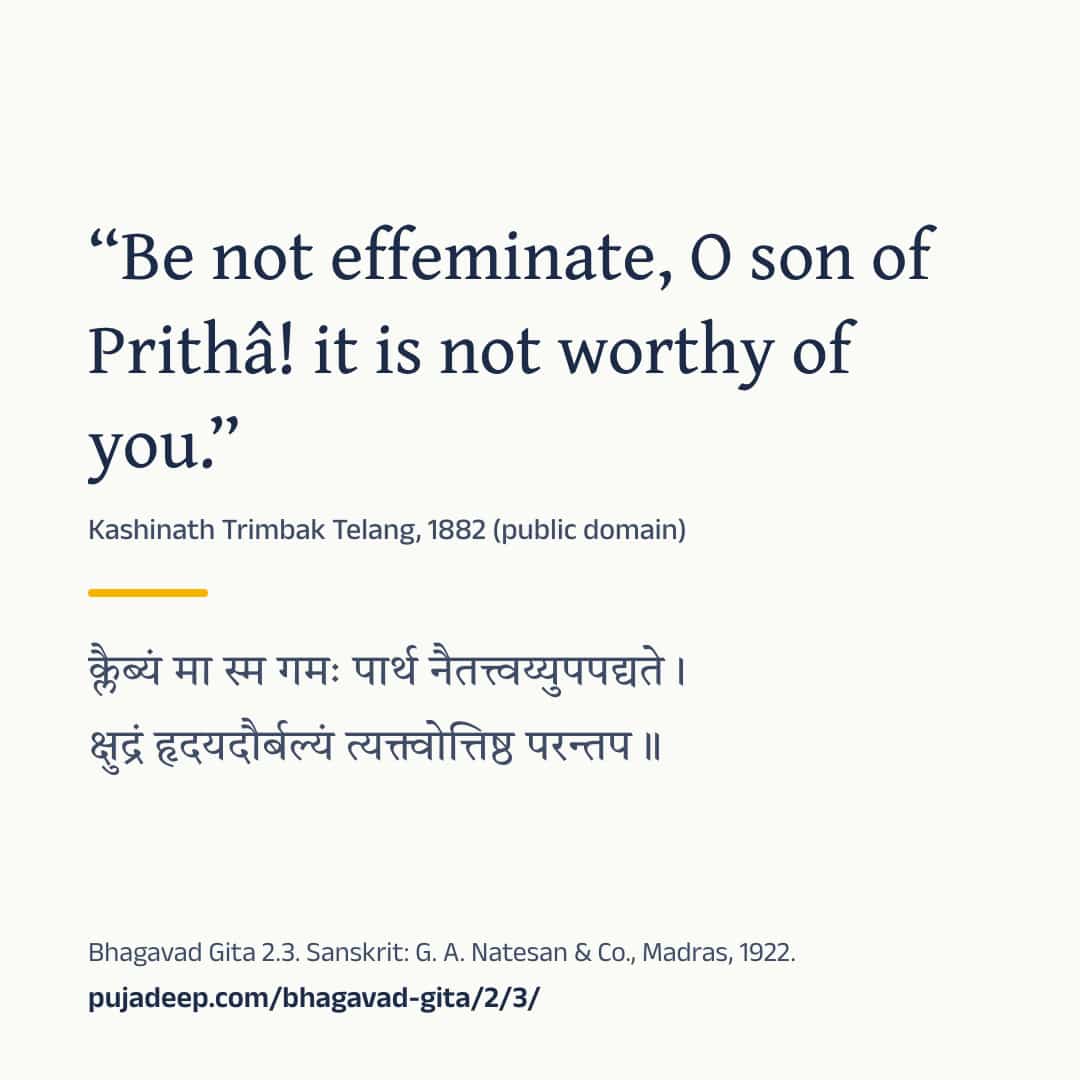
Send one picture or the text to one chat. The picture names its source and the address of this page.
Send as text
The words and the link only. Many elders prefer this.
Bhagavad Gita 2.3

क्लैब्यं मा स्म गमः पार्थ नैतत्त्वय्युपपद्यते ।
क्षुद्रं हृदयदौर्बल्यं त्यक्त्वोत्तिष्ठ परन्तप ॥

“Be not effeminate, O son of Prithâ! it is not worthy of you. Cast off this base weakness of heart, and arise, O terror of (your) foes!”
(Kashinath Trimbak Telang, 1882, public domain)

“Yield not to impotence, O Pârtha! it doth not befit thee. Shake off this paltry faint-heartedness! Stand up, Parantapa!”
(Annie Besant, 1895, public domain)

“Yield not to unmanliness, O son of Prithá! Ill doth it become thee. Cast off this mean faintheartedness and arise, O scorcher of thine enemies!”
(Swami Swarupananda, 1909 (first printed 1907), public domain)

Sanskrit: G. A. Natesan & Co., Madras, 1922.
https://pujadeep.com/bhagavad-gita/2/3/?s=copy Nothing is sent from this site. Your own app sends it, to the chat you choose. The picture quotes Telang (1882). If you chose another translation above, the text quotes yours and no picture is offered.
Sanskrit text: The Bhagavad-Gita, or The Lord's Song, with the text in Devanagari and an English translation, 1922. Meanings: written for Pujadeep with AI help and reviewed. Source and changes
Questions families ask
Who speaks Bhagavad Gita 2.3?
Krishna speaks this verse, in chapter 2 (Sankhya Yoga).
Where does the Sanskrit text come from?
Sanskrit text: The Bhagavad-Gita, or The Lord's Song, with the text in Devanagari and an English translation, 1922. Meanings: written for Pujadeep with AI help and reviewed. See the source
Is the meaning on this page a translation?
Explanation written for this site with AI help from the sources listed here, and reviewed. It is not a translation and not the only way to read the text. Free to quote with credit.
Source and licence
- Sanskrit text
- The Bhagavad-Gita, or The Lord's Song, with the text in Devanagari and an English translation (Annie Besant, G. A. Natesan & Co., Madras, 1922). Public domain. The Sanskrit on these pages was read from this printing’s page images.
- Translation
- The Bhagavadgîtâ with the Sanatsugâtîya and the Anugîtâ, translated by Kâshinâth Trimbak Telang (The Sacred Books of the East, vol. VIII, ed. F. Max Müller) (Kashinath Trimbak Telang, F. Max Müller, Clarendon Press, Oxford, 1882). Public domain. Shown verbatim, as printed.
- Translation
- The Bhagavad Gîtâ, or The Lord's Song, translated by Annie Besant (Annie Besant, Theosophical Publishing Society, London, 1895). Public domain. Shown verbatim, as printed.
- Sanskrit text
- Srimad-Bhagavad-Gita, with Sanskrit Text; Paraphrase with Word-by-word Literal Translation; English Rendering and Comments, Index, &c., by the Swami Swarupananda (Himalayan Series, No. XX) (Swami Swarupananda, The Editors and Publishers, Advaita Ashrama, Mayavati, Prabuddha Bharata Press, Mayavati, Almora, Himalayas, 1909). Public domain. Used only to date the text. The Devanagari on this page is a reading text and is not copied from this printing.
- Common wording
- In this text, 32 words follow today's common wording, checked against sanskritdocuments.org; Sanskrit Wikisource; Gita Press, Gorakhpur; GRETIL, Göttingen and Bhaktivedanta Book Trust.
- Our explanation
- Explanation written for this site with AI help from the sources listed here, and reviewed. It is not a translation and not the only way to read the text. Free to quote with credit.
- Review
- AI review: 2 independent reviews against the cited edition, October 15, 2026.