Bhagavad Gita · Chapter 2: Sankhya Yoga · Speaker: Arjuna
Bhagavad Gita 2.4: Katham bhishmamaham sankhye
Arjuna asks Krishna how he can shoot arrows at Bhishma and Drona in battle.
Bhagavad Gita 2.4
अर्जुन उवाच ।
कथं भीष्ममहं सङ्ख्ये द्रोणं च मधुसूदन ।इषुभिः प्रतियोत्स्यामि पूजार्हावरिसूदन ॥
Katham bhishmamaham sankhye dronam cha madhusudana
Ishubhih pratiyotsyami pujarhavarisudana
kathaṃ bhīṣmamahaṃ saṅkhye droṇaṃ ca madhusūdana |
iṣubhiḥ pratiyotsyāmi pūjārhāvarisūdana ||
Our meaning Arjuna asks Krishna how he can shoot arrows at Bhishma and Drona in battle. Both elders are worthy of his worship. Bhishma is the grand elder of his family, and Drona is his teacher.
हिंदी अर्थ अर्जुन कृष्ण से पूछते हैं कि वे युद्ध में भीष्म और द्रोण पर बाण कैसे चलाएँ। ये दोनों तो पूजा के योग्य हैं। भीष्म उनके कुल के पितामह हैं और द्रोण उनके गुरु।
Word by word
Every word, with its dictionary page
Word by word
- कथम् katham how (indeclinable) Dictionary: katham, Monier-Williams 1899, p. 247, col. 2
how? in what manner?
- भीष्मम् bhīṣmam Bhishma (noun (masculine), accusative singular) Dictionary: bhīṣma, Monier-Williams 1899, p. 758, col. 3
N. of a son of Śāṃtanu and Gaṅgā
- अहम् aham "I" (pronoun, nominative singular) Dictionary: aham, Monier-Williams 1899, p. 124, col. 2
nom. sg. ‘I,’
- सङ्ख्ये saṅkhye in battle (noun (neuter), locative singular) Dictionary: saṃ-khya, Monier-Williams 1899, p. 1128, col. 1
n. conflict, battle, war
- द्रोणम् droṇam Drona (noun (masculine), accusative singular) Dictionary: droṇa, Monier-Williams 1899, p. 503, col. 1
the military preceptor of both the Kuru and Pāṇḍu princes
- च ca and (indeclinable) Dictionary: 2. ca, Monier-Williams 1899, p. 380, col. 1
ind. and, both, also, moreover, as well as
- मधुसूदन madhusūdana O Madhusudana (Krishna) (noun (masculine), vocative singular) Dictionary: madhu-sūdana, Monier-Williams 1899, p. 780, col. 3
destroyer of the demon Madhu
- इषुभिः iṣubhiḥ with arrows (noun (masculine), instrumental plural) Dictionary: iṣu, Monier-Williams 1899, p. 168, col. 3
an arrow
- प्रतियोत्स्यामि pratiyotsyāmi shall fight against (future, 1st person singular) Dictionary: prati-yudh, Monier-Williams 1899, p. 669, col. 2
to fight against, be a match for
- पूजार्हौ pūjārhau both worthy of worship (compound (masculine), accusative dual) Dictionary: pūjārha, Monier-Williams 1899, p. 641, col. 2
worthy of reverence or honour, venerable, respectable
- अरिसूदन arisūdana O slayer of enemies (noun (masculine), vocative singular) Dictionary: 2. a-ri, Monier-Williams 1899, p. 87, col. 3
m. an enemy
; sūdana, Monier-Williams 1899, p. 1242, col. 2killing, destroying
Public-domain translations
Kashinath Trimbak Telang, 1882. Public domain. Page 42.
Arguna said:
How, O destroyer of Madhu! shall I encounter with arrows in the battle Bhîshma and Drona—both, O destroyer of enemies! entitled to reverence?
Compare 3 translations
Kashinath Trimbak Telang, 1882. Public domain. Page 42.
Arguna said:
How, O destroyer of Madhu! shall I encounter with arrows in the battle Bhîshma and Drona—both, O destroyer of enemies! entitled to reverence?
You are reading this one
Annie Besant, 1895. Public domain. Page 25.
Arjuna said:
How, Madhusûdana, shall I attack with arrows in battle Bhîshma and Drona, worthy of reverence, O slayer of foes!
You are reading this one
Swami Swarupananda, 1909 (first printed 1907). Public domain. Page 26.
Arjuna said:
—But how can I, in battle, O slayer of Madhu, fight with arrows against Bhishma and Drona, who are rather worthy to be worshipped, O destroyer of foes!
You are reading this one
Share
Send one picture or the text to one chat. The picture names its source and the address of this page.
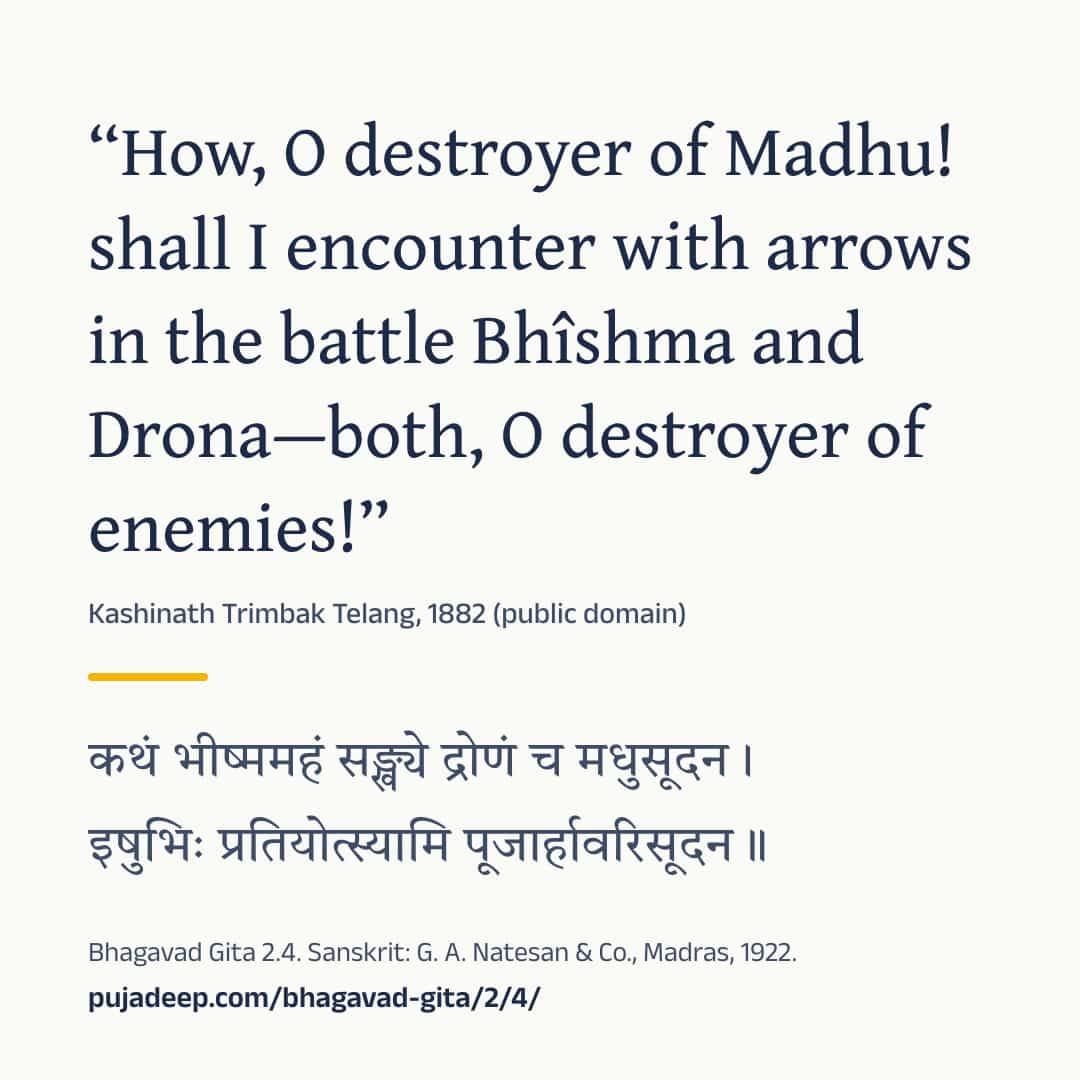
Send as text
The words and the link only. Many elders prefer this.
Bhagavad Gita 2.4

कथं भीष्ममहं सङ्ख्ये द्रोणं च मधुसूदन ।
इषुभिः प्रतियोत्स्यामि पूजार्हावरिसूदन ॥

“How, O destroyer of Madhu! shall I encounter with arrows in the battle Bhîshma and Drona—both, O destroyer of enemies! entitled to reverence?”
(Kashinath Trimbak Telang, 1882, public domain)

“How, Madhusûdana, shall I attack with arrows in battle Bhîshma and Drona, worthy of reverence, O slayer of foes!”
(Annie Besant, 1895, public domain)

“—But how can I, in battle, O slayer of Madhu, fight with arrows against Bhishma and Drona, who are rather worthy to be worshipped, O destroyer of foes!”
(Swami Swarupananda, 1909 (first printed 1907), public domain)

Sanskrit: G. A. Natesan & Co., Madras, 1922.
https://pujadeep.com/bhagavad-gita/2/4/?s=copy Nothing is sent from this site. Your own app sends it, to the chat you choose. The picture quotes Telang (1882). If you chose another translation above, the text quotes yours and no picture is offered.
Sanskrit text: The Bhagavad-Gita, or The Lord's Song, with the text in Devanagari and an English translation, 1922. Meanings: written for Pujadeep with AI help and reviewed. Source and changes
Questions families ask
Who speaks Bhagavad Gita 2.4?
Arjuna speaks this verse, in chapter 2 (Sankhya Yoga).
Where does the Sanskrit text come from?
Sanskrit text: The Bhagavad-Gita, or The Lord's Song, with the text in Devanagari and an English translation, 1922. Meanings: written for Pujadeep with AI help and reviewed. See the source
Is the meaning on this page a translation?
Explanation written for this site with AI help from the sources listed here, and reviewed. It is not a translation and not the only way to read the text. Free to quote with credit.
Source and licence
- Sanskrit text
- The Bhagavad-Gita, or The Lord's Song, with the text in Devanagari and an English translation (Annie Besant, G. A. Natesan & Co., Madras, 1922). Public domain. The Sanskrit on these pages was read from this printing’s page images.
- Translation
- The Bhagavadgîtâ with the Sanatsugâtîya and the Anugîtâ, translated by Kâshinâth Trimbak Telang (The Sacred Books of the East, vol. VIII, ed. F. Max Müller) (Kashinath Trimbak Telang, F. Max Müller, Clarendon Press, Oxford, 1882). Public domain. Shown verbatim, as printed.
- Translation
- The Bhagavad Gîtâ, or The Lord's Song, translated by Annie Besant (Annie Besant, Theosophical Publishing Society, London, 1895). Public domain. Shown verbatim, as printed.
- Sanskrit text
- Srimad-Bhagavad-Gita, with Sanskrit Text; Paraphrase with Word-by-word Literal Translation; English Rendering and Comments, Index, &c., by the Swami Swarupananda (Himalayan Series, No. XX) (Swami Swarupananda, The Editors and Publishers, Advaita Ashrama, Mayavati, Prabuddha Bharata Press, Mayavati, Almora, Himalayas, 1909). Public domain. Used only to date the text. The Devanagari on this page is a reading text and is not copied from this printing.
- Common wording
- In this text, 32 words follow today's common wording, checked against sanskritdocuments.org; Sanskrit Wikisource; Gita Press, Gorakhpur; GRETIL, Göttingen and Bhaktivedanta Book Trust.
- Our explanation
- Explanation written for this site with AI help from the sources listed here, and reviewed. It is not a translation and not the only way to read the text. Free to quote with credit.
- Review
- AI review: 2 independent reviews against the cited edition, October 15, 2026.