Bhagavad Gita · Chapter 2: Sankhya Yoga · Speaker: Arjuna
Bhagavad Gita 2.5: Gurunahatva hi mahanubhavan
Arjuna says it would be better to live by begging in this world than to kill these honoured teachers.
Bhagavad Gita 2.5
गुरूनहत्वा हि महानुभावान् श्रेयो भोक्तुं भैक्ष्यमपीह लोके ।हत्वाऽर्थकामांस्तु गुरूनिहैव भुञ्जीय भोगान्रुधिरप्रदिग्धान् ॥
Gurunahatva hi mahanubhavan shreyo bhoktum bhaikshyamapiha loke
Hatvarthakamanstu gurunihaiva bhunjiya bhoganrudhirapradigdhan
gurūnahatvā hi mahānubhāvān śreyo bhoktuṃ bhaikṣyamapīha loke |
hatvā’rthakāmāṃstu gurūnihaiva bhuñjīya bhogānrudhirapradigdhān ||
Our meaning Arjuna says it would be better to live by begging in this world than to kill these honoured teachers. If he kills them, every pleasure he enjoys afterwards would be stained with their blood.
हिंदी अर्थ अर्जुन कहते हैं कि इन महान गुरुओं को मारने से अच्छा है कि इस संसार में भीख माँगकर जी लिया जाए। इन्हें मारकर जो भी सुख भोगे जाएँगे, वे इनके खून से सने होंगे।
Word by word
Every word, with its dictionary page
Word by word
- गुरून् gurūn teachers, elders (noun (masculine), accusative plural) Dictionary: guru, Monier-Williams 1899, p. 359, col. 2
m. any venerable or respectable person
- अहत्वा ahatvā not killing (negative absolutive: not having killed) Dictionary: 3. a, Monier-Williams 1899, p. 1, col. 1
having a negative or privative or contrary sense
; 1. han, Monier-Williams 1899, p. 1287, col. 2to smite, slay, hit, kill, mar, destroy
- हि hi for, indeed (indeclinable) Dictionary: 2. hi, Monier-Williams 1899, p. 1297, col. 3
for, because, on account of
- महानुभावान् mahānubhāvān noble, of great dignity (compound (masculine), accusative plural) Dictionary: mahānubhāva, Monier-Williams 1899, p. 797, col. 1
of great might, mighty
- श्रेयः śreyaḥ better (noun (neuter), nominative singular) Dictionary: śreyas, Monier-Williams 1899, p. 1102, col. 2
superior, preferable, better
- भोक्तुम् bhoktum to eat, to live on (infinitive (to do)) Dictionary: 3. bhuj, Monier-Williams 1899, p. 759, col. 2
to enjoy, use, possess
- भैक्ष्यम् bhaikṣyam alms, food got by begging (noun (neuter), accusative singular) Dictionary: bhaikṣya, Monier-Williams 1899, p. 767, col. 1 ; bhaikṣa, Monier-Williams 1899, p. 766, col. 3
asking alms, begging, mendicancy
- अपि api even (indeclinable) Dictionary: api, Monier-Williams 1899, p. 55, col. 1
in the sense of even, also, very
- इह iha here (indeclinable) Dictionary: iha, Monier-Williams 1899, p. 169, col. 3
in this place, here
- लोके loke in the world (noun (masculine), locative singular) Dictionary: loka, Monier-Williams 1899, p. 906, col. 1
the wide space or world
- हत्वा hatvā having killed (absolutive (having done)) Dictionary: 1. han, Monier-Williams 1899, p. 1287, col. 2
to smite, slay, hit, kill, mar, destroy
- अर्थकामान् arthakāmān seeking gain (or: wealth and desires) (compound (masculine), accusative plural) Dictionary: artha, Monier-Williams 1899, p. 90, col. 3
aim, purpose
; kāma, Monier-Williams 1899, p. 271, col. 3wish, desire, longing
- तु tu but (indeclinable) Dictionary: 2. tu, Monier-Williams 1899, p. 449, col. 3
but
- गुरून् gurūn teachers, elders (noun (masculine), accusative plural) Dictionary: guru, Monier-Williams 1899, p. 359, col. 2
m. any venerable or respectable person
- इह iha here (indeclinable) Dictionary: iha, Monier-Williams 1899, p. 169, col. 3
in this place, here
- एव eva only, itself (indeclinable) Dictionary: 1. eva, Monier-Williams 1899, p. 232, col. 2
just, exactly, very, same, only, even, alone, merely
- भुञ्जीय bhuñjīya "I would enjoy" (optative, 1st person singular) Dictionary: 3. bhuj, Monier-Williams 1899, p. 759, col. 2
to enjoy, use, possess
- भोगान् bhogān enjoyments (noun (masculine), accusative plural) Dictionary: 2. bhoga, Monier-Williams 1899, p. 767, col. 2
enjoyment, eating, feeding on
- रुधिरप्रदिग्धान् rudhirapradigdhān smeared with blood (compound (masculine), accusative plural) Dictionary: rudhira, Monier-Williams 1899, p. 884, col. 3
red, blood-red, bloody
; pra-digdha, Monier-Williams 1899, p. 680, col. 1smeared over, anointed, stained or covered with
1 printing differs
Public-domain translations
Kashinath Trimbak Telang, 1882. Public domain. Page 42–43.
Not killing (my) preceptors—(men) of great glory—it is better to live even on alms in this world. But killing them, though they are avaricious of worldly goods, I should only enjoy blood-tainted enjoyments.
Compare 3 translations
Kashinath Trimbak Telang, 1882. Public domain. Page 42–43.
Not killing (my) preceptors—(men) of great glory—it is better to live even on alms in this world. But killing them, though they are avaricious of worldly goods, I should only enjoy blood-tainted enjoyments.
You are reading this one
Annie Besant, 1895. Public domain. Page 25.
Better to eat in this world even the beggar's crust than to slay these Gurus, high-minded. Slaying these Gurus, well-wishers,1 I should taste of blood-besprinkled feasts.
Footnotes (the translator’s own) - More often translated, "greedy of wealth," but the word is used elsewhere for well-wisher, and the term is more in accordance with the tone of Arjuna's remarks. ↩
You are reading this one
Swami Swarupananda, 1909 (first printed 1907). Public domain. Page 26.
Surely it would be better even to eat the bread of beggary in this life than to slay these great-souled masters.
But if I kill them, even in this world, all my enjoyment of wealth and desires will be stained with blood.
You are reading this one
Share
Send one picture or the text to one chat. The picture names its source and the address of this page.
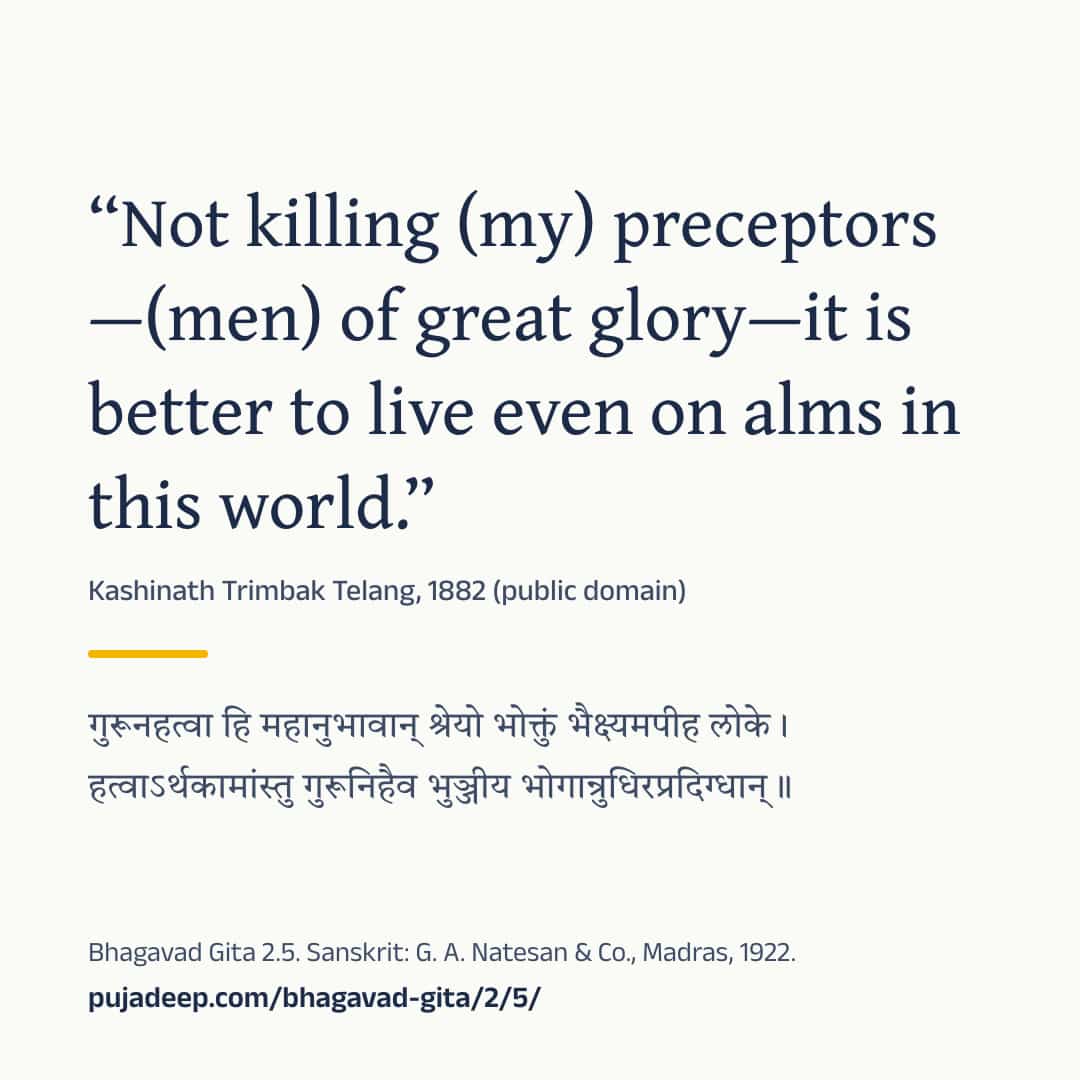
Send as text
The words and the link only. Many elders prefer this.
Bhagavad Gita 2.5

गुरूनहत्वा हि महानुभावान् श्रेयो भोक्तुं भैक्ष्यमपीह लोके ।
हत्वाऽर्थकामांस्तु गुरूनिहैव भुञ्जीय भोगान्रुधिरप्रदिग्धान् ॥

“Not killing (my) preceptors—(men) of great glory—it is better to live even on alms in this world. But killing them, though they are avaricious of worldly goods, I should only enjoy blood-tainted enjoyments.”
(Kashinath Trimbak Telang, 1882, public domain)

“Better to eat in this world even the beggar's crust than to slay these Gurus, high-minded. Slaying these Gurus, well-wishers, I should taste of blood-besprinkled feasts.”
(Annie Besant, 1895, public domain)

“Surely it would be better even to eat the bread of beggary in this life than to slay these great-souled masters. But if I kill them, even in this world, all my enjoyment of wealth and desires will be stained with blood.”
(Swami Swarupananda, 1909 (first printed 1907), public domain)

Sanskrit: G. A. Natesan & Co., Madras, 1922.
https://pujadeep.com/bhagavad-gita/2/5/?s=copy Nothing is sent from this site. Your own app sends it, to the chat you choose. The picture quotes Telang (1882). If you chose another translation above, the text quotes yours and no picture is offered.
Sanskrit text: The Bhagavad-Gita, or The Lord's Song, with the text in Devanagari and an English translation, 1922. Meanings: written for Pujadeep with AI help and reviewed. Source and changes
Questions families ask
Who speaks Bhagavad Gita 2.5?
Arjuna speaks this verse, in chapter 2 (Sankhya Yoga).
Where does the Sanskrit text come from?
Sanskrit text: The Bhagavad-Gita, or The Lord's Song, with the text in Devanagari and an English translation, 1922. Meanings: written for Pujadeep with AI help and reviewed. See the source
Is the meaning on this page a translation?
Explanation written for this site with AI help from the sources listed here, and reviewed. It is not a translation and not the only way to read the text. Free to quote with credit.
Source and licence
- Sanskrit text
- The Bhagavad-Gita, or The Lord's Song, with the text in Devanagari and an English translation (Annie Besant, G. A. Natesan & Co., Madras, 1922). Public domain. The Sanskrit on these pages was read from this printing’s page images.
- Translation
- The Bhagavadgîtâ with the Sanatsugâtîya and the Anugîtâ, translated by Kâshinâth Trimbak Telang (The Sacred Books of the East, vol. VIII, ed. F. Max Müller) (Kashinath Trimbak Telang, F. Max Müller, Clarendon Press, Oxford, 1882). Public domain. Shown verbatim, as printed.
- Translation
- The Bhagavad Gîtâ, or The Lord's Song, translated by Annie Besant (Annie Besant, Theosophical Publishing Society, London, 1895). Public domain. Shown verbatim, as printed.
- Sanskrit text
- Srimad-Bhagavad-Gita, with Sanskrit Text; Paraphrase with Word-by-word Literal Translation; English Rendering and Comments, Index, &c., by the Swami Swarupananda (Himalayan Series, No. XX) (Swami Swarupananda, The Editors and Publishers, Advaita Ashrama, Mayavati, Prabuddha Bharata Press, Mayavati, Almora, Himalayas, 1909). Public domain. Used only to date the text. The Devanagari on this page is a reading text and is not copied from this printing.
- Common wording
- In this text, 32 words follow today's common wording, checked against sanskritdocuments.org; Sanskrit Wikisource; Gita Press, Gorakhpur; GRETIL, Göttingen and Bhaktivedanta Book Trust.
- Our explanation
- Explanation written for this site with AI help from the sources listed here, and reviewed. It is not a translation and not the only way to read the text. Free to quote with credit.
- Review
- AI review: 2 independent reviews against the cited edition, October 15, 2026.