Bhagavad Gita · Chapter 2: Sankhya Yoga · Speaker: Arjuna
Bhagavad Gita 2.6: Na chaitadvidmah kataranno
Arjuna says he cannot tell which is better: that his side wins, or that the other side wins.
Bhagavad Gita 2.6
न चैतद्विद्मः कतरन्नो गरीयो यद्वा जयेम यदि वा नो जयेयुः ।यानेव हत्वा न जिजीविषामः तेऽवस्थिताः प्रमुखे धार्तराष्ट्राः ॥
Na chaitadvidmah kataranno gariyo yadva jayema yadi va no jayeyuh
Yaneva hatva na jijivishamah tevasthitah pramukhe dhartarashtrah
na caitadvidmaḥ kataranno garīyo yadvā jayema yadi vā no jayeyuḥ |
yāneva hatvā na jijīviṣāmaḥ te’vasthitāḥ pramukhe dhārtarāṣṭrāḥ ||
Our meaning Arjuna says he cannot tell which is better: that his side wins, or that the other side wins. The sons of Dhritarashtra stand facing them. If they kill these men, they would not even want to live.
हिंदी अर्थ अर्जुन कहते हैं कि वे नहीं जानते कि क्या अच्छा है — वे जीतें या सामने वाले जीतें। सामने धृतराष्ट्र के पुत्र खड़े हैं, जिन्हें मारकर वे जीना भी नहीं चाहेंगे।
Word by word
Every word, with its dictionary page
Word by word
- न na not (indeclinable) Dictionary: 2. na, Monier-Williams 1899, p. 523, col. 1
ind. not, no, nor, neither
- च ca and (indeclinable) Dictionary: 2. ca, Monier-Williams 1899, p. 380, col. 1
ind. and, both, also, moreover, as well as
- एतत् etat this (pronoun (neuter), accusative singular) Dictionary: etad, Monier-Williams 1899, p. 231, col. 2
this, this here, here
- विद्मः vidmaḥ we know (present, 1st person plural) Dictionary: 1. vid, Monier-Williams 1899, p. 963, col. 2
to know, understand, perceive, learn
- कतरत् katarat which of the two (pronoun (neuter), nominative singular) Dictionary: katara, Monier-Williams 1899, p. 246, col. 3
which of two? whether of two?
- नः naḥ for us (pronoun, genitive plural) Dictionary: 1. nas, Monier-Williams 1899, p. 532, col. 2
us, of us, to us
- गरीयः garīyaḥ better, weightier (noun (neuter), nominative singular) Dictionary: garīyas, Monier-Williams 1899, p. 348, col. 3
more precious or valuable
- यत् yat whether (indeclinable) Dictionary: yad, Monier-Williams 1899, p. 844, col. 2
who, which, what, whichever, whatever, that
- वा vā or (indeclinable) Dictionary: 1. vā, Monier-Williams 1899, p. 934, col. 2
ind. or
- जयेम jayema we should win (optative, 1st person plural) Dictionary: 1. ji, Monier-Williams 1899, p. 420, col. 2
conquer (in battle), vanquish
- यदि yadi if (indeclinable) Dictionary: yadi, Monier-Williams 1899, p. 844, col. 3
if, in case that
- वा vā or (indeclinable) Dictionary: 1. vā, Monier-Williams 1899, p. 934, col. 2
ind. or
- नः naḥ us (pronoun, accusative plural) Dictionary: 1. nas, Monier-Williams 1899, p. 532, col. 2
us, of us, to us
- जयेयुः jayeyuḥ they should defeat (optative, 3rd person plural) Dictionary: 1. ji, Monier-Williams 1899, p. 420, col. 2
conquer (in battle), vanquish
- यान् yān whom (pronoun (masculine), accusative plural) Dictionary: yad, Monier-Williams 1899, p. 844, col. 2
who, which, what, whichever, whatever, that
- एव eva very (indeclinable) Dictionary: 1. eva, Monier-Williams 1899, p. 232, col. 2
just, exactly, very, same, only, even, alone, merely
- हत्वा hatvā having killed (absolutive (having done)) Dictionary: 1. han, Monier-Williams 1899, p. 1287, col. 2
to smite, slay, hit, kill, mar, destroy
- न na not (indeclinable) Dictionary: 2. na, Monier-Williams 1899, p. 523, col. 1
ind. not, no, nor, neither
- जिजीविषामः jijīviṣāmaḥ we wish to live (desiderative, present, 1st person plural) Dictionary: jīv, Monier-Williams 1899, p. 422, col. 2
to live, be or remain alive
- ते te they (pronoun (masculine), nominative plural) Dictionary: tad, Monier-Williams 1899, p. 434, col. 1
m. he, f. she, n. it, that, this
- अवस्थिताः avasthitāḥ stand ready (past participle (masculine), nominative plural) Dictionary: ava-sthita, Monier-Williams 1899, p. 106, col. 1
placed, having its place or abode
- प्रमुखे pramukhe in front (noun (neuter), locative singular) Dictionary: pra-mukha, Monier-Williams 1899, p. 686, col. 3
in front of, before
- धार्तराष्ट्राः dhārtarāṣṭrāḥ the sons of Dhritarashtra (noun (masculine), nominative plural) Dictionary: dhārta-rāṣṭra, Monier-Williams 1899, p. 516, col. 1
a son of Dhṛ°, a Kuru
2 printings differ
Public-domain translations
Kashinath Trimbak Telang, 1882. Public domain. Page 43.
Nor do we know which of the two is better for us—whether that we should vanquish them, or that they should vanquish us. Even those, whom having killed, we do not wish to live—even those sons of Dhritarâshtra stand (arrayed) against us.
Compare 3 translations
Kashinath Trimbak Telang, 1882. Public domain. Page 43.
Nor do we know which of the two is better for us—whether that we should vanquish them, or that they should vanquish us. Even those, whom having killed, we do not wish to live—even those sons of Dhritarâshtra stand (arrayed) against us.
You are reading this one
Annie Besant, 1895. Public domain. Page 25.
Nor know I which for us would be the better, that we conquer them or they conquer us—these, whom having slain we should not care to live, even these arrayed against us, the sons of Dhritarâshtra.
You are reading this one
Swami Swarupananda, 1909 (first printed 1907). Public domain. Page 27.
And indeed I can scarcely tell which will be better, that they should conquer us, or that we should conquer them. The very sons of Dhritaràshtra,—after slaying whom we should not care to live,—stand facing us.
You are reading this one
Share
Send one picture or the text to one chat. The picture names its source and the address of this page.
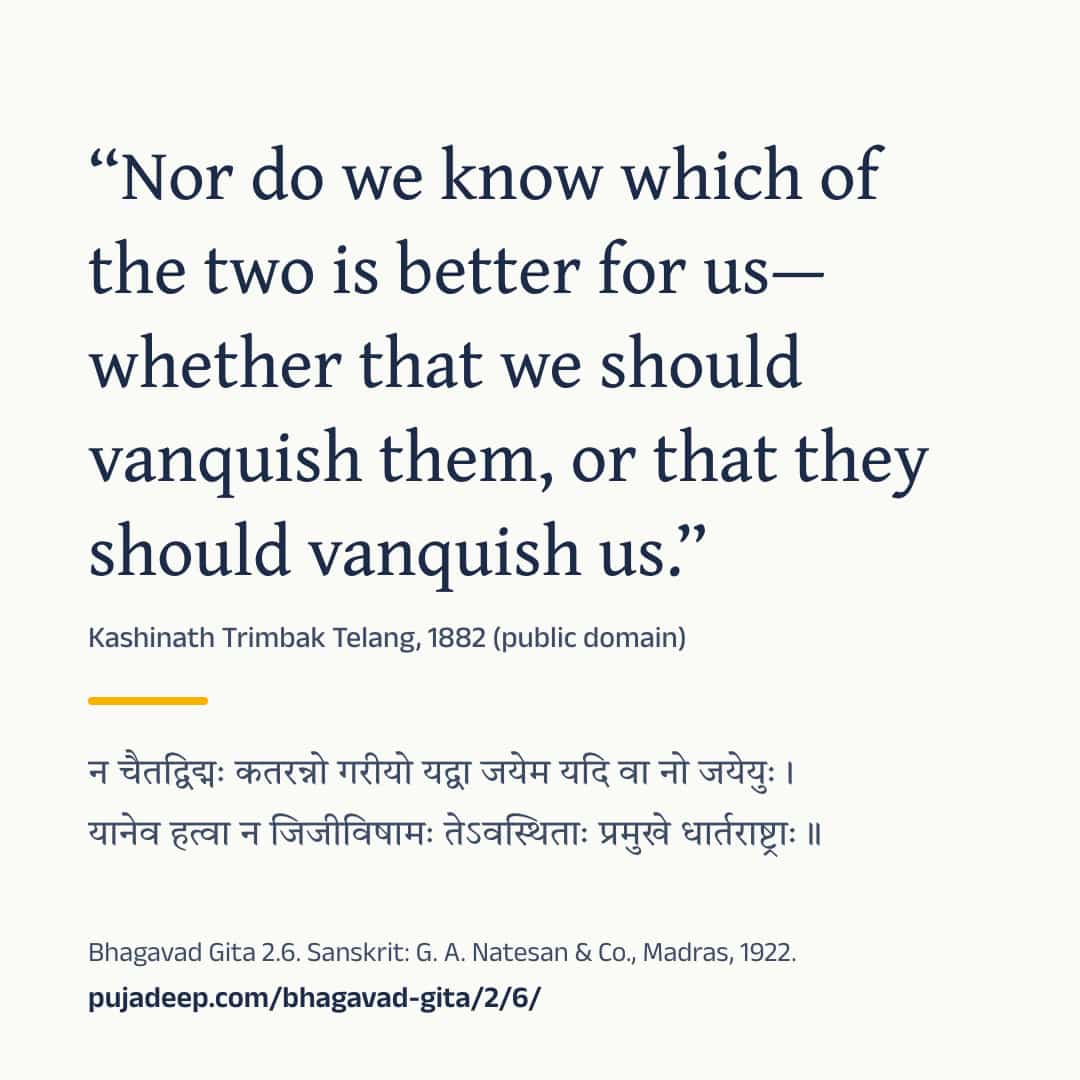
Send as text
The words and the link only. Many elders prefer this.
Bhagavad Gita 2.6

न चैतद्विद्मः कतरन्नो गरीयो यद्वा जयेम यदि वा नो जयेयुः ।
यानेव हत्वा न जिजीविषामः तेऽवस्थिताः प्रमुखे धार्तराष्ट्राः ॥

“Nor do we know which of the two is better for us—whether that we should vanquish them, or that they should vanquish us. Even those, whom having killed, we do not wish to live—even those sons of Dhritarâshtra stand (arrayed) against us.”
(Kashinath Trimbak Telang, 1882, public domain)

“Nor know I which for us would be the better, that we conquer them or they conquer us—these, whom having slain we should not care to live, even these arrayed against us, the sons of Dhritarâshtra.”
(Annie Besant, 1895, public domain)

“And indeed I can scarcely tell which will be better, that they should conquer us, or that we should conquer them. The very sons of Dhritaràshtra,—after slaying whom we should not care to live,—stand facing us.”
(Swami Swarupananda, 1909 (first printed 1907), public domain)

Sanskrit: G. A. Natesan & Co., Madras, 1922.
https://pujadeep.com/bhagavad-gita/2/6/?s=copy Nothing is sent from this site. Your own app sends it, to the chat you choose. The picture quotes Telang (1882). If you chose another translation above, the text quotes yours and no picture is offered.
Sanskrit text: The Bhagavad-Gita, or The Lord's Song, with the text in Devanagari and an English translation, 1922. Meanings: written for Pujadeep with AI help and reviewed. Source and changes
Questions families ask
Who speaks Bhagavad Gita 2.6?
Arjuna speaks this verse, in chapter 2 (Sankhya Yoga).
Where does the Sanskrit text come from?
Sanskrit text: The Bhagavad-Gita, or The Lord's Song, with the text in Devanagari and an English translation, 1922. Meanings: written for Pujadeep with AI help and reviewed. See the source
Is the meaning on this page a translation?
Explanation written for this site with AI help from the sources listed here, and reviewed. It is not a translation and not the only way to read the text. Free to quote with credit.
Source and licence
- Sanskrit text
- The Bhagavad-Gita, or The Lord's Song, with the text in Devanagari and an English translation (Annie Besant, G. A. Natesan & Co., Madras, 1922). Public domain. The Sanskrit on these pages was read from this printing’s page images.
- Translation
- The Bhagavadgîtâ with the Sanatsugâtîya and the Anugîtâ, translated by Kâshinâth Trimbak Telang (The Sacred Books of the East, vol. VIII, ed. F. Max Müller) (Kashinath Trimbak Telang, F. Max Müller, Clarendon Press, Oxford, 1882). Public domain. Shown verbatim, as printed.
- Translation
- The Bhagavad Gîtâ, or The Lord's Song, translated by Annie Besant (Annie Besant, Theosophical Publishing Society, London, 1895). Public domain. Shown verbatim, as printed.
- Sanskrit text
- Srimad-Bhagavad-Gita, with Sanskrit Text; Paraphrase with Word-by-word Literal Translation; English Rendering and Comments, Index, &c., by the Swami Swarupananda (Himalayan Series, No. XX) (Swami Swarupananda, The Editors and Publishers, Advaita Ashrama, Mayavati, Prabuddha Bharata Press, Mayavati, Almora, Himalayas, 1909). Public domain. Used only to date the text. The Devanagari on this page is a reading text and is not copied from this printing.
- Common wording
- In this text, 32 words follow today's common wording, checked against sanskritdocuments.org; Sanskrit Wikisource; Gita Press, Gorakhpur; GRETIL, Göttingen and Bhaktivedanta Book Trust.
- Our explanation
- Explanation written for this site with AI help from the sources listed here, and reviewed. It is not a translation and not the only way to read the text. Free to quote with credit.
- Review
- AI review: 2 independent reviews against the cited edition, October 15, 2026.