Bhagavad Gita · Chapter 2: Sankhya Yoga · Speaker: Arjuna
Bhagavad Gita 2.7: Karpanyadoshopahatasvabhavah
Arjuna admits that weakness has overcome his nature and that he is confused about what is right (dharma).
Bhagavad Gita 2.7
कार्पण्यदोषोपहतस्वभावः पृच्छामि त्वां धर्मसम्मूढचेताः ।यच्छ्रेयः स्यान्निश्चितं ब्रूहि तन्मे शिष्यस्तेऽहं शाधि मां त्वां प्रपन्नम् ॥
Karpanyadoshopahatasvabhavah prichchhami tvam dharmasammudhachetah
Yachchhreyah syannishchitam bruhi tanme shishyasteham shadhi mam tvam prapannam
kārpaṇyadoṣopahatasvabhāvaḥ pṛcchāmi tvāṃ dharmasammūḍhacetāḥ |
yacchreyaḥ syānniścitaṃ brūhi tanme śiṣyaste’haṃ śādhi māṃ tvāṃ prapannam ||
Our meaning Arjuna admits that weakness has overcome his nature and that he is confused about what is right (dharma). He asks Krishna to tell him clearly what is best. He says he is Krishna's disciple and has come to him for shelter, and asks to be taught. Here Arjuna becomes a student.
हिंदी अर्थ अर्जुन स्वीकार करते हैं कि दीनता की कमज़ोरी ने उनके स्वभाव को दबा दिया है और धर्म के बारे में उनका मन भ्रम में है। वे कृष्ण से कहते हैं कि जो कल्याणकारी हो, वह साफ़-साफ़ बताएँ। वे कहते हैं कि वे कृष्ण के शिष्य हैं और उनकी शरण में आए हैं, इसलिए कृष्ण उन्हें शिक्षा दें। यहीं अर्जुन शिष्य बनते हैं।
Word by word
Every word, with its dictionary page
Word by word
- कार्पण्यदोषोपहतस्वभावः kārpaṇyadoṣopahatasvabhāvaḥ nature struck by faint-hearted pity (compound (masculine), nominative singular) Dictionary: kārpaṇya, Monier-Williams 1899, p. 275, col. 3
poorness of spirit, weakness
; 2. doṣa, Monier-Williams 1899, p. 498, col. 2fault, vice, deficiency, want
; upa-hata, Monier-Williams 1899, p. 211, col. 3hit, hurt, damaged, injured, visited, afflicted
; sva-bhāva, Monier-Williams 1899, p. 1276, col. 1innate or inherent disposition, nature
- पृच्छामि pṛcchāmi "I ask" (present, 1st person singular) Dictionary: prach, Monier-Williams 1899, p. 658, col. 1
to ask, question, interrogate
- त्वाम् tvām you (pronoun, accusative singular) Dictionary: 2. tva, Monier-Williams 1899, p. 463, col. 2
base of the 2nd personal pron.
- धर्मसम्मूढचेताः dharmasammūḍhacetāḥ mind confused about dharma (compound (masculine), nominative singular) Dictionary: 1. dharma, Monier-Williams 1899, p. 510, col. 3
usage, practice, customary observance or prescribed conduct, duty
; sam-mūḍha-cetas, Monier-Williams 1899, p. 1181, col. 1troubled or infatuated in mind
- यत् yat what (pronoun (neuter), nominative singular) Dictionary: yad, Monier-Williams 1899, p. 844, col. 2
who, which, what, whichever, whatever, that
- श्रेयः śreyaḥ the better, the good (noun (neuter), nominative singular) Dictionary: śreyas, Monier-Williams 1899, p. 1102, col. 2
superior, preferable, better
- स्यात् syāt would be (optative, 3rd person singular) Dictionary: 1. as, Monier-Williams 1899, p. 117, col. 2
to be, live, exist, be present
- निश्चितम् niścitam for certain (past participle, used as adverb) Dictionary: niś-cita, Monier-Williams 1899, p. 561, col. 2
(am), ind. decidedly, positively
- ब्रूहि brūhi tell (imperative, 2nd person singular) Dictionary: brū, Monier-Williams 1899, p. 742, col. 1
to speak, say, tell
- तत् tat that (pronoun (neuter), accusative singular) Dictionary: tad, Monier-Williams 1899, p. 434, col. 1
m. he, f. she, n. it, that, this
- मे me "to me" (pronoun, dative singular) Dictionary: 1. mad, Monier-Williams 1899, p. 777, col. 2
base of the first pers. pron. in the sg. number
- शिष्यः śiṣyaḥ pupil, disciple (noun (masculine), nominative singular) Dictionary: śiṣya, Monier-Williams 1899, p. 1077, col. 1
a pupil, scholar, disciple
- ते te your (pronoun, genitive singular) Dictionary: 2. tva, Monier-Williams 1899, p. 463, col. 2
base of the 2nd personal pron.
- अहम् aham "I" (pronoun, nominative singular) Dictionary: aham, Monier-Williams 1899, p. 124, col. 2
nom. sg. ‘I,’
- शाधि śādhi teach, instruct (imperative, 2nd person singular) Dictionary: śās, Monier-Williams 1899, p. 1068, col. 3
- माम् mām "me" (pronoun, accusative singular) Dictionary: 1. mad, Monier-Williams 1899, p. 777, col. 2
base of the first pers. pron. in the sg. number
- त्वाम् tvām to you (pronoun, accusative singular) Dictionary: 2. tva, Monier-Williams 1899, p. 463, col. 2
base of the 2nd personal pron.
- प्रपन्नम् prapannam come for refuge (past participle (masculine), accusative singular) Dictionary: pra-panna, Monier-Williams 1899, p. 682, col. 1
arrived at, come to
Public-domain translations
Kashinath Trimbak Telang, 1882. Public domain. Page 43.
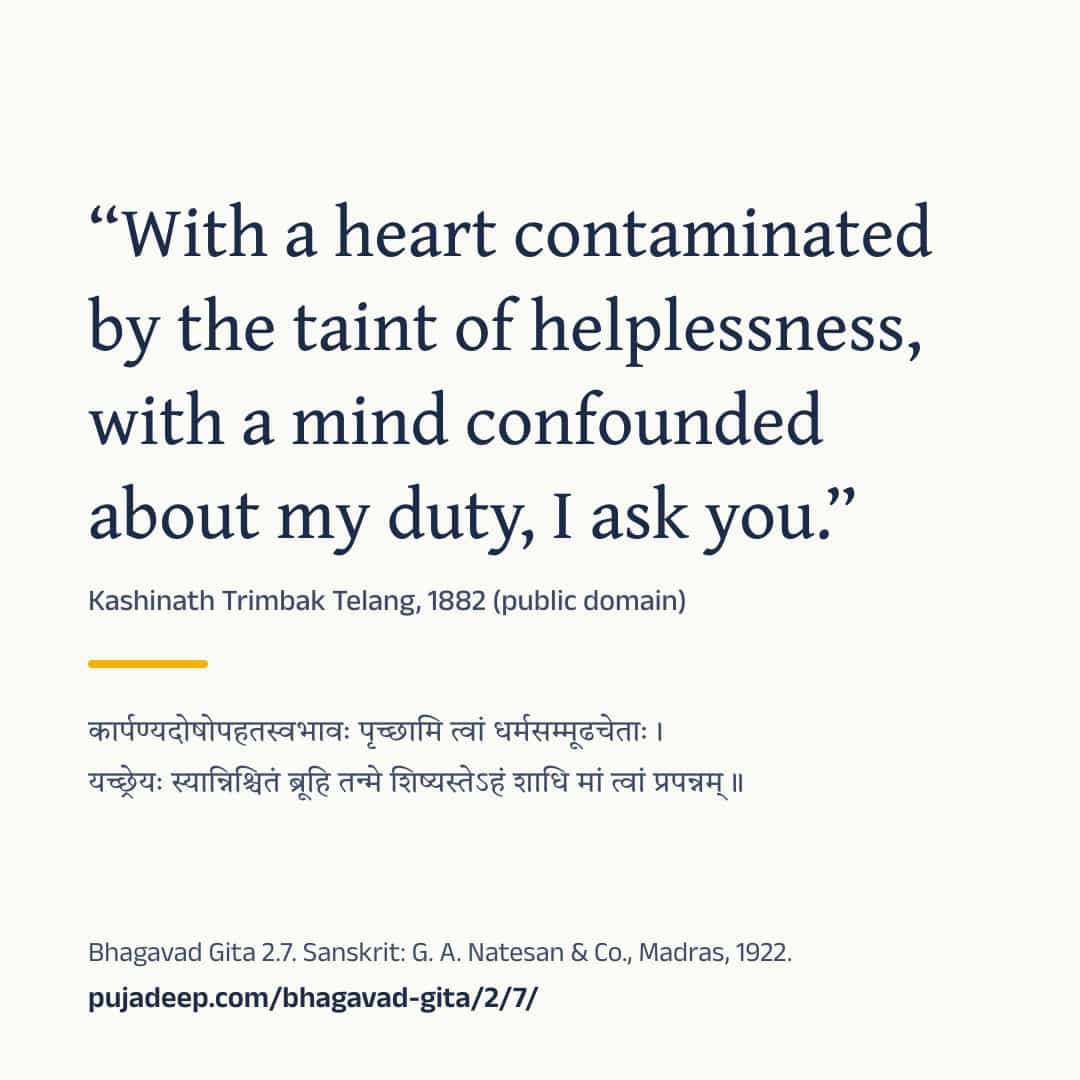
With a heart contaminated by the taint of helplessness1, with a mind confounded about my duty, I ask you. Tell me what is assuredly good for me. I am your disciple; instruct me, who have thrown myself on your (indulgence).
Footnotes (the translator’s own) - The commentators say that 'heart' here signifies the dispositions which are stated in chapter XVIII infra, p. 126. The feeling of 'helplessness' is incompatible with what is there stated as the proper disposition for a Kshatriya. ↩
Compare 3 translations
Kashinath Trimbak Telang, 1882. Public domain. Page 43.
With a heart contaminated by the taint of helplessness1, with a mind confounded about my duty, I ask you. Tell me what is assuredly good for me. I am your disciple; instruct me, who have thrown myself on your (indulgence).
Footnotes (the translator’s own) - The commentators say that 'heart' here signifies the dispositions which are stated in chapter XVIII infra, p. 126. The feeling of 'helplessness' is incompatible with what is there stated as the proper disposition for a Kshatriya. ↩
You are reading this one
Annie Besant, 1895. Public domain. Page 25–26.
My heart is weighed down with the vice of faintness; my mind is confused as to Dharma. I ask Thee which may be the better—that tell me decisively. I am Thy disciple, suppliant to Thee; teach me.
You are reading this one
Swami Swarupananda, 1909 (first printed 1907). Public domain. Page 27–28.
With my nature overpowered by weak commiseration, with a mind in confusion about duty, I supplicate Thee. Say decidedly what is good for me. I am Thy disciple. Instruct me who have taken refuge in Thee.
You are reading this one
Share
Send one picture or the text to one chat. The picture names its source and the address of this page.
Send as text
The words and the link only. Many elders prefer this.
Bhagavad Gita 2.7

कार्पण्यदोषोपहतस्वभावः पृच्छामि त्वां धर्मसम्मूढचेताः ।
यच्छ्रेयः स्यान्निश्चितं ब्रूहि तन्मे शिष्यस्तेऽहं शाधि मां त्वां प्रपन्नम् ॥

“With a heart contaminated by the taint of helplessness, with a mind confounded about my duty, I ask you. Tell me what is assuredly good for me. I am your disciple; instruct me, who have thrown myself on your (indulgence).”
(Kashinath Trimbak Telang, 1882, public domain)

“My heart is weighed down with the vice of faintness; my mind is confused as to Dharma. I ask Thee which may be the better—that tell me decisively. I am Thy disciple, suppliant to Thee; teach me.”
(Annie Besant, 1895, public domain)

“With my nature overpowered by weak commiseration, with a mind in confusion about duty, I supplicate Thee. Say decidedly what is good for me. I am Thy disciple. Instruct me who have taken refuge in Thee.”
(Swami Swarupananda, 1909 (first printed 1907), public domain)

Sanskrit: G. A. Natesan & Co., Madras, 1922.
https://pujadeep.com/bhagavad-gita/2/7/?s=copy Nothing is sent from this site. Your own app sends it, to the chat you choose. The picture quotes Telang (1882). If you chose another translation above, the text quotes yours and no picture is offered.
Sanskrit text: The Bhagavad-Gita, or The Lord's Song, with the text in Devanagari and an English translation, 1922. Meanings: written for Pujadeep with AI help and reviewed. Source and changes
Questions families ask
Who speaks Bhagavad Gita 2.7?
Arjuna speaks this verse, in chapter 2 (Sankhya Yoga).
Where does the Sanskrit text come from?
Sanskrit text: The Bhagavad-Gita, or The Lord's Song, with the text in Devanagari and an English translation, 1922. Meanings: written for Pujadeep with AI help and reviewed. See the source
Is the meaning on this page a translation?
Explanation written for this site with AI help from the sources listed here, and reviewed. It is not a translation and not the only way to read the text. Free to quote with credit.
Source and licence
- Sanskrit text
- The Bhagavad-Gita, or The Lord's Song, with the text in Devanagari and an English translation (Annie Besant, G. A. Natesan & Co., Madras, 1922). Public domain. The Sanskrit on these pages was read from this printing’s page images.
- Translation
- The Bhagavadgîtâ with the Sanatsugâtîya and the Anugîtâ, translated by Kâshinâth Trimbak Telang (The Sacred Books of the East, vol. VIII, ed. F. Max Müller) (Kashinath Trimbak Telang, F. Max Müller, Clarendon Press, Oxford, 1882). Public domain. Shown verbatim, as printed.
- Translation
- The Bhagavad Gîtâ, or The Lord's Song, translated by Annie Besant (Annie Besant, Theosophical Publishing Society, London, 1895). Public domain. Shown verbatim, as printed.
- Sanskrit text
- Srimad-Bhagavad-Gita, with Sanskrit Text; Paraphrase with Word-by-word Literal Translation; English Rendering and Comments, Index, &c., by the Swami Swarupananda (Himalayan Series, No. XX) (Swami Swarupananda, The Editors and Publishers, Advaita Ashrama, Mayavati, Prabuddha Bharata Press, Mayavati, Almora, Himalayas, 1909). Public domain. Used only to date the text. The Devanagari on this page is a reading text and is not copied from this printing.
- Common wording
- In this text, 32 words follow today's common wording, checked against sanskritdocuments.org; Sanskrit Wikisource; Gita Press, Gorakhpur; GRETIL, Göttingen and Bhaktivedanta Book Trust.
- Our explanation
- Explanation written for this site with AI help from the sources listed here, and reviewed. It is not a translation and not the only way to read the text. Free to quote with credit.
- Review
- AI review: 2 independent reviews against the cited edition, October 15, 2026.