Bhagavad Gita · Chapter 2: Sankhya Yoga · Speaker: Arjuna
Bhagavad Gita 2.8: Na hi prapashyami
Arjuna says he sees nothing that could take away the grief that is drying up his senses.
Bhagavad Gita 2.8
न हि प्रपश्यामि ममापनुद्याद्यच्छोकमुच्छोषणमिन्द्रियाणाम् ।अवाप्य भूमावसपत्नमृद्धं राज्यं सुराणामपि चाधिपत्यम् ॥
Na hi prapashyami mamapanudyadyachchhokamuchchhoshanamindriyanam
Avapya bhumavasapatnamriddham rajyam suranamapi chadhipatyam
na hi prapaśyāmi mamāpanudyādyacchokamucchoṣaṇamindriyāṇām |
avāpya bhūmāvasapatnamṛddhaṃ rājyaṃ surāṇāmapi cādhipatyam ||
Our meaning Arjuna says he sees nothing that could take away the grief that is drying up his senses. Not a rich kingdom on earth with no rival, and not even rule over the gods.
हिंदी अर्थ अर्जुन कहते हैं कि उन्हें ऐसा कुछ नहीं दिखता जो उनके उस शोक को दूर कर दे जो उनकी इंद्रियों को सुखा रहा है — न धरती का समृद्ध और निष्कंटक राज्य, न देवताओं पर स्वामित्व।
Word by word
Every word, with its dictionary page
Word by word
- न na not (indeclinable) Dictionary: 2. na, Monier-Williams 1899, p. 523, col. 1
ind. not, no, nor, neither
- हि hi for, indeed (indeclinable) Dictionary: 2. hi, Monier-Williams 1899, p. 1297, col. 3
for, because, on account of
- प्रपश्यामि prapaśyāmi "I see" (present, 1st person singular) Dictionary: pra-paś, Monier-Williams 1899, p. 682, col. 2
look at, observe, behold
- मम mama "my" (pronoun, genitive singular) Dictionary: 1. mad, Monier-Williams 1899, p. 777, col. 2
base of the first pers. pron. in the sg. number
- अपनुद्यात् apanudyāt could drive away (optative, 3rd person singular) Dictionary: apa-nud, Monier-Williams 1899, p. 49, col. 3
to remove
- यत् yat what (pronoun (neuter), nominative singular) Dictionary: yad, Monier-Williams 1899, p. 844, col. 2
who, which, what, whichever, whatever, that
- शोकम् śokam grief (noun (masculine), accusative singular) Dictionary: śoka, Monier-Williams 1899, p. 1091, col. 1
sorrow, affliction, anguish, pain, trouble, grief
- उच्छोषणम् ucchoṣaṇam drying up (adjective (masculine), accusative singular) Dictionary: uc-choṣaṇa, Monier-Williams 1899, p. 174, col. 1
making dry, parching
- इन्द्रियाणाम् indriyāṇām of the senses (noun (neuter), genitive plural) Dictionary: indriya, Monier-Williams 1899, p. 167, col. 2
faculty of sense, sense, organ of sense
- अवाप्य avāpya having gained (absolutive (having done)) Dictionary: avāp, Monier-Williams 1899, p. 107, col. 1
to reach, attain, obtain, gain, get
- भूमौ bhūmau on earth (noun (feminine), locative singular) Dictionary: bhūmi, Monier-Williams 1899, p. 763, col. 1
the earth, soil, ground
- असपत्नम् asapatnam without a rival (adjective (neuter), accusative singular) Dictionary: a-sapatna, Monier-Williams 1899, p. 119, col. 1
without a rival or adversary, undisturbed
- ऋद्धम् ṛddham rich, prosperous (past participle (neuter), accusative singular) Dictionary: ṛddha, Monier-Williams 1899, p. 226, col. 1
increased, thriving, prosperous, abundant, wealthy
- राज्यम् rājyam kingdom (noun (neuter), accusative singular) Dictionary: rājya, Monier-Williams 1899, p. 875, col. 1
kingdom, country, realm
- सुराणाम् surāṇām of the gods (noun (masculine), genitive plural) Dictionary: sura, Monier-Williams 1899, p. 1234, col. 2
a god, divinity, deity
- अपि api even (indeclinable) Dictionary: api, Monier-Williams 1899, p. 55, col. 1
in the sense of even, also, very
- च ca and (indeclinable) Dictionary: 2. ca, Monier-Williams 1899, p. 380, col. 1
ind. and, both, also, moreover, as well as
- आधिपत्यम् ādhipatyam lordship (noun (neuter), accusative singular) Dictionary: ādhipatya, Monier-Williams 1899, p. 138, col. 3
supremacy, sovereignty, power
Public-domain translations
Kashinath Trimbak Telang, 1882. Public domain. Page 43.
For I do not perceive what is to dispel that grief which will dry up my organs1 after I shall have obtained a prosperous kingdom on earth without a foe, or even the sovereignty of the gods2.
Footnotes (the translator’s own) Compare 3 translations
Kashinath Trimbak Telang, 1882. Public domain. Page 43.
For I do not perceive what is to dispel that grief which will dry up my organs1 after I shall have obtained a prosperous kingdom on earth without a foe, or even the sovereignty of the gods2.
Footnotes (the translator’s own) You are reading this one
Annie Besant, 1895. Public domain. Page 26.
For I see not that it would drive away this anguish that withers up my senses, if I should attain monarchy on earth without a foe, or even the sovereignty of the Gods.
You are reading this one
Swami Swarupananda, 1909 (first printed 1907). Public domain. Page 28–29.
I do not see anything to remove this sorrow which blasts my senses, even were I to obtain unrivalled and flourishing dominion over the earth, and mastery over the gods.
You are reading this one
Share
Send one picture or the text to one chat. The picture names its source and the address of this page.
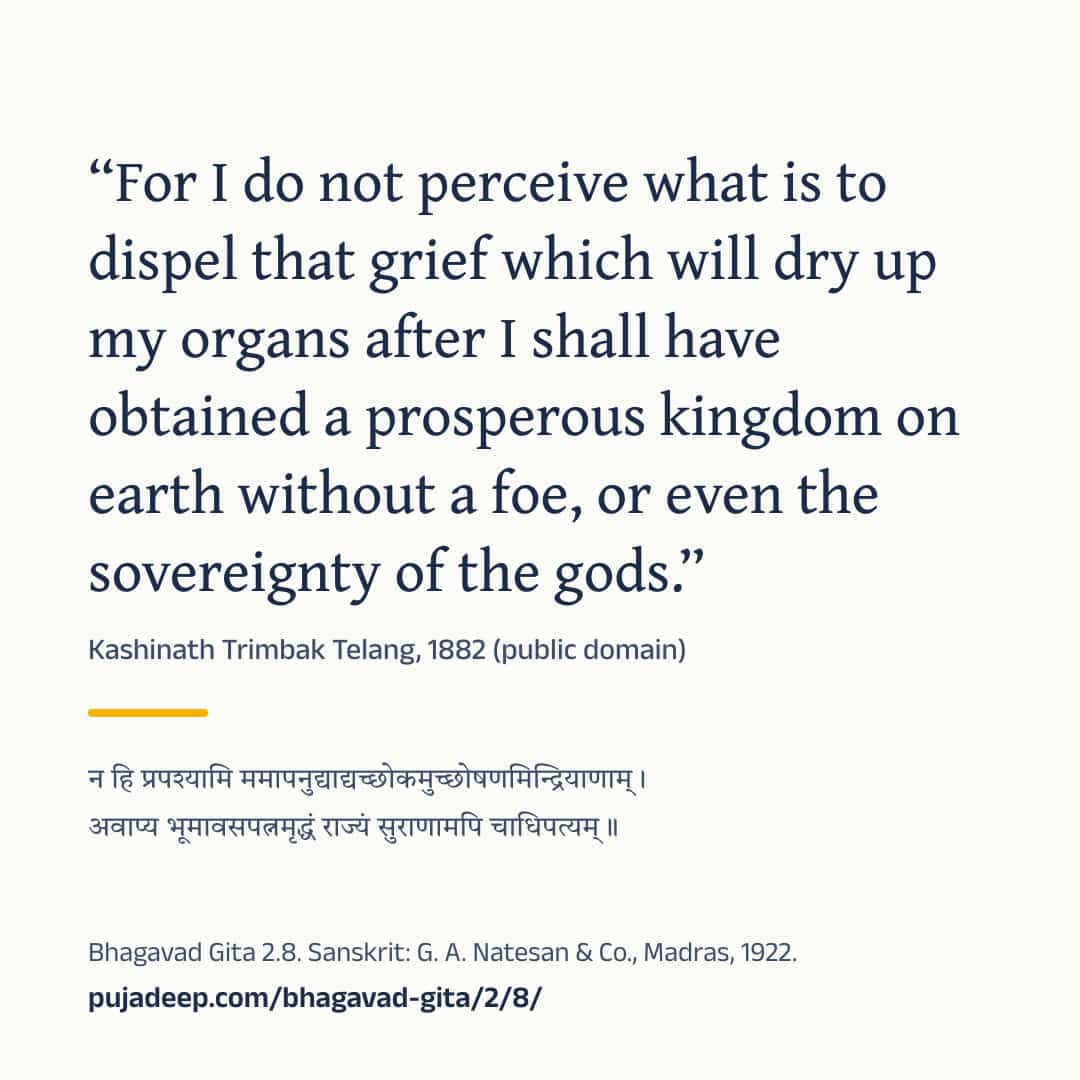
Send as text
The words and the link only. Many elders prefer this.
Bhagavad Gita 2.8

न हि प्रपश्यामि ममापनुद्याद्यच्छोकमुच्छोषणमिन्द्रियाणाम् ।
अवाप्य भूमावसपत्नमृद्धं राज्यं सुराणामपि चाधिपत्यम् ॥

“For I do not perceive what is to dispel that grief which will dry up my organs after I shall have obtained a prosperous kingdom on earth without a foe, or even the sovereignty of the gods.”
(Kashinath Trimbak Telang, 1882, public domain)

“For I see not that it would drive away this anguish that withers up my senses, if I should attain monarchy on earth without a foe, or even the sovereignty of the Gods.”
(Annie Besant, 1895, public domain)

“I do not see anything to remove this sorrow which blasts my senses, even were I to obtain unrivalled and flourishing dominion over the earth, and mastery over the gods.”
(Swami Swarupananda, 1909 (first printed 1907), public domain)

Sanskrit: G. A. Natesan & Co., Madras, 1922.
https://pujadeep.com/bhagavad-gita/2/8/?s=copy Nothing is sent from this site. Your own app sends it, to the chat you choose. The picture quotes Telang (1882). If you chose another translation above, the text quotes yours and no picture is offered.
Sanskrit text: The Bhagavad-Gita, or The Lord's Song, with the text in Devanagari and an English translation, 1922. Meanings: written for Pujadeep with AI help and reviewed. Source and changes
Questions families ask
Who speaks Bhagavad Gita 2.8?
Arjuna speaks this verse, in chapter 2 (Sankhya Yoga).
Where does the Sanskrit text come from?
Sanskrit text: The Bhagavad-Gita, or The Lord's Song, with the text in Devanagari and an English translation, 1922. Meanings: written for Pujadeep with AI help and reviewed. See the source
Is the meaning on this page a translation?
Explanation written for this site with AI help from the sources listed here, and reviewed. It is not a translation and not the only way to read the text. Free to quote with credit.
Source and licence
- Sanskrit text
- The Bhagavad-Gita, or The Lord's Song, with the text in Devanagari and an English translation (Annie Besant, G. A. Natesan & Co., Madras, 1922). Public domain. The Sanskrit on these pages was read from this printing’s page images.
- Translation
- The Bhagavadgîtâ with the Sanatsugâtîya and the Anugîtâ, translated by Kâshinâth Trimbak Telang (The Sacred Books of the East, vol. VIII, ed. F. Max Müller) (Kashinath Trimbak Telang, F. Max Müller, Clarendon Press, Oxford, 1882). Public domain. Shown verbatim, as printed.
- Translation
- The Bhagavad Gîtâ, or The Lord's Song, translated by Annie Besant (Annie Besant, Theosophical Publishing Society, London, 1895). Public domain. Shown verbatim, as printed.
- Sanskrit text
- Srimad-Bhagavad-Gita, with Sanskrit Text; Paraphrase with Word-by-word Literal Translation; English Rendering and Comments, Index, &c., by the Swami Swarupananda (Himalayan Series, No. XX) (Swami Swarupananda, The Editors and Publishers, Advaita Ashrama, Mayavati, Prabuddha Bharata Press, Mayavati, Almora, Himalayas, 1909). Public domain. Used only to date the text. The Devanagari on this page is a reading text and is not copied from this printing.
- Common wording
- In this text, 32 words follow today's common wording, checked against sanskritdocuments.org; Sanskrit Wikisource; Gita Press, Gorakhpur; GRETIL, Göttingen and Bhaktivedanta Book Trust.
- Our explanation
- Explanation written for this site with AI help from the sources listed here, and reviewed. It is not a translation and not the only way to read the text. Free to quote with credit.
- Review
- AI review: 2 independent reviews against the cited edition, October 15, 2026.