Bhagavad Gita · Chapter 2: Sankhya Yoga · Speaker: Sanjaya
Bhagavad Gita 2.9: Evamuktva hrishikesham
Sanjaya tells the king, whom he calls “scorcher of foes,” that Arjuna, having said all this to Krishna, declared “I will not fight,” and fell silent.
Bhagavad Gita 2.9
सञ्जय उवाच ।
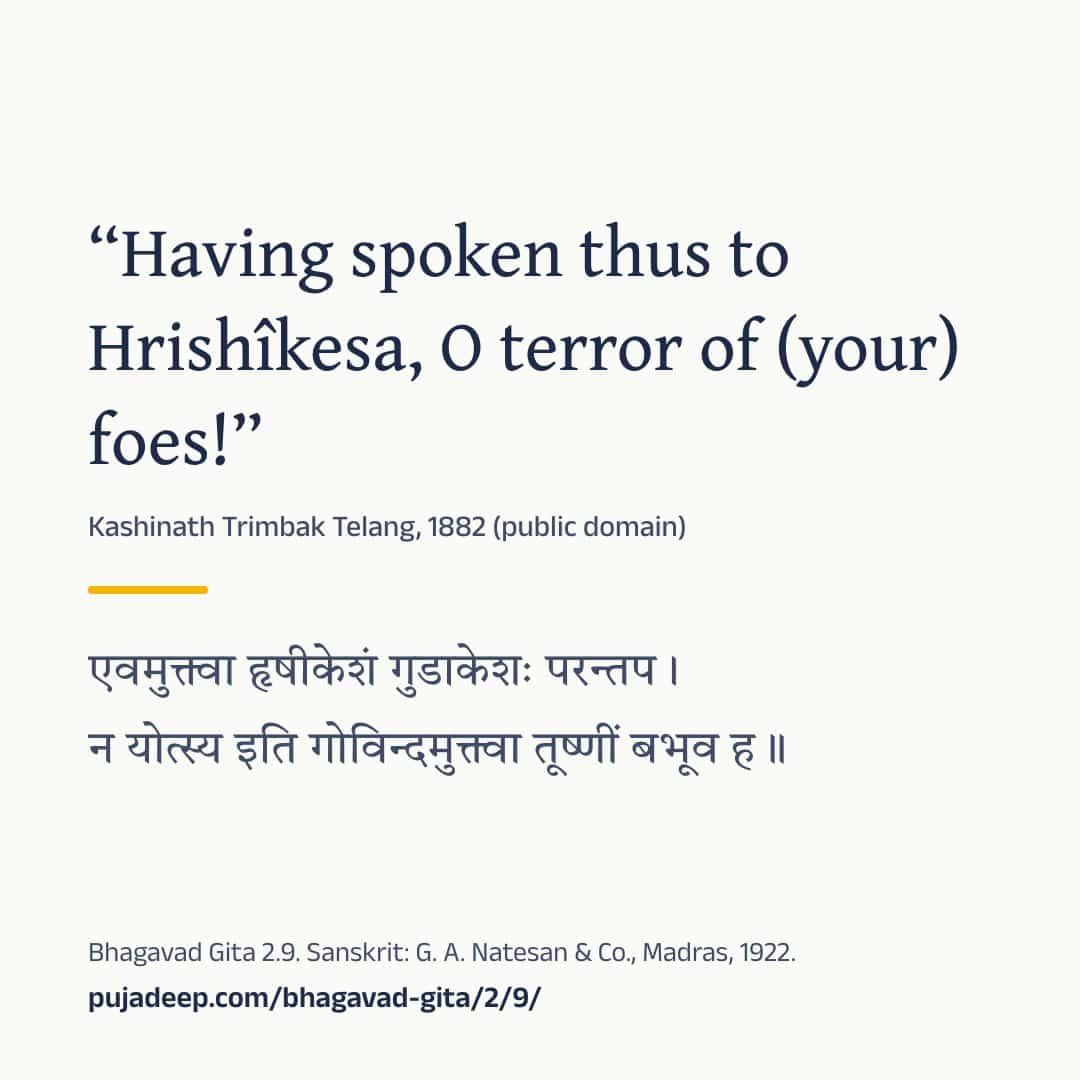
एवमुक्त्वा हृषीकेशं गुडाकेशः परन्तप ।न योत्स्य इति गोविन्दमुक्त्वा तूष्णीं बभूव ह ॥
Evamuktva hrishikesham gudakeshah parantapa
Na yotsya iti govindamuktva tushnim babhuva ha
evamuktvā hṛṣīkeśaṃ guḍākeśaḥ parantapa |
na yotsya iti govindamuktvā tūṣṇīṃ babhūva ha ||
Our meaning Sanjaya tells the king, whom he calls “scorcher of foes,” that Arjuna, having said all this to Krishna, declared “I will not fight,” and fell silent. The 1922 printing reads parantapaḥ, which makes “scorcher of foes” a name for Arjuna. Hrishikesha and Govinda are names of Krishna; Gudakesha (one who has conquered sleep) is a name of Arjuna.
हिंदी अर्थ संजय राजा को “शत्रुओं को तपाने वाले” कहकर संबोधित करते हैं और बताते हैं कि अर्जुन ने कृष्ण से यह सब कहकर कहा, “मैं युद्ध नहीं करूँगा,” और चुप हो गए। 1922 की छपाई में “परन्तपः” है, जिससे “शत्रुओं को तपाने वाला” अर्जुन का विशेषण बनता है। हृषीकेश और गोविंद कृष्ण के नाम हैं; गुडाकेश (जिसने नींद को जीत लिया हो) अर्जुन का नाम है।
Word by word
Every word, with its dictionary page
Word by word
- एवम् evam thus (indeclinable) Dictionary: evam, Monier-Williams 1899, p. 232, col. 2
thus, in this way, in such a manner
- उक्त्वा uktvā having spoken (absolutive (having done)) Dictionary: vac, Monier-Williams 1899, p. 912, col. 1
to speak, say, tell, utter, announce
- हृषीकेशम् hṛṣīkeśam to Hrishikesha (Krishna) (noun (masculine), accusative singular) Dictionary: hṛṣīkeśa, Monier-Williams 1899, p. 1303, col. 2
- गुडाकेशः guḍākeśaḥ Gudakesha (Arjuna) (noun (masculine), nominative singular) Dictionary: guḍā-keśa, Monier-Williams 1899, p. 356, col. 3
‘thick-haired,’ the hero Arjuna
- परन्तप parantapa O scorcher of foes (King Dhritarashtra) (noun (masculine), vocative singular) Dictionary: param-tapa, Monier-Williams 1899, p. 586, col. 3
destroying foes (said of heroes)
- न na not (indeclinable) Dictionary: 2. na, Monier-Williams 1899, p. 523, col. 1
ind. not, no, nor, neither
- योत्स्ये yotsye "I shall fight" (future, 1st person singular) Dictionary: 1. yudh, Monier-Williams 1899, p. 854, col. 3
to fight, wage war
- इति iti thus (ends his words) (indeclinable) Dictionary: 2. iti, Monier-Williams 1899, p. 165, col. 1
in this manner, thus
- गोविन्दम् govindam to Govinda (Krishna) (noun (masculine), accusative singular) Dictionary: go-vinda, Monier-Williams 1899, p. 366, col. 3
Kṛishṇa (or Vishṇu)
- उक्त्वा uktvā having said (absolutive (having done)) Dictionary: vac, Monier-Williams 1899, p. 912, col. 1
to speak, say, tell, utter, announce
- तूष्णीम् tūṣṇīm silent (indeclinable) Dictionary: tūṣṇīm, Monier-Williams 1899, p. 453, col. 1
silently, quietly
- बभूव babhūva became (perfect, 3rd person singular) Dictionary: 1. bhū, Monier-Williams 1899, p. 760, col. 2
arise, come into being, exist
- ह ha indeed (adds stress) (indeclinable) Dictionary: 3. ha, Monier-Williams 1899, p. 1286, col. 1
indeed, assuredly, verily, of course, then
2 printings differ
Public-domain translations
Kashinath Trimbak Telang, 1882. Public domain. Page 43.
Sañgaya said:
Having spoken thus to Hrishîkesa, O terror of (your) foes! Gudâkesa said to Govinda, 'I shall not engage in battle;' and verily remained silent.
Compare 3 translations
Kashinath Trimbak Telang, 1882. Public domain. Page 43.
Sañgaya said:
Having spoken thus to Hrishîkesa, O terror of (your) foes! Gudâkesa said to Govinda, 'I shall not engage in battle;' and verily remained silent.
You are reading this one
Annie Besant, 1895. Public domain. Page 26.
Sanjaya said:
Gudâkesha, conqueror of his foes, having thus addressed Hrishîkesha, and said to Govinda, "I will not fight!" became silent.
You are reading this one
Swami Swarupananda, 1909 (first printed 1907). Public domain. Page 29.
Sanjaya said:
Having spoken thus to the Lord of the Senses, Gudákesha the scorcher of foes said, "I shall not fight O Govinda!" and became silent.
You are reading this one
Share
Send one picture or the text to one chat. The picture names its source and the address of this page.
Send as text
The words and the link only. Many elders prefer this.
Bhagavad Gita 2.9

एवमुक्त्वा हृषीकेशं गुडाकेशः परन्तप ।
न योत्स्य इति गोविन्दमुक्त्वा तूष्णीं बभूव ह ॥

“Having spoken thus to Hrishîkesa, O terror of (your) foes! Gudâkesa said to Govinda, 'I shall not engage in battle;' and verily remained silent.”
(Kashinath Trimbak Telang, 1882, public domain)

“Gudâkesha, conqueror of his foes, having thus addressed Hrishîkesha, and said to Govinda, "I will not fight!" became silent.”
(Annie Besant, 1895, public domain)

“Having spoken thus to the Lord of the Senses, Gudákesha the scorcher of foes said, "I shall not fight O Govinda!" and became silent.”
(Swami Swarupananda, 1909 (first printed 1907), public domain)

Sanskrit: G. A. Natesan & Co., Madras, 1922.
https://pujadeep.com/bhagavad-gita/2/9/?s=copy Nothing is sent from this site. Your own app sends it, to the chat you choose. The picture quotes Telang (1882). If you chose another translation above, the text quotes yours and no picture is offered.
Sanskrit text: The Bhagavad-Gita, or The Lord's Song, with the text in Devanagari and an English translation, 1922. Meanings: written for Pujadeep with AI help and reviewed. Source and changes
Questions families ask
Who speaks Bhagavad Gita 2.9?
Sanjaya speaks this verse, in chapter 2 (Sankhya Yoga).
Where does the Sanskrit text come from?
Sanskrit text: The Bhagavad-Gita, or The Lord's Song, with the text in Devanagari and an English translation, 1922. Meanings: written for Pujadeep with AI help and reviewed. See the source
Is the meaning on this page a translation?
Explanation written for this site with AI help from the sources listed here, and reviewed. It is not a translation and not the only way to read the text. Free to quote with credit.
Source and licence
- Sanskrit text
- The Bhagavad-Gita, or The Lord's Song, with the text in Devanagari and an English translation (Annie Besant, G. A. Natesan & Co., Madras, 1922). Public domain. The Sanskrit on these pages was read from this printing’s page images.
- Translation
- The Bhagavadgîtâ with the Sanatsugâtîya and the Anugîtâ, translated by Kâshinâth Trimbak Telang (The Sacred Books of the East, vol. VIII, ed. F. Max Müller) (Kashinath Trimbak Telang, F. Max Müller, Clarendon Press, Oxford, 1882). Public domain. Shown verbatim, as printed.
- Translation
- The Bhagavad Gîtâ, or The Lord's Song, translated by Annie Besant (Annie Besant, Theosophical Publishing Society, London, 1895). Public domain. Shown verbatim, as printed.
- Sanskrit text
- Srimad-Bhagavad-Gita, with Sanskrit Text; Paraphrase with Word-by-word Literal Translation; English Rendering and Comments, Index, &c., by the Swami Swarupananda (Himalayan Series, No. XX) (Swami Swarupananda, The Editors and Publishers, Advaita Ashrama, Mayavati, Prabuddha Bharata Press, Mayavati, Almora, Himalayas, 1909). Public domain. Used only to date the text. The Devanagari on this page is a reading text and is not copied from this printing.
- Common wording
- In this text, 32 words follow today's common wording, checked against sanskritdocuments.org; Sanskrit Wikisource; Gita Press, Gorakhpur; GRETIL, Göttingen and Bhaktivedanta Book Trust.
- Our explanation
- Explanation written for this site with AI help from the sources listed here, and reviewed. It is not a translation and not the only way to read the text. Free to quote with credit.
- Review
- AI review: 2 independent reviews against the cited edition, October 15, 2026.