Bhagavad Gita · Chapter 2: Sankhya Yoga · Speaker: Sanjaya
Bhagavad Gita 2.10: Tamuvacha hrishikeshah
Sanjaya says that Krishna, as if smiling, then spoke to the grieving Arjuna there between the two armies.
Bhagavad Gita 2.10
तमुवाच हृषीकेशः प्रहसन्निव भारत ।सेनयोरुभयोर्मध्ये विषीदन्तमिदं वचः ॥
Tamuvacha hrishikeshah prahasanniva bharata
Senayorubhayormadhye vishidantamidam vachah
tamuvāca hṛṣīkeśaḥ prahasanniva bhārata |
senayorubhayormadhye viṣīdantamidaṃ vacaḥ ||
Our meaning Sanjaya says that Krishna, as if smiling, then spoke to the grieving Arjuna there between the two armies.
हिंदी अर्थ संजय कहते हैं कि तब दोनों सेनाओं के बीच शोक में डूबे अर्जुन से कृष्ण ने मानो मुस्कराते हुए ये वचन कहे।
Word by word
Every word, with its dictionary page
Word by word
- तम् tam to him (pronoun (masculine), accusative singular) Dictionary: tad, Monier-Williams 1899, p. 434, col. 1
m. he, f. she, n. it, that, this
- उवाच uvāca spoke (perfect, 3rd person singular) Dictionary: vac, Monier-Williams 1899, p. 912, col. 1
to speak, say, tell, utter, announce
- हृषीकेशः hṛṣīkeśaḥ Hrishikesha (Krishna) (noun (masculine), nominative singular) Dictionary: hṛṣīkeśa, Monier-Williams 1899, p. 1303, col. 2
- प्रहसन् prahasan smiling (present participle (masculine), nominative singular) Dictionary: pra-hasat, Monier-Williams 1899, p. 700, col. 3
laughing, smiling
- इव iva as if (indeclinable) Dictionary: iva, Monier-Williams 1899, p. 168, col. 3
like, in the same manner as
- भारत bhārata O Bharata (Dhritarashtra) (noun (masculine), vocative singular) Dictionary: bhārata, Monier-Williams 1899, p. 753, col. 1
- सेनयोः senayoḥ of the two armies (noun (feminine), genitive dual) Dictionary: senā, Monier-Williams 1899, p. 1246, col. 2
an army, armament, battle-array, armed force
- उभयोः ubhayoḥ of both (pronoun (feminine), genitive dual) Dictionary: ubhaya, Monier-Williams 1899, p. 216, col. 2
both, of both kinds
- मध्ये madhye in the middle (noun (neuter), locative singular) Dictionary: madhya, Monier-Williams 1899, p. 781, col. 3
middle
- विषीदन्तम् viṣīdantam to the despairing one (present participle (masculine), accusative singular) Dictionary: vi-ṣad, Monier-Williams 1899, p. 996, col. 2
to be exhausted or dejected, despond, despair
- इदम् idam this (pronoun (neuter), accusative singular) Dictionary: 1. idam, Monier-Williams 1899, p. 165, col. 2
- वचः vacaḥ word, speech (noun (neuter), accusative singular) Dictionary: 1. vacas, Monier-Williams 1899, p. 912, col. 3
speech
Public-domain translations
Kashinath Trimbak Telang, 1882. Public domain. Page 43.
To him thus desponding between the two armies, O descendant of Bharata! Hrishîkesa spoke these words with a slight smile.
Compare 3 translations
Kashinath Trimbak Telang, 1882. Public domain. Page 43.
To him thus desponding between the two armies, O descendant of Bharata! Hrishîkesa spoke these words with a slight smile.
You are reading this one
Annie Besant, 1895. Public domain. Page 26.
Then Hrishîkesha, tenderly smiling, O Bhârata, in the midst of the two armies, to him, despondent, spake these words:
You are reading this one
Swami Swarupananda, 1909 (first printed 1907). Public domain. Page 79.
To him who was sorrowing in the midst of the two armies, Hrishikesha, as if smiling, O descendant of Bharata! spoke these words.
You are reading this one
Share
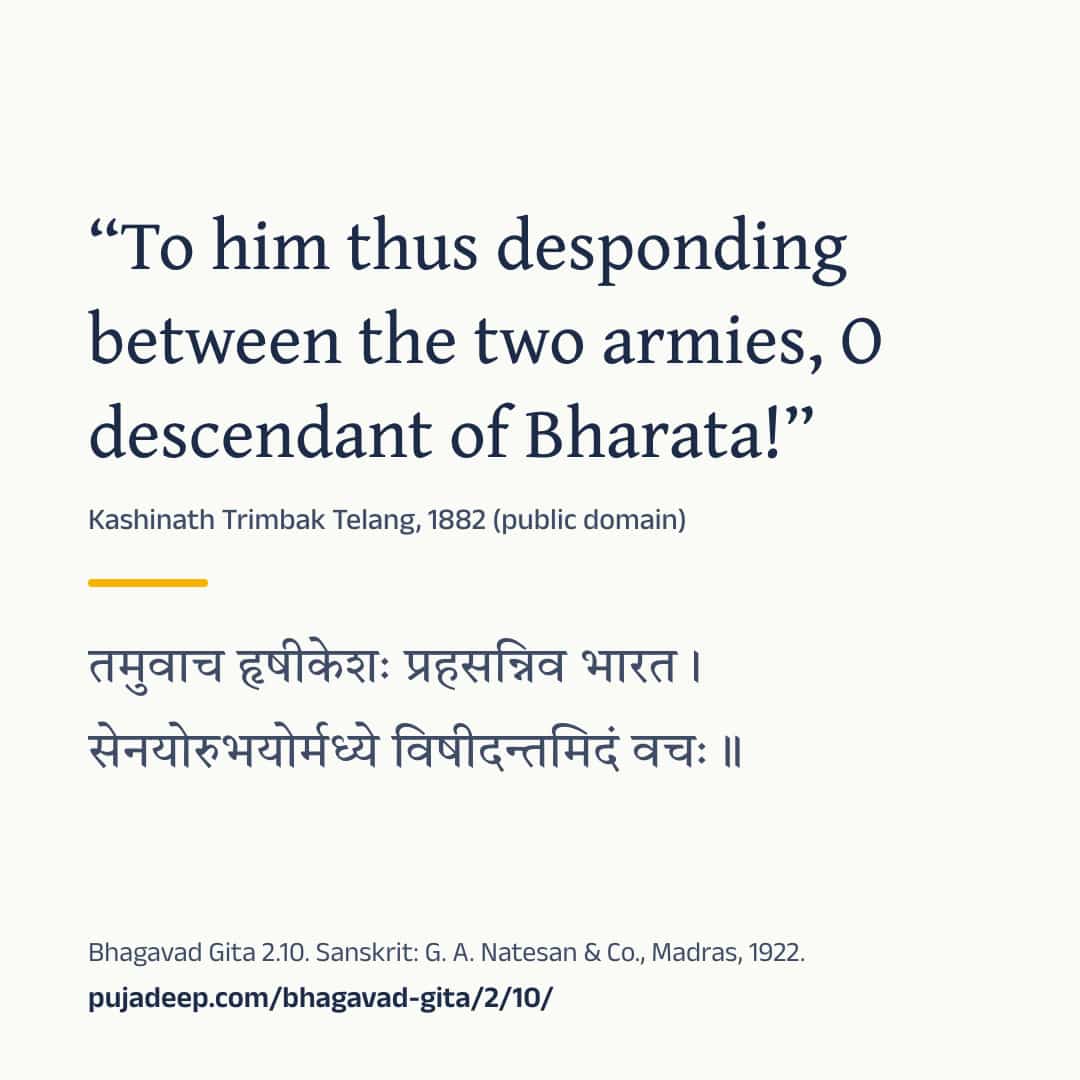
Send one picture or the text to one chat. The picture names its source and the address of this page.
Send as text
The words and the link only. Many elders prefer this.
Bhagavad Gita 2.10

तमुवाच हृषीकेशः प्रहसन्निव भारत ।
सेनयोरुभयोर्मध्ये विषीदन्तमिदं वचः ॥

“To him thus desponding between the two armies, O descendant of Bharata! Hrishîkesa spoke these words with a slight smile.”
(Kashinath Trimbak Telang, 1882, public domain)

“Then Hrishîkesha, tenderly smiling, O Bhârata, in the midst of the two armies, to him, despondent, spake these words:”
(Annie Besant, 1895, public domain)

“To him who was sorrowing in the midst of the two armies, Hrishikesha, as if smiling, O descendant of Bharata! spoke these words.”
(Swami Swarupananda, 1909 (first printed 1907), public domain)

Sanskrit: G. A. Natesan & Co., Madras, 1922.
https://pujadeep.com/bhagavad-gita/2/10/?s=copy Nothing is sent from this site. Your own app sends it, to the chat you choose. The picture quotes Telang (1882). If you chose another translation above, the text quotes yours and no picture is offered.
Sanskrit text: The Bhagavad-Gita, or The Lord's Song, with the text in Devanagari and an English translation, 1922. Meanings: written for Pujadeep with AI help and reviewed. Source and changes
Questions families ask
Who speaks Bhagavad Gita 2.10?
Sanjaya speaks this verse, in chapter 2 (Sankhya Yoga).
Where does the Sanskrit text come from?
Sanskrit text: The Bhagavad-Gita, or The Lord's Song, with the text in Devanagari and an English translation, 1922. Meanings: written for Pujadeep with AI help and reviewed. See the source
Is the meaning on this page a translation?
Explanation written for this site with AI help from the sources listed here, and reviewed. It is not a translation and not the only way to read the text. Free to quote with credit.
Source and licence
- Sanskrit text
- The Bhagavad-Gita, or The Lord's Song, with the text in Devanagari and an English translation (Annie Besant, G. A. Natesan & Co., Madras, 1922). Public domain. The Sanskrit on these pages was read from this printing’s page images.
- Translation
- The Bhagavadgîtâ with the Sanatsugâtîya and the Anugîtâ, translated by Kâshinâth Trimbak Telang (The Sacred Books of the East, vol. VIII, ed. F. Max Müller) (Kashinath Trimbak Telang, F. Max Müller, Clarendon Press, Oxford, 1882). Public domain. Shown verbatim, as printed.
- Translation
- The Bhagavad Gîtâ, or The Lord's Song, translated by Annie Besant (Annie Besant, Theosophical Publishing Society, London, 1895). Public domain. Shown verbatim, as printed.
- Sanskrit text
- Srimad-Bhagavad-Gita, with Sanskrit Text; Paraphrase with Word-by-word Literal Translation; English Rendering and Comments, Index, &c., by the Swami Swarupananda (Himalayan Series, No. XX) (Swami Swarupananda, The Editors and Publishers, Advaita Ashrama, Mayavati, Prabuddha Bharata Press, Mayavati, Almora, Himalayas, 1909). Public domain. Used only to date the text. The Devanagari on this page is a reading text and is not copied from this printing.
- Common wording
- In this text, 32 words follow today's common wording, checked against sanskritdocuments.org; Sanskrit Wikisource; Gita Press, Gorakhpur; GRETIL, Göttingen and Bhaktivedanta Book Trust.
- Our explanation
- Explanation written for this site with AI help from the sources listed here, and reviewed. It is not a translation and not the only way to read the text. Free to quote with credit.
- Review
- AI review: 2 independent reviews against the cited edition, October 15, 2026.