Bhagavad Gita · Chapter 2: Sankhya Yoga · Speaker: Krishna
Bhagavad Gita 2.11: Ashochyananvashochastvam
Krishna begins his teaching.
Bhagavad Gita 2.11
श्रीभगवानुवाच ।
अशोच्यानन्वशोचस्त्वं प्रज्ञावादांश्च भाषसे ।गतासूनगतासूंश्च नानुशोचन्ति पण्डिताः ॥
Ashochyananvashochastvam prajnavadanshcha bhashase
Gatasunagatasunshcha nanushochanti panditah
aśocyānanvaśocastvaṃ prajñāvādāṃśca bhāṣase |
gatāsūnagatāsūṃśca nānuśocanti paṇḍitāḥ ||
Our meaning Krishna begins his teaching. He tells Arjuna that he is grieving for those who need no grief, while speaking words that sound wise. The truly wise, he says, do not grieve for the dead or for the living.
हिंदी अर्थ यहाँ से कृष्ण का उपदेश आरंभ होता है। वे अर्जुन से कहते हैं कि वे उनके लिए शोक कर रहे हैं जिनके लिए शोक नहीं करना चाहिए, और बातें ज्ञानियों जैसी कर रहे हैं। वे कहते हैं कि ज्ञानी लोग न मरे हुओं के लिए शोक करते हैं, न जीवितों के लिए।
Word by word
Every word, with its dictionary page
Word by word
- अशोच्यान् aśocyān those not to be grieved for (gerundive (to be done) (masculine), accusative plural) Dictionary: a-śocya, Monier-Williams 1899, p. 114, col. 1
- अन्वशोचः anvaśocaḥ you have grieved (imperfect, 2nd person singular) Dictionary: anu-śuc, Monier-Williams 1899, p. 39, col. 3
to mourn over, regret, bewail
- त्वम् tvam you (pronoun, nominative singular) Dictionary: 2. tva, Monier-Williams 1899, p. 463, col. 2
base of the 2nd personal pron.
- प्रज्ञावादान् prajñāvādān words of wisdom (compound (masculine), accusative plural) Dictionary: pra-jñā, Monier-Williams 1899, p. 659, col. 2
wisdom, intelligence, knowledge, discrimination, judgment
; vāda, Monier-Williams 1899, p. 939, col. 3speech, discourse, talk, utterance, statement
- च ca and (indeclinable) Dictionary: 2. ca, Monier-Williams 1899, p. 380, col. 1
ind. and, both, also, moreover, as well as
- भाषसे bhāṣase you speak (present, 2nd person singular) Dictionary: 1. bhāṣ, Monier-Williams 1899, p. 755, col. 2
to speak, talk, say, tell
- गतासून् gatāsūn the dead (compound (masculine), accusative plural) Dictionary: gatāsu, Monier-Williams 1899, p. 347, col. 2
one whose breath has gone, expired, dead
- अगतासून् agatāsūn the living (compound (masculine), accusative plural) Dictionary: 3. a, Monier-Williams 1899, p. 1, col. 1
having a negative or privative or contrary sense
; gata, Monier-Williams 1899, p. 347, col. 1gone, gone away, departed
; asu, Monier-Williams 1899, p. 121, col. 1breath, life
- च ca and (indeclinable) Dictionary: 2. ca, Monier-Williams 1899, p. 380, col. 1
ind. and, both, also, moreover, as well as
- न na not (indeclinable) Dictionary: 2. na, Monier-Williams 1899, p. 523, col. 1
ind. not, no, nor, neither
- अनुशोचन्ति anuśocanti grieve for (present, 3rd person plural) Dictionary: anu-śuc, Monier-Williams 1899, p. 39, col. 3
to mourn over, regret, bewail
- पण्डिताः paṇḍitāḥ the wise (noun (masculine), nominative plural) Dictionary: paṇḍita, Monier-Williams 1899, p. 580, col. 3
learned, wise, shrewd, clever
Public-domain translations
Kashinath Trimbak Telang, 1882. Public domain. Page 43–44.
The Deity said:
You have grieved for those who deserve no grief, and you talk words of wisdom1. Learned men grieve not for the living nor the dead.
Footnotes (the translator’s own) - Scil. regarding family-rites, &c., for, says Nîlakantha, they indicate knowledge of soul as distinct from body. ↩
Compare 3 translations
Kashinath Trimbak Telang, 1882. Public domain. Page 43–44.
The Deity said:
You have grieved for those who deserve no grief, and you talk words of wisdom1. Learned men grieve not for the living nor the dead.
Footnotes (the translator’s own) - Scil. regarding family-rites, &c., for, says Nîlakantha, they indicate knowledge of soul as distinct from body. ↩
You are reading this one
Annie Besant, 1895. Public domain. Page 26.
The Blessed Lord said:
Thou grievest for those that should not be grieved for, and speakest words of wisdom.1 The wise grieve neither for the living nor for the dead.
Footnotes (the translator’s own) - Words that sound wise but miss the deeper sense of wisdom. ↩
You are reading this one
Swami Swarupananda, 1909 (first printed 1907). Public domain. Page 79.
The Blessed Lord said:
Thou hast been mourning for them who should not be mourned for. Yet thou speakest words of wisdom. The (truly) wise grieve neither for the living nor the dead.
You are reading this one
Share
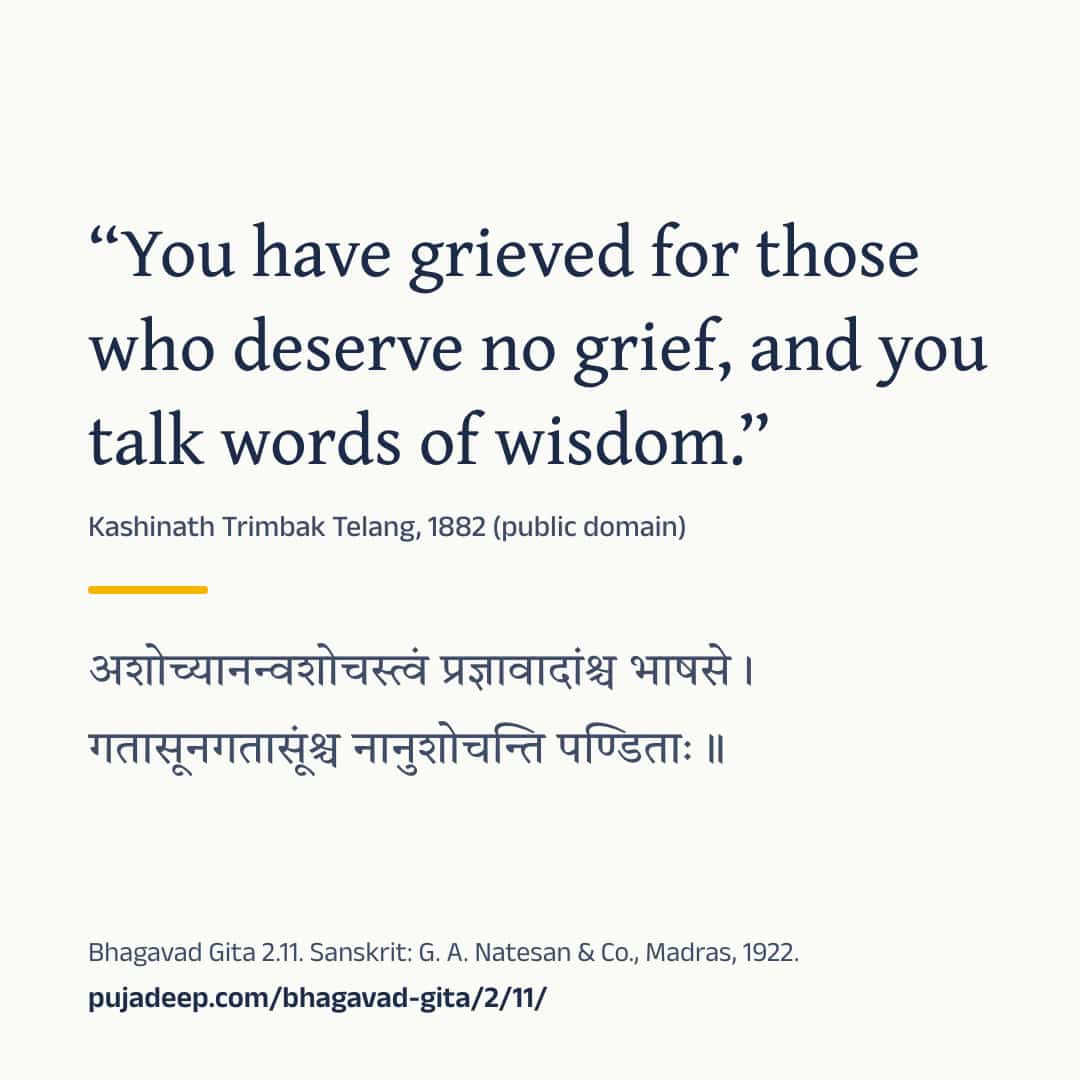
Send one picture or the text to one chat. The picture names its source and the address of this page.
Send as text
The words and the link only. Many elders prefer this.
Bhagavad Gita 2.11

अशोच्यानन्वशोचस्त्वं प्रज्ञावादांश्च भाषसे ।
गतासूनगतासूंश्च नानुशोचन्ति पण्डिताः ॥

“You have grieved for those who deserve no grief, and you talk words of wisdom. Learned men grieve not for the living nor the dead.”
(Kashinath Trimbak Telang, 1882, public domain)

“Thou grievest for those that should not be grieved for, and speakest words of wisdom. The wise grieve neither for the living nor for the dead.”
(Annie Besant, 1895, public domain)

“Thou hast been mourning for them who should not be mourned for. Yet thou speakest words of wisdom. The (truly) wise grieve neither for the living nor the dead.”
(Swami Swarupananda, 1909 (first printed 1907), public domain)

Sanskrit: G. A. Natesan & Co., Madras, 1922.
https://pujadeep.com/bhagavad-gita/2/11/?s=copy Nothing is sent from this site. Your own app sends it, to the chat you choose. The picture quotes Telang (1882). If you chose another translation above, the text quotes yours and no picture is offered.
Sanskrit text: The Bhagavad-Gita, or The Lord's Song, with the text in Devanagari and an English translation, 1922. Meanings: written for Pujadeep with AI help and reviewed. Source and changes
Questions families ask
Who speaks Bhagavad Gita 2.11?
Krishna speaks this verse, in chapter 2 (Sankhya Yoga).
Where does the Sanskrit text come from?
Sanskrit text: The Bhagavad-Gita, or The Lord's Song, with the text in Devanagari and an English translation, 1922. Meanings: written for Pujadeep with AI help and reviewed. See the source
Is the meaning on this page a translation?
Explanation written for this site with AI help from the sources listed here, and reviewed. It is not a translation and not the only way to read the text. Free to quote with credit.
Source and licence
- Sanskrit text
- The Bhagavad-Gita, or The Lord's Song, with the text in Devanagari and an English translation (Annie Besant, G. A. Natesan & Co., Madras, 1922). Public domain. The Sanskrit on these pages was read from this printing’s page images.
- Translation
- The Bhagavadgîtâ with the Sanatsugâtîya and the Anugîtâ, translated by Kâshinâth Trimbak Telang (The Sacred Books of the East, vol. VIII, ed. F. Max Müller) (Kashinath Trimbak Telang, F. Max Müller, Clarendon Press, Oxford, 1882). Public domain. Shown verbatim, as printed.
- Translation
- The Bhagavad Gîtâ, or The Lord's Song, translated by Annie Besant (Annie Besant, Theosophical Publishing Society, London, 1895). Public domain. Shown verbatim, as printed.
- Sanskrit text
- Srimad-Bhagavad-Gita, with Sanskrit Text; Paraphrase with Word-by-word Literal Translation; English Rendering and Comments, Index, &c., by the Swami Swarupananda (Himalayan Series, No. XX) (Swami Swarupananda, The Editors and Publishers, Advaita Ashrama, Mayavati, Prabuddha Bharata Press, Mayavati, Almora, Himalayas, 1909). Public domain. Used only to date the text. The Devanagari on this page is a reading text and is not copied from this printing.
- Common wording
- In this text, 32 words follow today's common wording, checked against sanskritdocuments.org; Sanskrit Wikisource; Gita Press, Gorakhpur; GRETIL, Göttingen and Bhaktivedanta Book Trust.
- Our explanation
- Explanation written for this site with AI help from the sources listed here, and reviewed. It is not a translation and not the only way to read the text. Free to quote with credit.
- Review
- AI review: 2 independent reviews against the cited edition, October 15, 2026.