Bhagavad Gita · Chapter 2: Sankhya Yoga · Speaker: Krishna
Bhagavad Gita 2.35: Bhayadranaduparatam mansyante
Krishna says that the great warriors will think Arjuna left the battle out of fear, and that those who once held him in high regard will think little of him.
Bhagavad Gita 2.35
भयाद्रणादुपरतं मंस्यन्ते त्वां महारथाः ।येषां च त्वं बहुमतो भूत्वा यास्यसि लाघवम् ॥
Bhayadranaduparatam mansyante tvam maharathah
Yesham cha tvam bahumato bhutva yasyasi laghavam
bhayādraṇāduparataṃ maṃsyante tvāṃ mahārathāḥ |
yeṣāṃ ca tvaṃ bahumato bhūtvā yāsyasi lāghavam ||
Our meaning Krishna says that the great warriors will think Arjuna left the battle out of fear, and that those who once held him in high regard will think little of him.
हिंदी अर्थ कृष्ण कहते हैं कि बड़े-बड़े महारथी समझेंगे कि अर्जुन डर के कारण युद्ध से हट गए, और जो उन्हें बहुत मानते थे, उनकी नज़र में वे छोटे हो जाएँगे।
Word by word
Every word, with its dictionary page
Word by word
- भयात् bhayāt from fear (noun (neuter), ablative singular) Dictionary: bhaya, Monier-Williams 1899, p. 747, col. 1
fear, alarm, dread, apprehension
- रणात् raṇāt from battle (noun (masculine), ablative singular) Dictionary: 1. raṇa, Monier-Williams 1899, p. 863, col. 3
war, combat, fight, conflict
- उपरतम् uparatam withdrawn (past participle (masculine), accusative singular) Dictionary: upa-rata, Monier-Williams 1899, p. 204, col. 3
ceased, stopped, quiet, indifferent
- मंस्यन्ते maṃsyante will think (future, 3rd person plural) Dictionary: man, Monier-Williams 1899, p. 783, col. 1
to think, believe, imagine, suppose, conjecture
- त्वाम् tvām you (pronoun, accusative singular) Dictionary: 2. tva, Monier-Williams 1899, p. 463, col. 2
base of the 2nd personal pron.
- महारथाः mahārathāḥ great chariot-warriors (compound (masculine), nominative plural) Dictionary: mahā-ratha, Monier-Williams 1899, p. 799, col. 2
a gr° warrior
- येषाम् yeṣām of whom, by whom (pronoun (masculine), genitive plural) Dictionary: yad, Monier-Williams 1899, p. 844, col. 2
who, which, what, whichever, whatever, that
- च ca and (indeclinable) Dictionary: 2. ca, Monier-Williams 1899, p. 380, col. 1
ind. and, both, also, moreover, as well as
- त्वम् tvam you (pronoun, nominative singular) Dictionary: 2. tva, Monier-Williams 1899, p. 463, col. 2
base of the 2nd personal pron.
- बहुमतः bahumataḥ highly esteemed (compound (masculine), nominative singular) Dictionary: bahu-mata, Monier-Williams 1899, p. 725, col. 2
much thought of, highly esteemed, valued
- भूत्वा bhūtvā having been (absolutive (having done)) Dictionary: 1. bhū, Monier-Williams 1899, p. 760, col. 2
arise, come into being, exist
- यास्यसि yāsyasi you will go (to) (future, 2nd person singular) Dictionary: 1. yā, Monier-Williams 1899, p. 849, col. 1
to go, proceed, move, walk, set out
- लाघवम् lāghavam lightness, low esteem (noun (neuter), accusative singular) Dictionary: lāghava, Monier-Williams 1899, p. 899, col. 3
lightness
Public-domain translations
Kashinath Trimbak Telang, 1882. Public domain. Page 46.
(Warriors who are) masters of great cars will think that you abstained from the battle through fear, and having been highly thought of by them, you will fall down to littleness.
Compare 3 translations
Kashinath Trimbak Telang, 1882. Public domain. Page 46.
(Warriors who are) masters of great cars will think that you abstained from the battle through fear, and having been highly thought of by them, you will fall down to littleness.
You are reading this one
Annie Besant, 1895. Public domain. Page 31.
The great car-warriors1 will think thou hast fled the battle from fear, and thou that wast highly thought of by them, wilt be lightly held.
Footnotes (the translator’s own) - The generals. ↩
You are reading this one
Swami Swarupananda, 1909 (first printed 1907). Public domain. Page 42–43.
The great chariot-warriors will believe that thou hast withdrawn from the battle through fear. And thou wilt be lightly esteemed by them who have thought much of thee.
You are reading this one
Share
Send one picture or the text to one chat. The picture names its source and the address of this page.
Send as text
The words and the link only. Many elders prefer this.
Bhagavad Gita 2.35

भयाद्रणादुपरतं मंस्यन्ते त्वां महारथाः ।
येषां च त्वं बहुमतो भूत्वा यास्यसि लाघवम् ॥

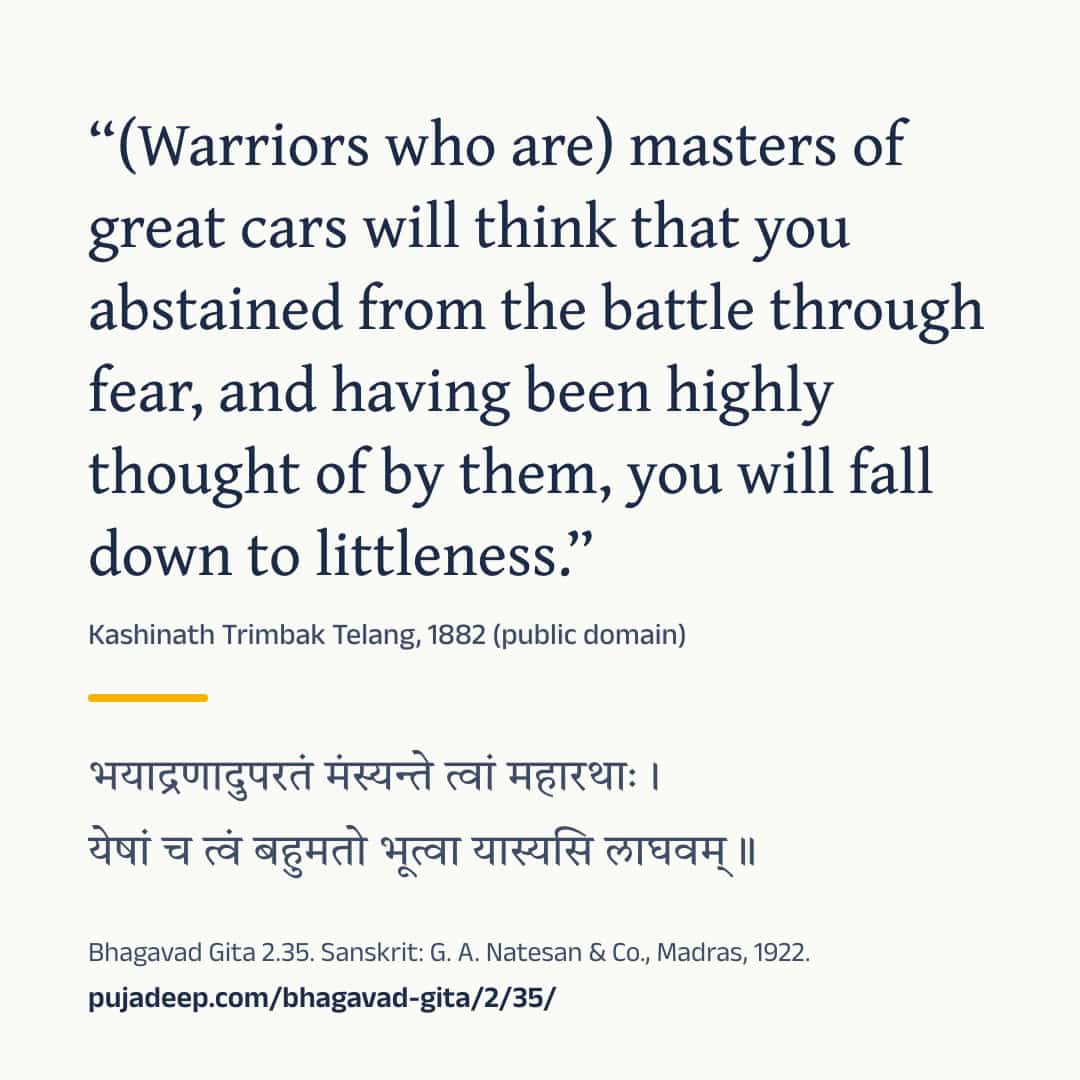
“(Warriors who are) masters of great cars will think that you abstained from the battle through fear, and having been highly thought of by them, you will fall down to littleness.”
(Kashinath Trimbak Telang, 1882, public domain)

“The great car-warriors will think thou hast fled the battle from fear, and thou that wast highly thought of by them, wilt be lightly held.”
(Annie Besant, 1895, public domain)

“The great chariot-warriors will believe that thou hast withdrawn from the battle through fear. And thou wilt be lightly esteemed by them who have thought much of thee.”
(Swami Swarupananda, 1909 (first printed 1907), public domain)

Sanskrit: G. A. Natesan & Co., Madras, 1922.
https://pujadeep.com/bhagavad-gita/2/35/?s=copy Nothing is sent from this site. Your own app sends it, to the chat you choose. The picture quotes Telang (1882). If you chose another translation above, the text quotes yours and no picture is offered.
Sanskrit text: The Bhagavad-Gita, or The Lord's Song, with the text in Devanagari and an English translation, 1922. Meanings: written for Pujadeep with AI help and reviewed. Source and changes
Questions families ask
Who speaks Bhagavad Gita 2.35?
Krishna speaks this verse, in chapter 2 (Sankhya Yoga).
Where does the Sanskrit text come from?
Sanskrit text: The Bhagavad-Gita, or The Lord's Song, with the text in Devanagari and an English translation, 1922. Meanings: written for Pujadeep with AI help and reviewed. See the source
Is the meaning on this page a translation?
Explanation written for this site with AI help from the sources listed here, and reviewed. It is not a translation and not the only way to read the text. Free to quote with credit.
Source and licence
- Sanskrit text
- The Bhagavad-Gita, or The Lord's Song, with the text in Devanagari and an English translation (Annie Besant, G. A. Natesan & Co., Madras, 1922). Public domain. The Sanskrit on these pages was read from this printing’s page images.
- Translation
- The Bhagavadgîtâ with the Sanatsugâtîya and the Anugîtâ, translated by Kâshinâth Trimbak Telang (The Sacred Books of the East, vol. VIII, ed. F. Max Müller) (Kashinath Trimbak Telang, F. Max Müller, Clarendon Press, Oxford, 1882). Public domain. Shown verbatim, as printed.
- Translation
- The Bhagavad Gîtâ, or The Lord's Song, translated by Annie Besant (Annie Besant, Theosophical Publishing Society, London, 1895). Public domain. Shown verbatim, as printed.
- Sanskrit text
- Srimad-Bhagavad-Gita, with Sanskrit Text; Paraphrase with Word-by-word Literal Translation; English Rendering and Comments, Index, &c., by the Swami Swarupananda (Himalayan Series, No. XX) (Swami Swarupananda, The Editors and Publishers, Advaita Ashrama, Mayavati, Prabuddha Bharata Press, Mayavati, Almora, Himalayas, 1909). Public domain. Used only to date the text. The Devanagari on this page is a reading text and is not copied from this printing.
- Common wording
- In this text, 32 words follow today's common wording, checked against sanskritdocuments.org; Sanskrit Wikisource; Gita Press, Gorakhpur; GRETIL, Göttingen and Bhaktivedanta Book Trust.
- Our explanation
- Explanation written for this site with AI help from the sources listed here, and reviewed. It is not a translation and not the only way to read the text. Free to quote with credit.
- Review
- AI review: 2 independent reviews against the cited edition, October 15, 2026.