Bhagavad Gita · Chapter 2: Sankhya Yoga · Speaker: Krishna
Bhagavad Gita 2.36: Avachyavadanshcha
Krishna says that Arjuna's enemies will say many cruel things and mock his strength, and asks what could be more painful than that.
Bhagavad Gita 2.36
अवाच्यवादांश्च बहून्वदिष्यन्ति तवाहिताः ।निन्दन्तस्तव सामर्थ्यं ततो दुःखतरं नु किम् ॥
Avachyavadanshcha bahunvadishyanti tavahitah
Nindantastava samarthyam tato duhkhataram nu kim
avācyavādāṃśca bahūnvadiṣyanti tavāhitāḥ |
nindantastava sāmarthyaṃ tato duḥkhataraṃ nu kim ||
Our meaning Krishna says that Arjuna's enemies will say many cruel things and mock his strength, and asks what could be more painful than that.
हिंदी अर्थ कृष्ण कहते हैं कि उनके शत्रु उनकी सामर्थ्य की निंदा करते हुए बहुत-सी न कहने योग्य बातें कहेंगे, और पूछते हैं कि इससे बढ़कर दुःख क्या होगा?
Word by word
Every word, with its dictionary page
Word by word
- अवाच्यवादान् avācyavādān words not to be spoken (compound (masculine), accusative plural) Dictionary: 1. a-vācya, Monier-Williams 1899, p. 106, col. 3
improper to be uttered
; vāda, Monier-Williams 1899, p. 939, col. 3speech, discourse, talk, utterance, statement
- च ca and (indeclinable) Dictionary: 2. ca, Monier-Williams 1899, p. 380, col. 1
ind. and, both, also, moreover, as well as
- बहून् bahūn many (adjective (masculine), accusative plural) Dictionary: bahu, Monier-Williams 1899, p. 724, col. 2
much, many, frequent, abundant, numerous
- वदिष्यन्ति vadiṣyanti will speak (future, 3rd person plural) Dictionary: vad, Monier-Williams 1899, p. 916, col. 1
to speak, say, utter, tell, report
- तव tava your (pronoun, genitive singular) Dictionary: 2. tva, Monier-Williams 1899, p. 463, col. 2
base of the 2nd personal pron.
- अहिताः ahitāḥ enemies (noun (masculine), nominative plural) Dictionary: a-hita, Monier-Williams 1899, p. 125, col. 2
an enemy
- निन्दन्तः nindantaḥ scorning (present participle (masculine), nominative plural) Dictionary: nind, Monier-Williams 1899, p. 549, col. 2
to blame, censure, revile, despise
- तव tava your (pronoun, genitive singular) Dictionary: 2. tva, Monier-Williams 1899, p. 463, col. 2
base of the 2nd personal pron.
- सामर्थ्यम् sāmarthyam strength, ability (noun (neuter), accusative singular) Dictionary: sāmarthya, Monier-Williams 1899, p. 1205, col. 3
- ततः tataḥ than that (indeclinable) Dictionary: tatas, Monier-Williams 1899, p. 432, col. 2
thereupon, then, after that
- दुःखतरम् duḥkhataram more painful (adjective (neuter), nominative singular) Dictionary: duḥkha-tara, Monier-Williams 1899, p. 483, col. 2
greater pain, a greater evil
- नु nu indeed (indeclinable) Dictionary: 1. nu, Monier-Williams 1899, p. 567, col. 1
now, still, just, at once
- किम् kim what (pronoun (neuter), nominative singular) Dictionary: kim, Monier-Williams 1899, p. 282, col. 2
what? how? whence? wherefore? why?
Public-domain translations
Kashinath Trimbak Telang, 1882. Public domain. Page 46–47.
Your enemies, too, decrying your power, will speak much about you that should not be spoken. And what, indeed, more lamentable than that?
Compare 3 translations
Kashinath Trimbak Telang, 1882. Public domain. Page 46–47.
Your enemies, too, decrying your power, will speak much about you that should not be spoken. And what, indeed, more lamentable than that?
You are reading this one
Annie Besant, 1895. Public domain. Page 31.
Many unseemly words will be spoken by thine enemies, slandering thy strength; what more painful than that?
You are reading this one
Swami Swarupananda, 1909 (first printed 1907). Public domain. Page 43.
Thine enemies also, cavilling at thy great prowess, will say of thee things that are not to be uttered. What could be more intolerable than this?
You are reading this one
Share
Send one picture or the text to one chat. The picture names its source and the address of this page.
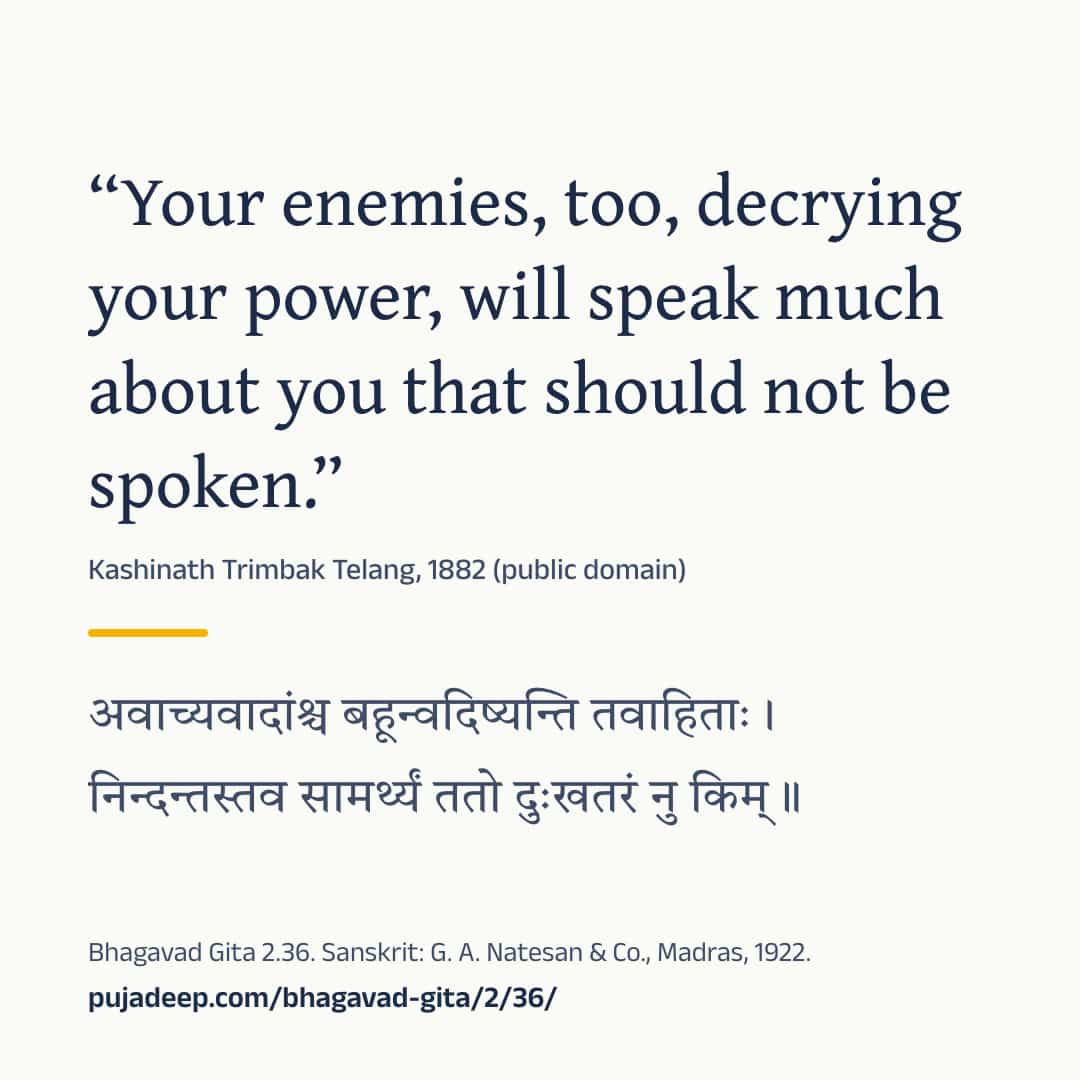
Send as text
The words and the link only. Many elders prefer this.
Bhagavad Gita 2.36

अवाच्यवादांश्च बहून्वदिष्यन्ति तवाहिताः ।
निन्दन्तस्तव सामर्थ्यं ततो दुःखतरं नु किम् ॥

“Your enemies, too, decrying your power, will speak much about you that should not be spoken. And what, indeed, more lamentable than that?”
(Kashinath Trimbak Telang, 1882, public domain)

“Many unseemly words will be spoken by thine enemies, slandering thy strength; what more painful than that?”
(Annie Besant, 1895, public domain)

“Thine enemies also, cavilling at thy great prowess, will say of thee things that are not to be uttered. What could be more intolerable than this?”
(Swami Swarupananda, 1909 (first printed 1907), public domain)

Sanskrit: G. A. Natesan & Co., Madras, 1922.
https://pujadeep.com/bhagavad-gita/2/36/?s=copy Nothing is sent from this site. Your own app sends it, to the chat you choose. The picture quotes Telang (1882). If you chose another translation above, the text quotes yours and no picture is offered.
Sanskrit text: The Bhagavad-Gita, or The Lord's Song, with the text in Devanagari and an English translation, 1922. Meanings: written for Pujadeep with AI help and reviewed. Source and changes
Questions families ask
Who speaks Bhagavad Gita 2.36?
Krishna speaks this verse, in chapter 2 (Sankhya Yoga).
Where does the Sanskrit text come from?
Sanskrit text: The Bhagavad-Gita, or The Lord's Song, with the text in Devanagari and an English translation, 1922. Meanings: written for Pujadeep with AI help and reviewed. See the source
Is the meaning on this page a translation?
Explanation written for this site with AI help from the sources listed here, and reviewed. It is not a translation and not the only way to read the text. Free to quote with credit.
Source and licence
- Sanskrit text
- The Bhagavad-Gita, or The Lord's Song, with the text in Devanagari and an English translation (Annie Besant, G. A. Natesan & Co., Madras, 1922). Public domain. The Sanskrit on these pages was read from this printing’s page images.
- Translation
- The Bhagavadgîtâ with the Sanatsugâtîya and the Anugîtâ, translated by Kâshinâth Trimbak Telang (The Sacred Books of the East, vol. VIII, ed. F. Max Müller) (Kashinath Trimbak Telang, F. Max Müller, Clarendon Press, Oxford, 1882). Public domain. Shown verbatim, as printed.
- Translation
- The Bhagavad Gîtâ, or The Lord's Song, translated by Annie Besant (Annie Besant, Theosophical Publishing Society, London, 1895). Public domain. Shown verbatim, as printed.
- Sanskrit text
- Srimad-Bhagavad-Gita, with Sanskrit Text; Paraphrase with Word-by-word Literal Translation; English Rendering and Comments, Index, &c., by the Swami Swarupananda (Himalayan Series, No. XX) (Swami Swarupananda, The Editors and Publishers, Advaita Ashrama, Mayavati, Prabuddha Bharata Press, Mayavati, Almora, Himalayas, 1909). Public domain. Used only to date the text. The Devanagari on this page is a reading text and is not copied from this printing.
- Common wording
- In this text, 32 words follow today's common wording, checked against sanskritdocuments.org; Sanskrit Wikisource; Gita Press, Gorakhpur; GRETIL, Göttingen and Bhaktivedanta Book Trust.
- Our explanation
- Explanation written for this site with AI help from the sources listed here, and reviewed. It is not a translation and not the only way to read the text. Free to quote with credit.
- Review
- AI review: 2 independent reviews against the cited edition, October 15, 2026.