Bhagavad Gita · Chapter 2: Sankhya Yoga · Speaker: Krishna
Bhagavad Gita 2.37: Hato va prapsyasi svargam
Krishna says that if Arjuna is killed, he gains heaven, and if he wins, he enjoys the earth.
Bhagavad Gita 2.37
हतो वा प्राप्स्यसि स्वर्गं जित्वा वा भोक्ष्यसे महीम् ।तस्मादुत्तिष्ठ कौन्तेय युद्धाय कृतनिश्चयः ॥
Hato va prapsyasi svargam jitva va bhokshyase mahim
Tasmaduttishtha kaunteya yuddhaya kritanishchayah
hato vā prāpsyasi svargaṃ jitvā vā bhokṣyase mahīm |
tasmāduttiṣṭha kaunteya yuddhāya kṛtaniścayaḥ ||
Our meaning Krishna says that if Arjuna is killed, he gains heaven, and if he wins, he enjoys the earth. So he should rise up, determined to fight.
हिंदी अर्थ कृष्ण कहते हैं कि यदि अर्जुन मारे गए तो स्वर्ग पाएँगे, और जीते तो पृथ्वी का राज्य भोगेंगे। इसलिए वे युद्ध का निश्चय करके उठें।
Word by word
Every word, with its dictionary page
Word by word
- हतः hataḥ if killed (past participle (masculine), nominative singular) Dictionary: hata, Monier-Williams 1899, p. 1287, col. 2
smitten, killed, slain
- वा vā either (indeclinable) Dictionary: 1. vā, Monier-Williams 1899, p. 934, col. 2
ind. or
- प्राप्स्यसि prāpsyasi you will reach (future, 2nd person singular) Dictionary: prāp, Monier-Williams 1899, p. 707, col. 2
to attain to, reach, arrive at, meet with, find
- स्वर्गम् svargam heaven (noun (masculine), accusative singular) Dictionary: svarga, Monier-Williams 1899, p. 1281, col. 2
going or leading to or being in light or heaven, heavenly, celestial
- जित्वा jitvā having won (absolutive (having done)) Dictionary: 1. ji, Monier-Williams 1899, p. 420, col. 2
conquer (in battle), vanquish
- वा vā or (indeclinable) Dictionary: 1. vā, Monier-Williams 1899, p. 934, col. 2
ind. or
- भोक्ष्यसे bhokṣyase you will enjoy (future, 2nd person singular) Dictionary: 3. bhuj, Monier-Williams 1899, p. 759, col. 2
to enjoy, use, possess
- महीम् mahīm the earth (noun (feminine), accusative singular) Dictionary: 1. mahī, Monier-Williams 1899, p. 803, col. 2
the earth
- तस्मात् tasmāt therefore (indeclinable) Dictionary: tasmāt, Monier-Williams 1899, p. 441, col. 2
from that, on that account, therefore
- उत्तिष्ठ uttiṣṭha stand up (imperative, 2nd person singular) Dictionary: ut-thā, Monier-Williams 1899, p. 179, col. 3
to stand up, spring up, rise
- कौन्तेय kaunteya O son of Kunti (noun (masculine), vocative singular) Dictionary: kaunteya, Monier-Williams 1899, p. 316, col. 2
metron. fr. Kuntī
- युद्धाय yuddhāya for battle (noun (neuter), dative singular) Dictionary: yuddha, Monier-Williams 1899, p. 854, col. 3
battle, fight, war
- कृतनिश्चयः kṛtaniścayaḥ resolved, decided (compound (masculine), nominative singular) Dictionary: 1. kṛta, Monier-Williams 1899, p. 301, col. 3
done, made, accomplished, performed
; niś-caya, Monier-Williams 1899, p. 561, col. 2inquiry, ascertainment, fixed opinion, conviction, certainty
Public-domain translations
Kashinath Trimbak Telang, 1882. Public domain. Page 47.
Killed, you will obtain heaven; victorious, you will enjoy the earth. Therefore arise, O son of Kuntî! resolved to (engage in) battle.
Compare 3 translations
Kashinath Trimbak Telang, 1882. Public domain. Page 47.
Killed, you will obtain heaven; victorious, you will enjoy the earth. Therefore arise, O son of Kuntî! resolved to (engage in) battle.
You are reading this one
Annie Besant, 1895. Public domain. Page 31.
Slain, thou wilt obtain Svarga; victorious, thou wilt enjoy the earth; therefore stand up, O son of Kunti, resolute to fight.
You are reading this one
Swami Swarupananda, 1909 (first printed 1907). Public domain. Page 43.
Dying thou gainest heaven; conquering thou enjoyest the earth. Therefore, O son of Kunti, arise, resolved to fight.
You are reading this one
Share
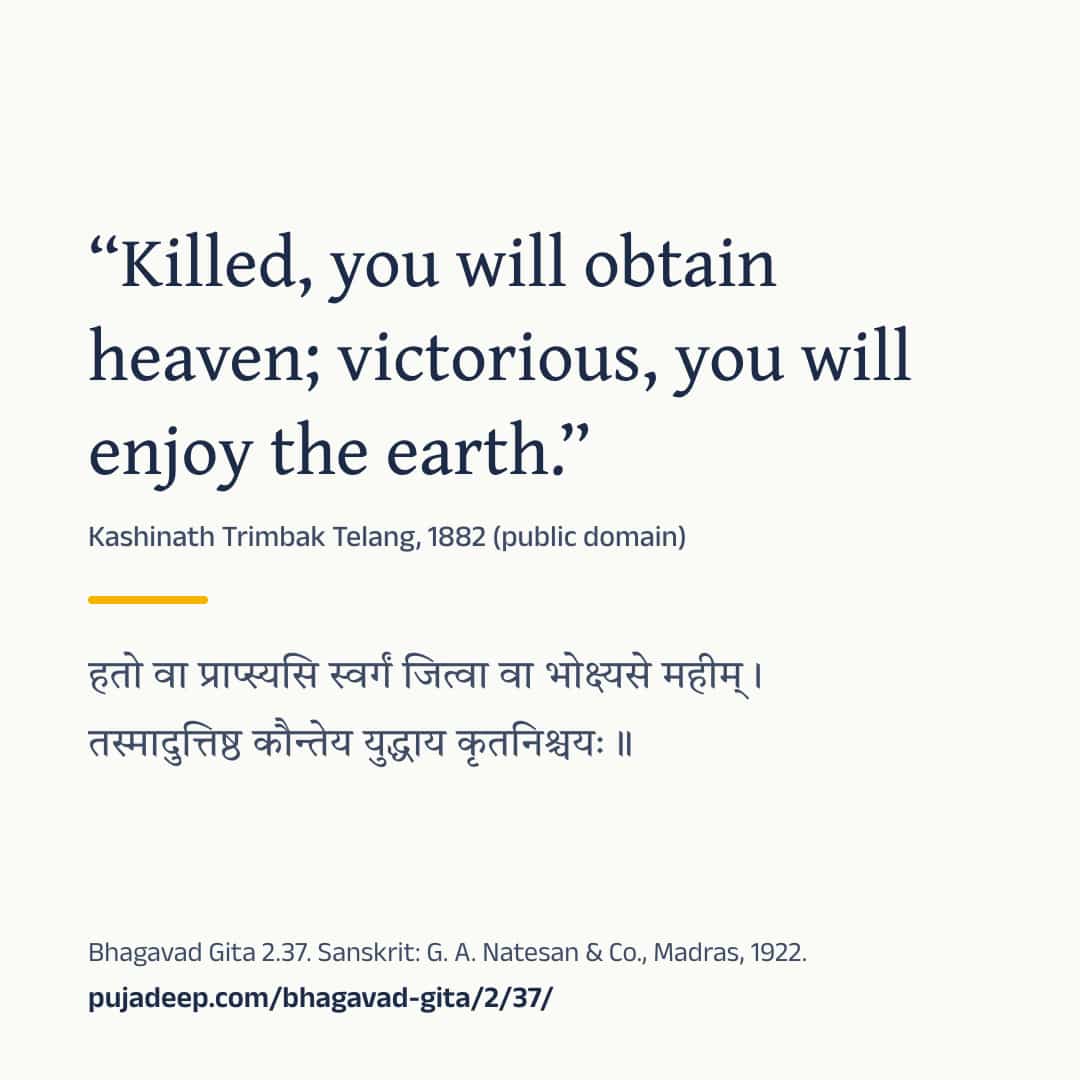
Send one picture or the text to one chat. The picture names its source and the address of this page.
Send as text
The words and the link only. Many elders prefer this.
Bhagavad Gita 2.37

हतो वा प्राप्स्यसि स्वर्गं जित्वा वा भोक्ष्यसे महीम् ।
तस्मादुत्तिष्ठ कौन्तेय युद्धाय कृतनिश्चयः ॥

“Killed, you will obtain heaven; victorious, you will enjoy the earth. Therefore arise, O son of Kuntî! resolved to (engage in) battle.”
(Kashinath Trimbak Telang, 1882, public domain)

“Slain, thou wilt obtain Svarga; victorious, thou wilt enjoy the earth; therefore stand up, O son of Kunti, resolute to fight.”
(Annie Besant, 1895, public domain)

“Dying thou gainest heaven; conquering thou enjoyest the earth. Therefore, O son of Kunti, arise, resolved to fight.”
(Swami Swarupananda, 1909 (first printed 1907), public domain)

Sanskrit: G. A. Natesan & Co., Madras, 1922.
https://pujadeep.com/bhagavad-gita/2/37/?s=copy Nothing is sent from this site. Your own app sends it, to the chat you choose. The picture quotes Telang (1882). If you chose another translation above, the text quotes yours and no picture is offered.
Sanskrit text: The Bhagavad-Gita, or The Lord's Song, with the text in Devanagari and an English translation, 1922. Meanings: written for Pujadeep with AI help and reviewed. Source and changes
Questions families ask
Who speaks Bhagavad Gita 2.37?
Krishna speaks this verse, in chapter 2 (Sankhya Yoga).
Where does the Sanskrit text come from?
Sanskrit text: The Bhagavad-Gita, or The Lord's Song, with the text in Devanagari and an English translation, 1922. Meanings: written for Pujadeep with AI help and reviewed. See the source
Is the meaning on this page a translation?
Explanation written for this site with AI help from the sources listed here, and reviewed. It is not a translation and not the only way to read the text. Free to quote with credit.
Source and licence
- Sanskrit text
- The Bhagavad-Gita, or The Lord's Song, with the text in Devanagari and an English translation (Annie Besant, G. A. Natesan & Co., Madras, 1922). Public domain. The Sanskrit on these pages was read from this printing’s page images.
- Translation
- The Bhagavadgîtâ with the Sanatsugâtîya and the Anugîtâ, translated by Kâshinâth Trimbak Telang (The Sacred Books of the East, vol. VIII, ed. F. Max Müller) (Kashinath Trimbak Telang, F. Max Müller, Clarendon Press, Oxford, 1882). Public domain. Shown verbatim, as printed.
- Translation
- The Bhagavad Gîtâ, or The Lord's Song, translated by Annie Besant (Annie Besant, Theosophical Publishing Society, London, 1895). Public domain. Shown verbatim, as printed.
- Sanskrit text
- Srimad-Bhagavad-Gita, with Sanskrit Text; Paraphrase with Word-by-word Literal Translation; English Rendering and Comments, Index, &c., by the Swami Swarupananda (Himalayan Series, No. XX) (Swami Swarupananda, The Editors and Publishers, Advaita Ashrama, Mayavati, Prabuddha Bharata Press, Mayavati, Almora, Himalayas, 1909). Public domain. Used only to date the text. The Devanagari on this page is a reading text and is not copied from this printing.
- Common wording
- In this text, 32 words follow today's common wording, checked against sanskritdocuments.org; Sanskrit Wikisource; Gita Press, Gorakhpur; GRETIL, Göttingen and Bhaktivedanta Book Trust.
- Our explanation
- Explanation written for this site with AI help from the sources listed here, and reviewed. It is not a translation and not the only way to read the text. Free to quote with credit.
- Review
- AI review: 2 independent reviews against the cited edition, October 15, 2026.