Bhagavad Gita · Chapter 2: Sankhya Yoga · Speaker: Krishna
Bhagavad Gita 2.38: Sukhaduhkhe same kritva
Krishna tells Arjuna to treat pleasure and pain, gain and loss, victory and defeat as the same, and then to fight.
Bhagavad Gita 2.38
सुखदुःखे समे कृत्वा लाभालाभौ जयाजयौ ।ततो युद्धाय युज्यस्व नैवं पापमवाप्स्यसि ॥
Sukhaduhkhe same kritva labhalabhau jayajayau
Tato yuddhaya yujyasva naivam papamavapsyasi
sukhaduḥkhe same kṛtvā lābhālābhau jayājayau |
tato yuddhāya yujyasva naivaṃ pāpamavāpsyasi ||
Our meaning Krishna tells Arjuna to treat pleasure and pain, gain and loss, victory and defeat as the same, and then to fight. Acting in this way, he will not incur sin. This idea of evenness leads into the teaching on yoga that follows.
हिंदी अर्थ कृष्ण कहते हैं कि सुख-दुःख, लाभ-हानि और जीत-हार को समान मानकर अर्जुन युद्ध करें; ऐसा करने से उन्हें पाप नहीं लगेगा। समता का यही विचार आगे के योग-उपदेश की नींव है।
Word by word
Every word, with its dictionary page
Word by word
- सुखदुःखे sukhaduḥkhe pleasure and pain (compound (neuter), accusative dual) Dictionary: sukha, Monier-Williams 1899, p. 1221, col. 1
ease, easiness, comfort, prosperity, pleasure, happiness
; 1. duḥkha, Monier-Williams 1899, p. 483, col. 2uneasiness, pain, sorrow, trouble, difficulty
- समे same as equal (adjective (neuter), accusative dual) Dictionary: 2. sama, Monier-Williams 1899, p. 1152, col. 1
same, equal, similar, like, equivalent
- कृत्वा kṛtvā having made (absolutive (having done)) Dictionary: 1. kṛ, Monier-Williams 1899, p. 301, col. 1
to do, make, perform, accomplish, cause, effect, prepare
- लाभालाभौ lābhālābhau gain and loss (compound (masculine), accusative dual) Dictionary: lābha, Monier-Williams 1899, p. 897, col. 1
obtaining, getting, attaining, acquisition, gain, profit
; a-lābha, Monier-Williams 1899, p. 95, col. 1non-acquirement
- जयाजयौ jayājayau victory and defeat (compound (masculine), accusative dual) Dictionary: jaya, Monier-Williams 1899, p. 412, col. 3
conquest, victory, triumph, winning
; a-jaya, Monier-Williams 1899, p. 10, col. 1non-victory, defeat
- ततः tataḥ then (indeclinable) Dictionary: tatas, Monier-Williams 1899, p. 432, col. 2
thereupon, then, after that
- युद्धाय yuddhāya for battle (noun (neuter), dative singular) Dictionary: yuddha, Monier-Williams 1899, p. 854, col. 3
battle, fight, war
- युज्यस्व yujyasva get ready, engage (imperative (middle), 2nd person singular) Dictionary: 1. yuj, Monier-Williams 1899, p. 853, col. 2
to yoke or join or fasten or harness
- न na not (indeclinable) Dictionary: 2. na, Monier-Williams 1899, p. 523, col. 1
ind. not, no, nor, neither
- एवम् evam thus (indeclinable) Dictionary: evam, Monier-Williams 1899, p. 232, col. 2
thus, in this way, in such a manner
- पापम् pāpam wrong, sin (noun (neuter), accusative singular) Dictionary: pāpa, Monier-Williams 1899, p. 618, col. 2
sin, vice, crime, guilt
- अवाप्स्यसि avāpsyasi you will incur (future, 2nd person singular) Dictionary: avāp, Monier-Williams 1899, p. 107, col. 1
to reach, attain, obtain, gain, get
Public-domain translations
Kashinath Trimbak Telang, 1882. Public domain. Page 47.
Looking alike on pleasure and pain, on gain and loss, on victory and defeat, then prepare for battle, and thus you will not incur sin.
Compare 3 translations
Kashinath Trimbak Telang, 1882. Public domain. Page 47.
Looking alike on pleasure and pain, on gain and loss, on victory and defeat, then prepare for battle, and thus you will not incur sin.
You are reading this one
Annie Besant, 1895. Public domain. Page 31.
Taking as equal pleasure and pain, gain and loss, victory and defeat, gird thee for the battle; thus thou shalt not incur sin.
You are reading this one
Swami Swarupananda, 1909 (first printed 1907). Public domain. Page 44.
Having made pain and pleasure, gain and loss, conquest and defeat, the same, engage thou then in battle. So shalt thou incur no sin.
You are reading this one
Share
Send one picture or the text to one chat. The picture names its source and the address of this page.
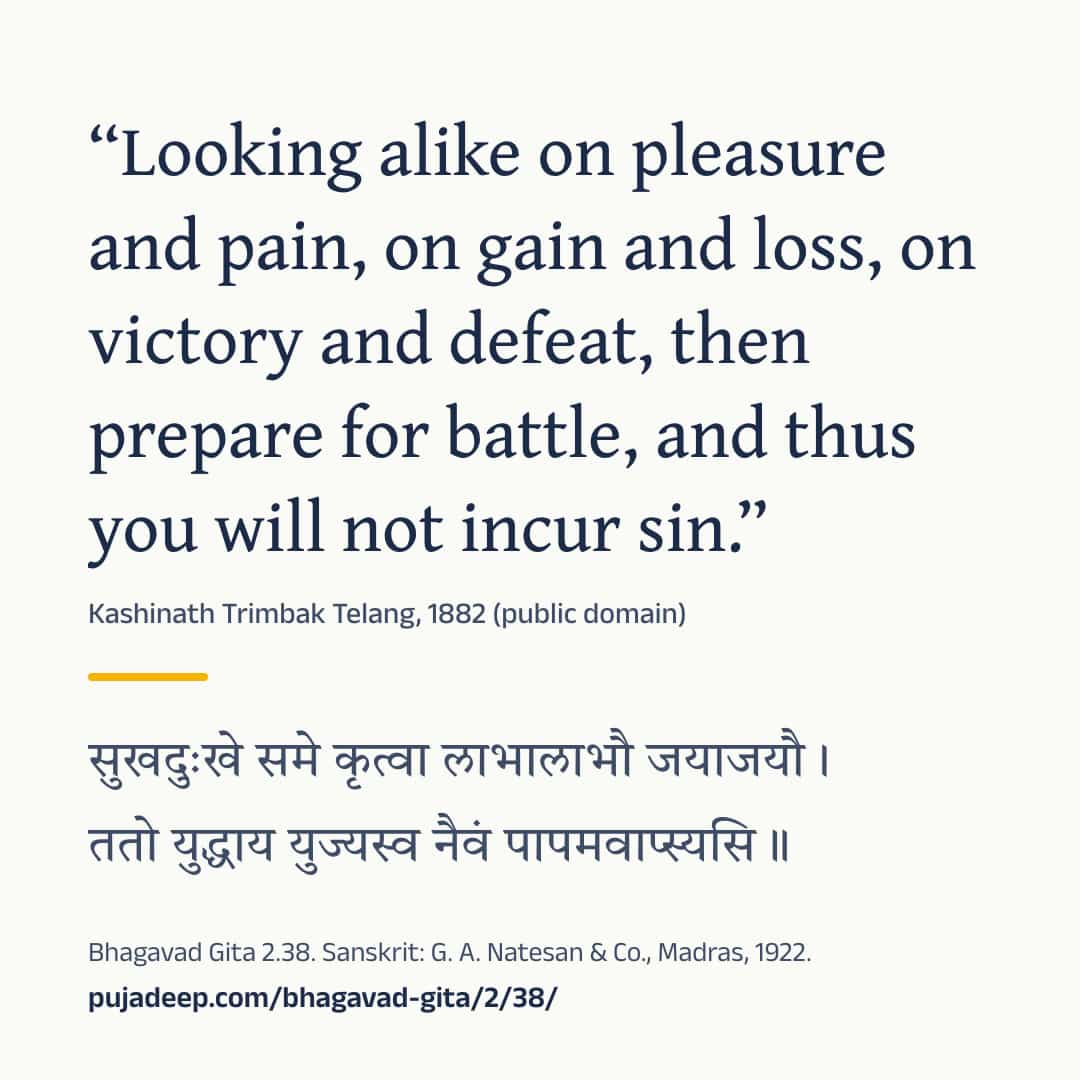
Send as text
The words and the link only. Many elders prefer this.
Bhagavad Gita 2.38

सुखदुःखे समे कृत्वा लाभालाभौ जयाजयौ ।
ततो युद्धाय युज्यस्व नैवं पापमवाप्स्यसि ॥

“Looking alike on pleasure and pain, on gain and loss, on victory and defeat, then prepare for battle, and thus you will not incur sin.”
(Kashinath Trimbak Telang, 1882, public domain)

“Taking as equal pleasure and pain, gain and loss, victory and defeat, gird thee for the battle; thus thou shalt not incur sin.”
(Annie Besant, 1895, public domain)

“Having made pain and pleasure, gain and loss, conquest and defeat, the same, engage thou then in battle. So shalt thou incur no sin.”
(Swami Swarupananda, 1909 (first printed 1907), public domain)

Sanskrit: G. A. Natesan & Co., Madras, 1922.
https://pujadeep.com/bhagavad-gita/2/38/?s=copy Nothing is sent from this site. Your own app sends it, to the chat you choose. The picture quotes Telang (1882). If you chose another translation above, the text quotes yours and no picture is offered.
Sanskrit text: The Bhagavad-Gita, or The Lord's Song, with the text in Devanagari and an English translation, 1922. Meanings: written for Pujadeep with AI help and reviewed. Source and changes
Questions families ask
Who speaks Bhagavad Gita 2.38?
Krishna speaks this verse, in chapter 2 (Sankhya Yoga).
Where does the Sanskrit text come from?
Sanskrit text: The Bhagavad-Gita, or The Lord's Song, with the text in Devanagari and an English translation, 1922. Meanings: written for Pujadeep with AI help and reviewed. See the source
Is the meaning on this page a translation?
Explanation written for this site with AI help from the sources listed here, and reviewed. It is not a translation and not the only way to read the text. Free to quote with credit.
Source and licence
- Sanskrit text
- The Bhagavad-Gita, or The Lord's Song, with the text in Devanagari and an English translation (Annie Besant, G. A. Natesan & Co., Madras, 1922). Public domain. The Sanskrit on these pages was read from this printing’s page images.
- Translation
- The Bhagavadgîtâ with the Sanatsugâtîya and the Anugîtâ, translated by Kâshinâth Trimbak Telang (The Sacred Books of the East, vol. VIII, ed. F. Max Müller) (Kashinath Trimbak Telang, F. Max Müller, Clarendon Press, Oxford, 1882). Public domain. Shown verbatim, as printed.
- Translation
- The Bhagavad Gîtâ, or The Lord's Song, translated by Annie Besant (Annie Besant, Theosophical Publishing Society, London, 1895). Public domain. Shown verbatim, as printed.
- Sanskrit text
- Srimad-Bhagavad-Gita, with Sanskrit Text; Paraphrase with Word-by-word Literal Translation; English Rendering and Comments, Index, &c., by the Swami Swarupananda (Himalayan Series, No. XX) (Swami Swarupananda, The Editors and Publishers, Advaita Ashrama, Mayavati, Prabuddha Bharata Press, Mayavati, Almora, Himalayas, 1909). Public domain. Used only to date the text. The Devanagari on this page is a reading text and is not copied from this printing.
- Common wording
- In this text, 32 words follow today's common wording, checked against sanskritdocuments.org; Sanskrit Wikisource; Gita Press, Gorakhpur; GRETIL, Göttingen and Bhaktivedanta Book Trust.
- Our explanation
- Explanation written for this site with AI help from the sources listed here, and reviewed. It is not a translation and not the only way to read the text. Free to quote with credit.
- Review
- AI review: 2 independent reviews against the cited edition, October 15, 2026.