Bhagavad Gita · Chapter 2: Sankhya Yoga · Speaker: Krishna
Bhagavad Gita 2.39: Esha tebhihita sankhye
Krishna says that so far he has explained this understanding by way of Sankhya (knowledge of the self).
Bhagavad Gita 2.39
एषा तेऽभिहिता साङ्ख्ये बुद्धिर्योगे त्विमां शृणु ।बुद्ध्या युक्तो यया पार्थ कर्मबन्धं प्रहास्यसि ॥
Esha tebhihita sankhye buddhiryoge tvimam shrinu
Buddhya yukto yaya partha karmabandham prahasyasi
eṣā te’bhihitā sāṅkhye buddhiryoge tvimāṃ śṛṇu |
buddhyā yukto yayā pārtha karmabandhaṃ prahāsyasi ||
Our meaning Krishna says that so far he has explained this understanding by way of Sankhya (knowledge of the self). Now he will explain it by way of Yoga (the discipline of action). With this understanding, Arjuna will break free of the bondage that action brings. The commentators explain the words Sankhya and Yoga here in different ways.
हिंदी अर्थ कृष्ण कहते हैं कि अब तक उन्होंने यह बुद्धि सांख्य (आत्मा के ज्ञान) की दृष्टि से बताई है; अब वे इसे योग (कर्म के अनुशासन) की दृष्टि से बताएँगे। इस बुद्धि से युक्त होकर अर्जुन कर्म के बंधन से छूट जाएँगे। टीकाकार यहाँ सांख्य और योग शब्दों को अलग-अलग ढंग से समझाते हैं।
Word by word
Every word, with its dictionary page
Word by word
- एषा eṣā this (pronoun (feminine), nominative singular) Dictionary: etad, Monier-Williams 1899, p. 231, col. 2
this, this here, here
- ते te to you (pronoun, dative singular) Dictionary: 2. tva, Monier-Williams 1899, p. 463, col. 2
base of the 2nd personal pron.
- अभिहिता abhihitā has been told (past participle (feminine), nominative singular) Dictionary: abhi-hita, Monier-Williams 1899, p. 74, col. 1
held forth, said, declared, spoken
- साङ्ख्ये sāṅkhye in Sankhya (knowledge) (noun (neuter), locative singular) Dictionary: sāṃkhya, Monier-Williams 1899, p. 1199, col. 1
rational, discriminative
- बुद्धिः buddhiḥ understanding (noun (feminine), nominative singular) Dictionary: buddhi, Monier-Williams 1899, p. 733, col. 3
intelligence, reason, intellect, mind, discernment, judgment
- योगे yoge in yoga (noun (masculine), locative singular) Dictionary: yoga, Monier-Williams 1899, p. 856, col. 2
the act of yoking, joining, attaching
- तु tu but, now (indeclinable) Dictionary: 2. tu, Monier-Williams 1899, p. 449, col. 3
but
- इमाम् imām this (pronoun (feminine), accusative singular) Dictionary: 1. idam, Monier-Williams 1899, p. 165, col. 2
- शृणु śṛṇu hear (imperative, 2nd person singular) Dictionary: 1. śru, Monier-Williams 1899, p. 1100, col. 3
- बुद्ध्या buddhyā with the understanding (noun (feminine), instrumental singular) Dictionary: buddhi, Monier-Williams 1899, p. 733, col. 3
intelligence, reason, intellect, mind, discernment, judgment
- युक्तः yuktaḥ joined, endowed (past participle (masculine), nominative singular) Dictionary: yukta, Monier-Williams 1899, p. 853, col. 2
yoked or joined or fastened or attached or harnessed
- यया yayā with which (pronoun (feminine), instrumental singular) Dictionary: yad, Monier-Williams 1899, p. 844, col. 2
who, which, what, whichever, whatever, that
- पार्थ pārtha O Partha (noun (masculine), vocative singular) Dictionary: 2. pārtha, Monier-Williams 1899, p. 621, col. 3
- कर्मबन्धम् karmabandham the bond of action (compound (masculine), accusative singular) Dictionary: karma-bandha, Monier-Williams 1899, p. 259, col. 1
the bonds of action
- प्रहास्यसि prahāsyasi you will cast off (future, 2nd person singular) Dictionary: pra-hā, Monier-Williams 1899, p. 700, col. 3
Public-domain translations
Kashinath Trimbak Telang, 1882. Public domain. Page 47.
The knowledge here declared to you is that relating to the Sâṅkhya1. Now hear that relating to the Yoga. Possessed of this knowledge, O son of Prithâ! you will cast off the bonds of action.
Footnotes (the translator’s own) - Sâṅkhya is explained in different modes by the different commentators, but the resulting meaning here seems to be, that the doctrine stated is the doctrine of true knowledge and emancipation by its means. See infra, p. 52. ↩
Compare 3 translations
Kashinath Trimbak Telang, 1882. Public domain. Page 47.
The knowledge here declared to you is that relating to the Sâṅkhya1. Now hear that relating to the Yoga. Possessed of this knowledge, O son of Prithâ! you will cast off the bonds of action.
Footnotes (the translator’s own) - Sâṅkhya is explained in different modes by the different commentators, but the resulting meaning here seems to be, that the doctrine stated is the doctrine of true knowledge and emancipation by its means. See infra, p. 52. ↩
You are reading this one
Annie Besant, 1895. Public domain. Page 31.
This teaching set forth to thee is in accordance with the Sânkhya; hear it now according to Yoga, imbued with which teaching, O Pârtha, thou shalt cast away the bonds of action.
You are reading this one
Swami Swarupananda, 1909 (first printed 1907). Public domain. Page 44.
The wisdom of Self-realisation has been declared unto thee. Hearken thou now to Yoga, following which, O son of Prithâ, thou shalt break through the bonds of Karma.
You are reading this one
Share
Send one picture or the text to one chat. The picture names its source and the address of this page.
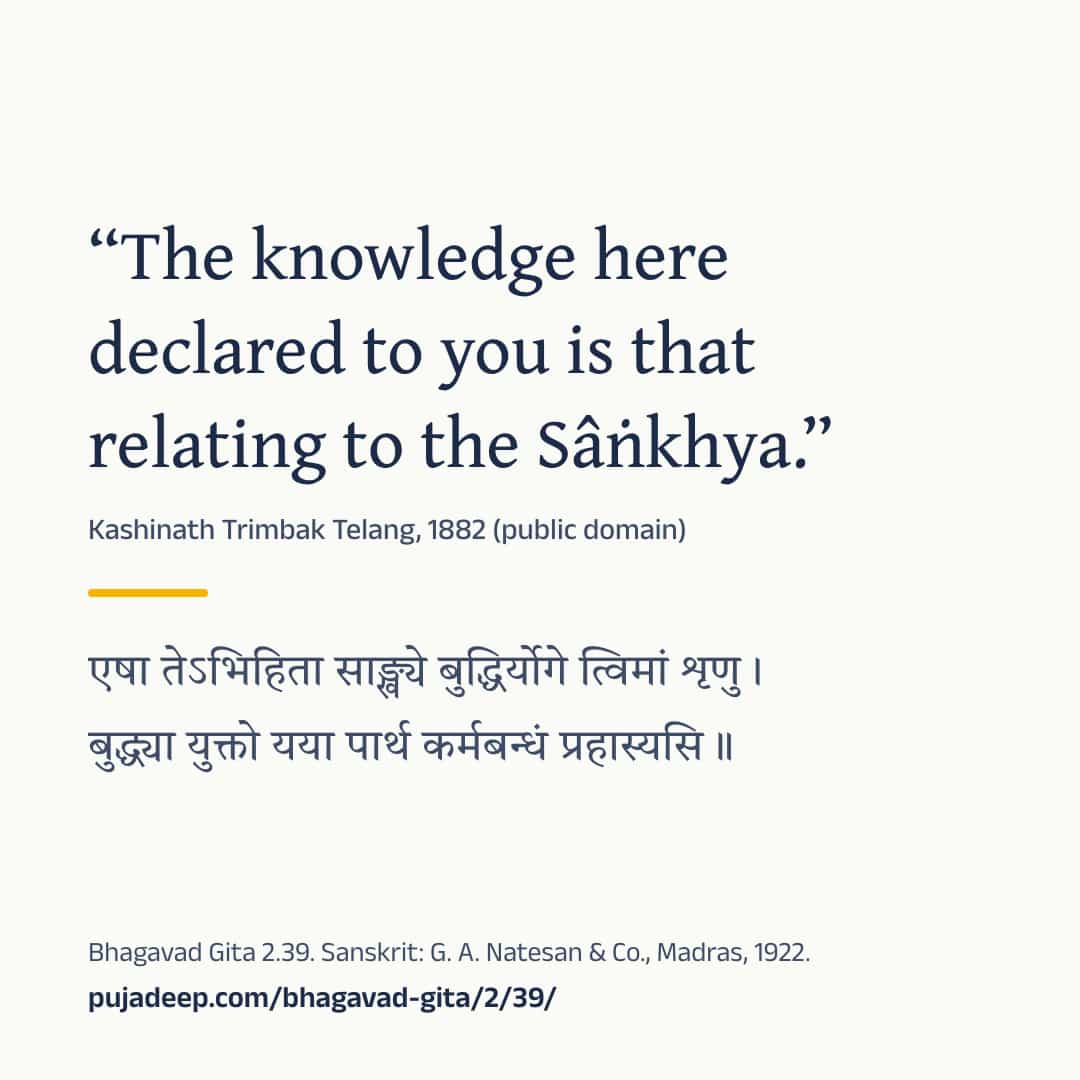
Send as text
The words and the link only. Many elders prefer this.
Bhagavad Gita 2.39

एषा तेऽभिहिता साङ्ख्ये बुद्धिर्योगे त्विमां शृणु ।
बुद्ध्या युक्तो यया पार्थ कर्मबन्धं प्रहास्यसि ॥

“The knowledge here declared to you is that relating to the Sâṅkhya. Now hear that relating to the Yoga. Possessed of this knowledge, O son of Prithâ! you will cast off the bonds of action.”
(Kashinath Trimbak Telang, 1882, public domain)

“This teaching set forth to thee is in accordance with the Sânkhya; hear it now according to Yoga, imbued with which teaching, O Pârtha, thou shalt cast away the bonds of action.”
(Annie Besant, 1895, public domain)

“The wisdom of Self-realisation has been declared unto thee. Hearken thou now to Yoga, following which, O son of Prithâ, thou shalt break through the bonds of Karma.”
(Swami Swarupananda, 1909 (first printed 1907), public domain)

Sanskrit: G. A. Natesan & Co., Madras, 1922.
https://pujadeep.com/bhagavad-gita/2/39/?s=copy Nothing is sent from this site. Your own app sends it, to the chat you choose. The picture quotes Telang (1882). If you chose another translation above, the text quotes yours and no picture is offered.
Sanskrit text: The Bhagavad-Gita, or The Lord's Song, with the text in Devanagari and an English translation, 1922. Meanings: written for Pujadeep with AI help and reviewed. Source and changes
Questions families ask
Who speaks Bhagavad Gita 2.39?
Krishna speaks this verse, in chapter 2 (Sankhya Yoga).
Where does the Sanskrit text come from?
Sanskrit text: The Bhagavad-Gita, or The Lord's Song, with the text in Devanagari and an English translation, 1922. Meanings: written for Pujadeep with AI help and reviewed. See the source
Is the meaning on this page a translation?
Explanation written for this site with AI help from the sources listed here, and reviewed. It is not a translation and not the only way to read the text. Free to quote with credit.
Source and licence
- Sanskrit text
- The Bhagavad-Gita, or The Lord's Song, with the text in Devanagari and an English translation (Annie Besant, G. A. Natesan & Co., Madras, 1922). Public domain. The Sanskrit on these pages was read from this printing’s page images.
- Translation
- The Bhagavadgîtâ with the Sanatsugâtîya and the Anugîtâ, translated by Kâshinâth Trimbak Telang (The Sacred Books of the East, vol. VIII, ed. F. Max Müller) (Kashinath Trimbak Telang, F. Max Müller, Clarendon Press, Oxford, 1882). Public domain. Shown verbatim, as printed.
- Translation
- The Bhagavad Gîtâ, or The Lord's Song, translated by Annie Besant (Annie Besant, Theosophical Publishing Society, London, 1895). Public domain. Shown verbatim, as printed.
- Sanskrit text
- Srimad-Bhagavad-Gita, with Sanskrit Text; Paraphrase with Word-by-word Literal Translation; English Rendering and Comments, Index, &c., by the Swami Swarupananda (Himalayan Series, No. XX) (Swami Swarupananda, The Editors and Publishers, Advaita Ashrama, Mayavati, Prabuddha Bharata Press, Mayavati, Almora, Himalayas, 1909). Public domain. Used only to date the text. The Devanagari on this page is a reading text and is not copied from this printing.
- Common wording
- In this text, 32 words follow today's common wording, checked against sanskritdocuments.org; Sanskrit Wikisource; Gita Press, Gorakhpur; GRETIL, Göttingen and Bhaktivedanta Book Trust.
- Our explanation
- Explanation written for this site with AI help from the sources listed here, and reviewed. It is not a translation and not the only way to read the text. Free to quote with credit.
- Review
- AI review: 2 independent reviews against the cited edition, October 15, 2026.