Bhagavad Gita · Chapter 2: Sankhya Yoga · Speaker: Krishna
Bhagavad Gita 2.40: Nehabhikramanashosti
Krishna says that on this path no effort is wasted and no harm results.
Bhagavad Gita 2.40
नेहाभिक्रमनाशोऽस्ति प्रत्यवायो न विद्यते ।स्वल्पमप्यस्य धर्मस्य त्रायते महतो भयात् ॥
Nehabhikramanashosti pratyavayo na vidyate
Svalpamapyasya dharmasya trayate mahato bhayat
nehābhikramanāśo’sti pratyavāyo na vidyate |
svalpamapyasya dharmasya trāyate mahato bhayāt ||
Our meaning Krishna says that on this path no effort is wasted and no harm results. Even a little of this practice protects a person from great fear.
हिंदी अर्थ कृष्ण कहते हैं कि इस मार्ग में किया गया आरंभ कभी नष्ट नहीं होता और इसका उलटा फल भी नहीं होता। इस धर्म का थोड़ा-सा पालन भी बड़े भय से बचाता है।
Word by word
Every word, with its dictionary page
Word by word
- न na not (indeclinable) Dictionary: 2. na, Monier-Williams 1899, p. 523, col. 1
ind. not, no, nor, neither
- इह iha here (indeclinable) Dictionary: iha, Monier-Williams 1899, p. 169, col. 3
in this place, here
- अभिक्रमनाशः abhikramanāśaḥ loss of an effort begun (compound (masculine), nominative singular) Dictionary: abhi-krama, Monier-Williams 1899, p. 61, col. 2
undertaking, attempt, beginning
; 2. nāśa, Monier-Williams 1899, p. 538, col. 1the being lost, loss, disappearance, destruction, annihilation, ruin
- अस्ति asti is (present, 3rd person singular) Dictionary: 1. as, Monier-Williams 1899, p. 117, col. 2
to be, live, exist, be present
- प्रत्यवायः pratyavāyaḥ contrary result, harm (noun (masculine), nominative singular) Dictionary: praty-avāya, Monier-Williams 1899, p. 676, col. 2
decrease, diminution
- न na not (indeclinable) Dictionary: 2. na, Monier-Williams 1899, p. 523, col. 1
ind. not, no, nor, neither
- विद्यते vidyate is found, exists (present passive, 3rd person singular) Dictionary: 1. vid, Monier-Williams 1899, p. 963, col. 2
to know, understand, perceive, learn
- स्वल्पम् svalpam a little (adjective (neuter), nominative singular) Dictionary: sv-alpa, Monier-Williams 1899, p. 1282, col. 2
very small or little
- अपि api even (indeclinable) Dictionary: api, Monier-Williams 1899, p. 55, col. 1
in the sense of even, also, very
- अस्य asya of this (pronoun (masculine), genitive singular) Dictionary: 1. idam, Monier-Williams 1899, p. 165, col. 2
- धर्मस्य dharmasya of this practice (dharma) (noun (masculine), genitive singular) Dictionary: 1. dharma, Monier-Williams 1899, p. 510, col. 3
usage, practice, customary observance or prescribed conduct, duty
- त्रायते trāyate protects (present, 3rd person singular) Dictionary: trai, Monier-Williams 1899, p. 462, col. 1
to protect, preserve, cherish, defend, rescue from
- महतः mahataḥ from great (adjective (neuter), ablative singular) Dictionary: mahat, Monier-Williams 1899, p. 794, col. 2
great (in space, time, quantity or degree)
- भयात् bhayāt from fear (noun (neuter), ablative singular) Dictionary: bhaya, Monier-Williams 1899, p. 747, col. 1
fear, alarm, dread, apprehension
Public-domain translations
Kashinath Trimbak Telang, 1882. Public domain. Page 47.
In this (path to final emancipation) nothing that is commenced becomes abortive; no obstacles exist; and even a little of this (form of) piety protects one from great danger1.
Footnotes (the translator’s own) - Viz. this mortal mundane life. ↩
Compare 3 translations
Kashinath Trimbak Telang, 1882. Public domain. Page 47.
In this (path to final emancipation) nothing that is commenced becomes abortive; no obstacles exist; and even a little of this (form of) piety protects one from great danger1.
Footnotes (the translator’s own) - Viz. this mortal mundane life. ↩
You are reading this one
Annie Besant, 1895. Public domain. Page 32.
In this there is no loss of effort, nor is there disappointment. Even a little of this Dharma frees one from great fear.
You are reading this one
Swami Swarupananda, 1909 (first printed 1907). Public domain. Page 45.
In this, there is no waste of the unfinished attempt, nor is there production of contrary results. Even very little of this Dharma protects from the great terror.
You are reading this one
Share
Send one picture or the text to one chat. The picture names its source and the address of this page.
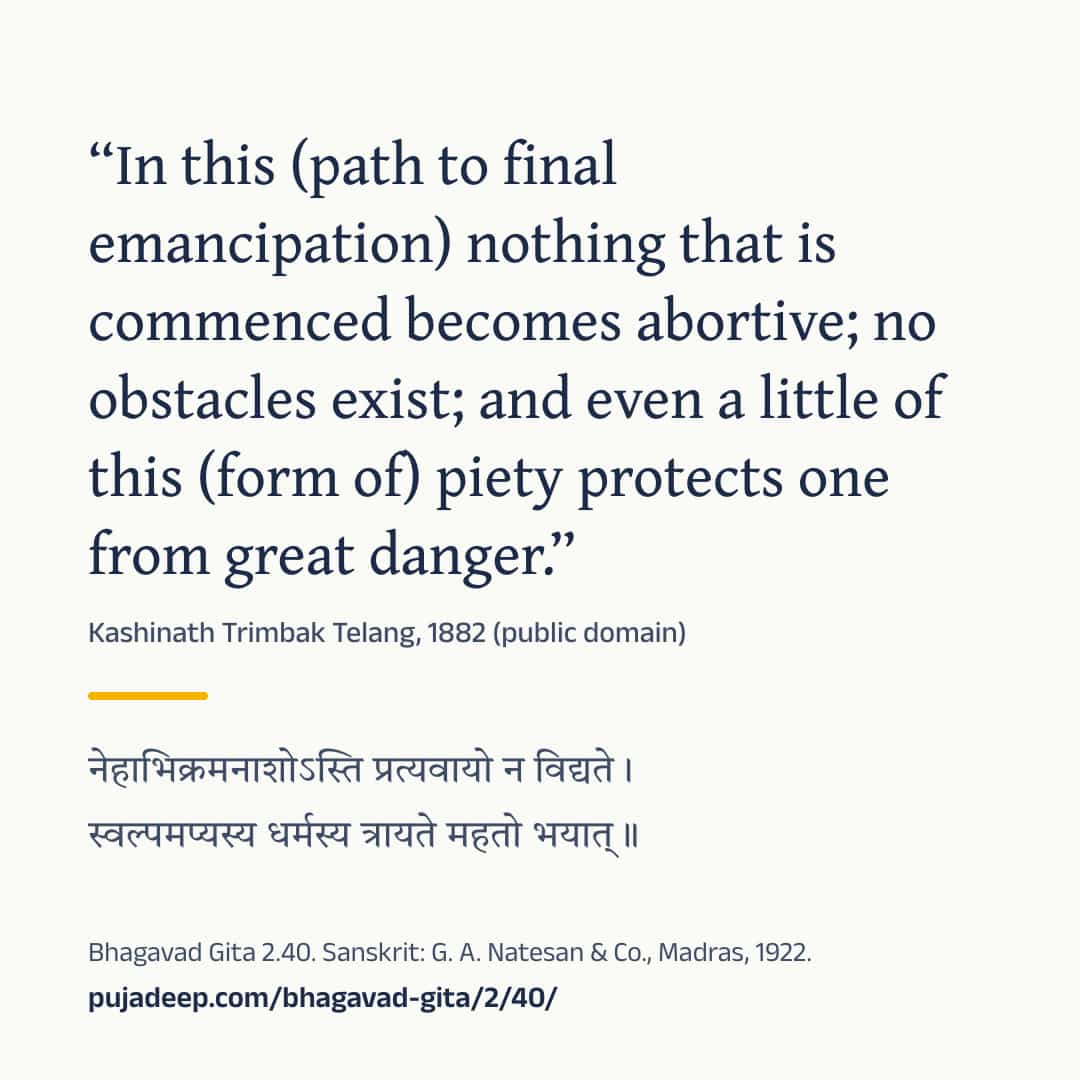
Send as text
The words and the link only. Many elders prefer this.
Bhagavad Gita 2.40

नेहाभिक्रमनाशोऽस्ति प्रत्यवायो न विद्यते ।
स्वल्पमप्यस्य धर्मस्य त्रायते महतो भयात् ॥

“In this (path to final emancipation) nothing that is commenced becomes abortive; no obstacles exist; and even a little of this (form of) piety protects one from great danger.”
(Kashinath Trimbak Telang, 1882, public domain)

“In this there is no loss of effort, nor is there disappointment. Even a little of this Dharma frees one from great fear.”
(Annie Besant, 1895, public domain)

“In this, there is no waste of the unfinished attempt, nor is there production of contrary results. Even very little of this Dharma protects from the great terror.”
(Swami Swarupananda, 1909 (first printed 1907), public domain)

Sanskrit: G. A. Natesan & Co., Madras, 1922.
https://pujadeep.com/bhagavad-gita/2/40/?s=copy Nothing is sent from this site. Your own app sends it, to the chat you choose. The picture quotes Telang (1882). If you chose another translation above, the text quotes yours and no picture is offered.
Sanskrit text: The Bhagavad-Gita, or The Lord's Song, with the text in Devanagari and an English translation, 1922. Meanings: written for Pujadeep with AI help and reviewed. Source and changes
Questions families ask
Who speaks Bhagavad Gita 2.40?
Krishna speaks this verse, in chapter 2 (Sankhya Yoga).
Where does the Sanskrit text come from?
Sanskrit text: The Bhagavad-Gita, or The Lord's Song, with the text in Devanagari and an English translation, 1922. Meanings: written for Pujadeep with AI help and reviewed. See the source
Is the meaning on this page a translation?
Explanation written for this site with AI help from the sources listed here, and reviewed. It is not a translation and not the only way to read the text. Free to quote with credit.
Source and licence
- Sanskrit text
- The Bhagavad-Gita, or The Lord's Song, with the text in Devanagari and an English translation (Annie Besant, G. A. Natesan & Co., Madras, 1922). Public domain. The Sanskrit on these pages was read from this printing’s page images.
- Translation
- The Bhagavadgîtâ with the Sanatsugâtîya and the Anugîtâ, translated by Kâshinâth Trimbak Telang (The Sacred Books of the East, vol. VIII, ed. F. Max Müller) (Kashinath Trimbak Telang, F. Max Müller, Clarendon Press, Oxford, 1882). Public domain. Shown verbatim, as printed.
- Translation
- The Bhagavad Gîtâ, or The Lord's Song, translated by Annie Besant (Annie Besant, Theosophical Publishing Society, London, 1895). Public domain. Shown verbatim, as printed.
- Sanskrit text
- Srimad-Bhagavad-Gita, with Sanskrit Text; Paraphrase with Word-by-word Literal Translation; English Rendering and Comments, Index, &c., by the Swami Swarupananda (Himalayan Series, No. XX) (Swami Swarupananda, The Editors and Publishers, Advaita Ashrama, Mayavati, Prabuddha Bharata Press, Mayavati, Almora, Himalayas, 1909). Public domain. Used only to date the text. The Devanagari on this page is a reading text and is not copied from this printing.
- Common wording
- In this text, 32 words follow today's common wording, checked against sanskritdocuments.org; Sanskrit Wikisource; Gita Press, Gorakhpur; GRETIL, Göttingen and Bhaktivedanta Book Trust.
- Our explanation
- Explanation written for this site with AI help from the sources listed here, and reviewed. It is not a translation and not the only way to read the text. Free to quote with credit.
- Review
- AI review: 2 independent reviews against the cited edition, October 15, 2026.