Bhagavad Gita · Chapter 2: Sankhya Yoga · Speaker: Krishna
Bhagavad Gita 2.55: Prajahati yada
Krishna answers.
Bhagavad Gita 2.55
श्रीभगवानुवाच ।
प्रजहाति यदा कामान्सर्वान्पार्थ मनोगतान् ।आत्मन्येवात्मना तुष्टः स्थितप्रज्ञस्तदोच्यते ॥
Prajahati yada kamansarvanpartha manogatan
Atmanyevatmana tushtah sthitaprajnastadochyate
prajahāti yadā kāmānsarvānpārtha manogatān |
ātmanyevātmanā tuṣṭaḥ sthitaprajñastadocyate ||
Our meaning Krishna answers. When a person gives up all the desires that arise in the mind, and is content in the self, by the self, that person is called one of steady wisdom. The verses up to the end of the chapter describe such a person.
हिंदी अर्थ कृष्ण उत्तर देते हैं कि जब व्यक्ति मन में उठने वाली सब कामनाओं को छोड़ देता है और आत्मा से आत्मा में ही संतुष्ट रहता है, तब वह स्थितप्रज्ञ कहलाता है। अध्याय के अंत तक के श्लोक ऐसे ही व्यक्ति का वर्णन करते हैं।
Word by word
Every word, with its dictionary page
Word by word
- प्रजहाति prajahāti gives up fully (present, 3rd person singular) Dictionary: pra-hā, Monier-Williams 1899, p. 700, col. 3
- यदा yadā when (indeclinable) Dictionary: yadā, Monier-Williams 1899, p. 844, col. 1
when, at what time, whenever
- कामान् kāmān desires (noun (masculine), accusative plural) Dictionary: kāma, Monier-Williams 1899, p. 271, col. 3
wish, desire, longing
- सर्वान् sarvān all (pronoun (masculine), accusative plural) Dictionary: sarva, Monier-Williams 1899, p. 1184, col. 3
whole, entire, all, every
- पार्थ pārtha O Partha (noun (masculine), vocative singular) Dictionary: 2. pārtha, Monier-Williams 1899, p. 621, col. 3
- मनोगतान् manogatān that are in the mind (compound (masculine), accusative plural) Dictionary: mano-gata, Monier-Williams 1899, p. 785, col. 1
existing or passing or concealed in the mind or heart
- आत्मनि ātmani in the Self (noun (masculine), locative singular) Dictionary: ātman, Monier-Williams 1899, p. 135, col. 1
the individual soul, self
- एव eva only (indeclinable) Dictionary: 1. eva, Monier-Williams 1899, p. 232, col. 2
just, exactly, very, same, only, even, alone, merely
- आत्मना ātmanā by the Self (noun (masculine), instrumental singular) Dictionary: ātman, Monier-Williams 1899, p. 135, col. 1
the individual soul, self
- तुष्टः tuṣṭaḥ content (past participle (masculine), nominative singular) Dictionary: tuṣṭa, Monier-Williams 1899, p. 452, col. 1
satisfied, pleased
- स्थितप्रज्ञः sthitaprajñaḥ steady in wisdom (compound (masculine), nominative singular) Dictionary: sthita-prajña, Monier-Williams 1899, p. 1264, col. 2
firm in judgment and wisdom, calm, contented
- तदा tadā then (indeclinable) Dictionary: tadā, Monier-Williams 1899, p. 434, col. 3
at that time, then, in that case
- उच्यते ucyate is called (present passive, 3rd person singular) Dictionary: vac, Monier-Williams 1899, p. 912, col. 1
to speak, say, tell, utter, announce
Public-domain translations
Kashinath Trimbak Telang, 1882. Public domain. Page 49–50.
The Deity said:
When a man, O son of Prithâ! abandons all the desires of his heart, and is pleased in his self only and by his self1, he is then called one of steady mind.
Footnotes (the translator’s own) - I. e. pleased, without regard to external objects, by self-contemplation alone. ↩
Compare 3 translations
Kashinath Trimbak Telang, 1882. Public domain. Page 49–50.
The Deity said:
When a man, O son of Prithâ! abandons all the desires of his heart, and is pleased in his self only and by his self1, he is then called one of steady mind.
Footnotes (the translator’s own) - I. e. pleased, without regard to external objects, by self-contemplation alone. ↩
You are reading this one
Annie Besant, 1895. Public domain. Page 35.
The Blessed Lord said:
When a man abandoneth, O Pârtha! all the desires of the heart, and is satisfied in the SELF by the SELF, then is he called stable in mind.
You are reading this one
Swami Swarupananda, 1909 (first printed 1907). Public domain. Page 54.
The Blessed Lord said:
When a man, completely casts away, O Partha! all the desires of the mind, satisfied in the Self alone by the Self, then, is he said to be one of steady wisdom.
You are reading this one
Share
Send one picture or the text to one chat. The picture names its source and the address of this page.
Send as text
The words and the link only. Many elders prefer this.
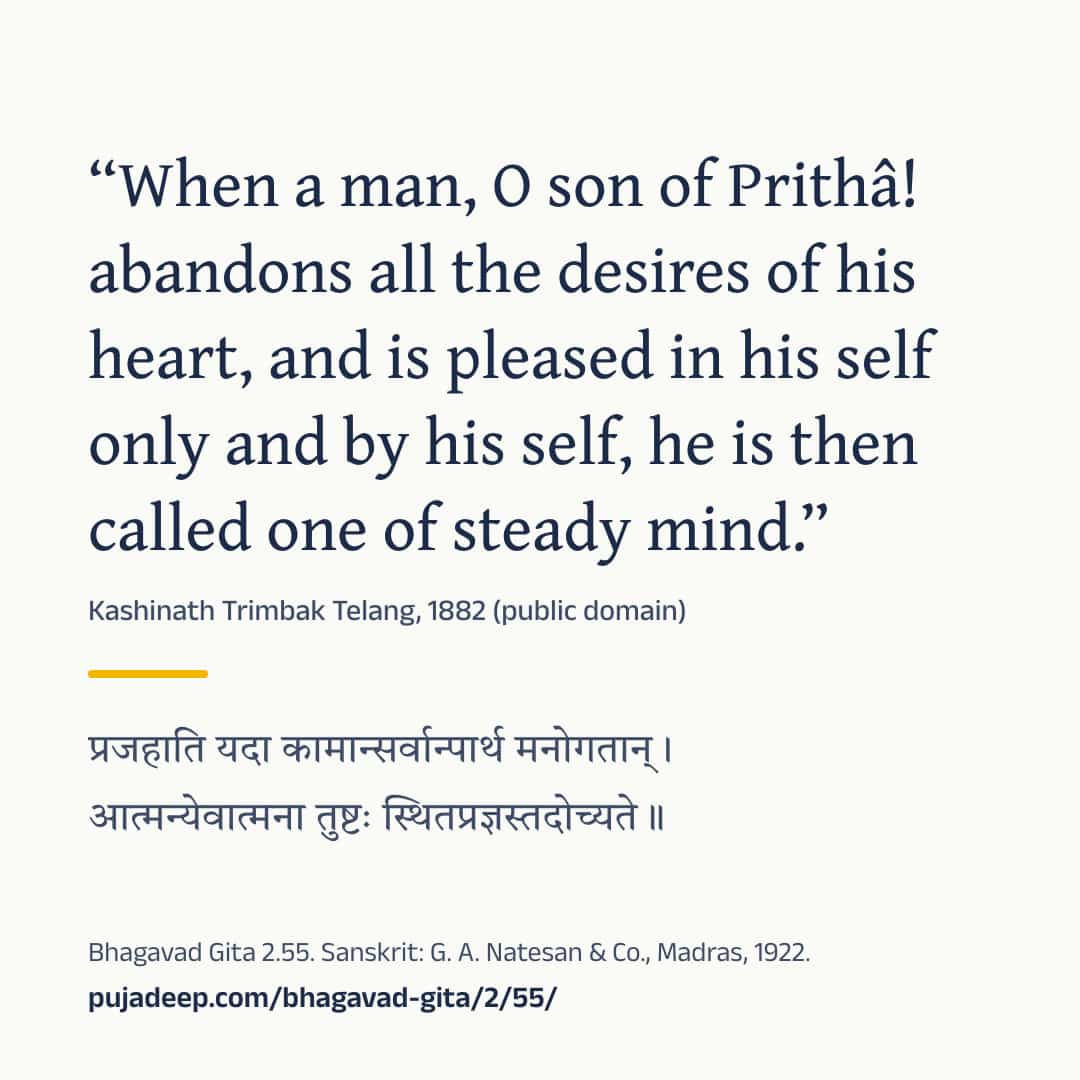
Bhagavad Gita 2.55

प्रजहाति यदा कामान्सर्वान्पार्थ मनोगतान् ।
आत्मन्येवात्मना तुष्टः स्थितप्रज्ञस्तदोच्यते ॥

“When a man, O son of Prithâ! abandons all the desires of his heart, and is pleased in his self only and by his self, he is then called one of steady mind.”
(Kashinath Trimbak Telang, 1882, public domain)

“When a man abandoneth, O Pârtha! all the desires of the heart, and is satisfied in the SELF by the SELF, then is he called stable in mind.”
(Annie Besant, 1895, public domain)

“When a man, completely casts away, O Partha! all the desires of the mind, satisfied in the Self alone by the Self, then, is he said to be one of steady wisdom.”
(Swami Swarupananda, 1909 (first printed 1907), public domain)

Sanskrit: G. A. Natesan & Co., Madras, 1922.
https://pujadeep.com/bhagavad-gita/2/55/?s=copy Nothing is sent from this site. Your own app sends it, to the chat you choose. The picture quotes Telang (1882). If you chose another translation above, the text quotes yours and no picture is offered.
Sanskrit text: The Bhagavad-Gita, or The Lord's Song, with the text in Devanagari and an English translation, 1922. Meanings: written for Pujadeep with AI help and reviewed. Source and changes
Questions families ask
Who speaks Bhagavad Gita 2.55?
Krishna speaks this verse, in chapter 2 (Sankhya Yoga).
Where does the Sanskrit text come from?
Sanskrit text: The Bhagavad-Gita, or The Lord's Song, with the text in Devanagari and an English translation, 1922. Meanings: written for Pujadeep with AI help and reviewed. See the source
Is the meaning on this page a translation?
Explanation written for this site with AI help from the sources listed here, and reviewed. It is not a translation and not the only way to read the text. Free to quote with credit.
Source and licence
- Sanskrit text
- The Bhagavad-Gita, or The Lord's Song, with the text in Devanagari and an English translation (Annie Besant, G. A. Natesan & Co., Madras, 1922). Public domain. The Sanskrit on these pages was read from this printing’s page images.
- Translation
- The Bhagavadgîtâ with the Sanatsugâtîya and the Anugîtâ, translated by Kâshinâth Trimbak Telang (The Sacred Books of the East, vol. VIII, ed. F. Max Müller) (Kashinath Trimbak Telang, F. Max Müller, Clarendon Press, Oxford, 1882). Public domain. Shown verbatim, as printed.
- Translation
- The Bhagavad Gîtâ, or The Lord's Song, translated by Annie Besant (Annie Besant, Theosophical Publishing Society, London, 1895). Public domain. Shown verbatim, as printed.
- Sanskrit text
- Srimad-Bhagavad-Gita, with Sanskrit Text; Paraphrase with Word-by-word Literal Translation; English Rendering and Comments, Index, &c., by the Swami Swarupananda (Himalayan Series, No. XX) (Swami Swarupananda, The Editors and Publishers, Advaita Ashrama, Mayavati, Prabuddha Bharata Press, Mayavati, Almora, Himalayas, 1909). Public domain. Used only to date the text. The Devanagari on this page is a reading text and is not copied from this printing.
- Common wording
- In this text, 32 words follow today's common wording, checked against sanskritdocuments.org; Sanskrit Wikisource; Gita Press, Gorakhpur; GRETIL, Göttingen and Bhaktivedanta Book Trust.
- Our explanation
- Explanation written for this site with AI help from the sources listed here, and reviewed. It is not a translation and not the only way to read the text. Free to quote with credit.
- Review
- AI review: 2 independent reviews against the cited edition, October 15, 2026.