Bhagavad Gita · Chapter 2: Sankhya Yoga · Speaker: Krishna
Bhagavad Gita 2.56: Duhkheshvanudvignamanah
Krishna says that the sage of steady mind is not shaken by sorrow and does not crave pleasure, and that attachment, fear and anger have left such a person.
Bhagavad Gita 2.56
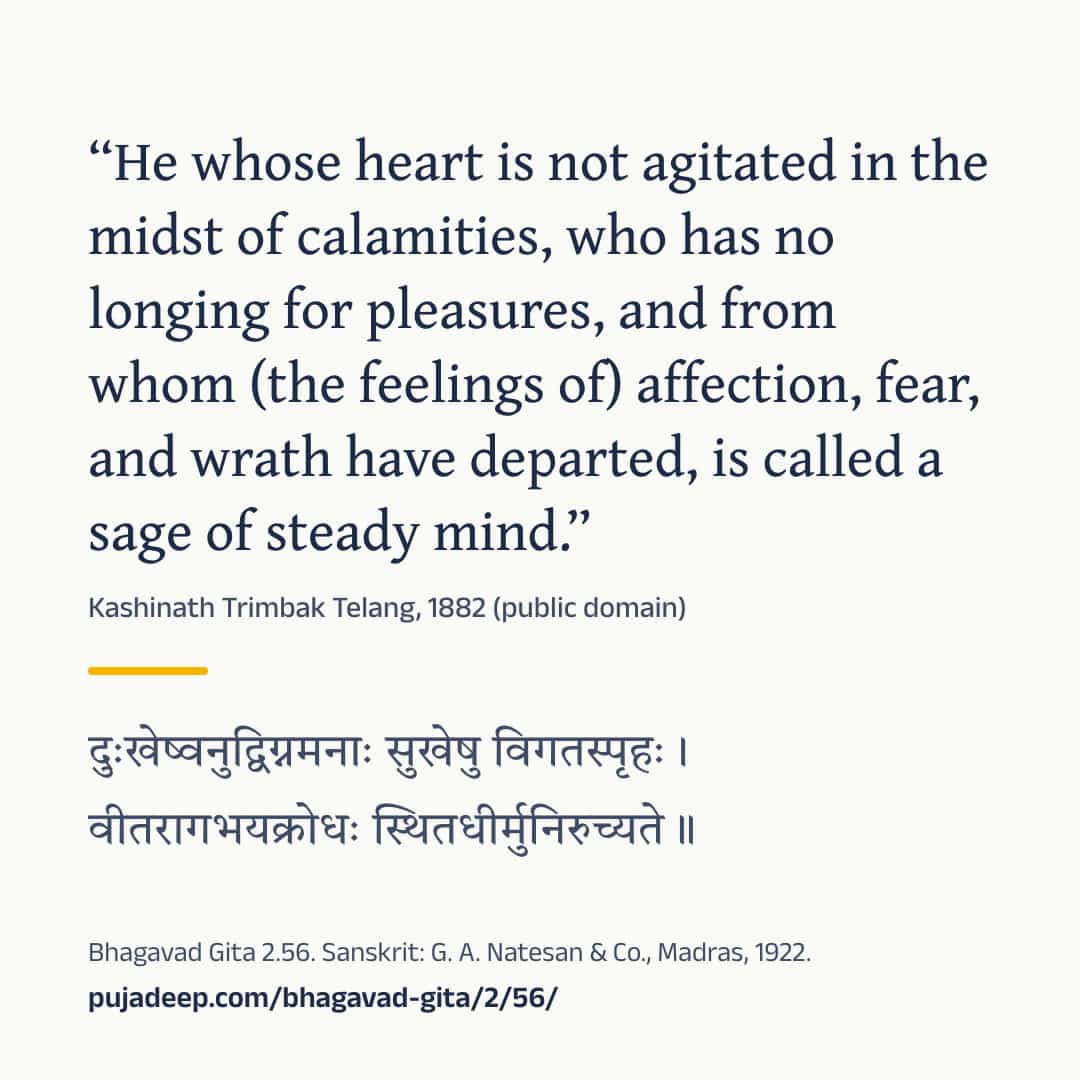
दुःखेष्वनुद्विग्नमनाः सुखेषु विगतस्पृहः ।वीतरागभयक्रोधः स्थितधीर्मुनिरुच्यते ॥
Duhkheshvanudvignamanah sukheshu vigatasprihah
Vitaragabhayakrodhah sthitadhirmuniruchyate
duḥkheṣvanudvignamanāḥ sukheṣu vigataspṛhaḥ |
vītarāgabhayakrodhaḥ sthitadhīrmunirucyate ||
Our meaning Krishna says that the sage of steady mind is not shaken by sorrow and does not crave pleasure, and that attachment, fear and anger have left such a person.
हिंदी अर्थ कृष्ण कहते हैं कि जिसका मन दुःख में विचलित नहीं होता, जिसे सुख की लालसा नहीं, और जिसके राग, भय और क्रोध मिट गए हैं, वह मुनि स्थितधी (स्थिर बुद्धि वाला) कहलाता है।
Word by word
Every word, with its dictionary page
Word by word
- दुःखेषु duḥkheṣu in sorrows (noun (neuter), locative plural) Dictionary: 1. duḥkha, Monier-Williams 1899, p. 483, col. 2
uneasiness, pain, sorrow, trouble, difficulty
- अनुद्विग्नमनाः anudvignamanāḥ with an untroubled mind (compound (masculine), nominative singular) Dictionary: an-udvigna, Monier-Williams 1899, p. 33, col. 3
free from apprehension or perplexity, easy in mind
; manas, Monier-Williams 1899, p. 783, col. 3mind (in its widest sense as applied to all the mental powers)
- सुखेषु sukheṣu in pleasures (noun (neuter), locative plural) Dictionary: sukha, Monier-Williams 1899, p. 1221, col. 1
ease, easiness, comfort, prosperity, pleasure, happiness
- विगतस्पृहः vigataspṛhaḥ free from craving (compound (masculine), nominative singular) Dictionary: vi-gata-spṛha, Monier-Williams 1899, p. 957, col. 1
devoid of wish or desire, indifferent
- वीतरागभयक्रोधः vītarāgabhayakrodhaḥ free from passion, fear, anger (compound (masculine), nominative singular) Dictionary: vīta-rāga, Monier-Williams 1899, p. 1004, col. 2
free from passions or affections, dispassionate, desireless, calm, tranquil
; bhaya, Monier-Williams 1899, p. 747, col. 1fear, alarm, dread, apprehension
; krodha, Monier-Williams 1899, p. 322, col. 1anger, wrath, passion
- स्थितधीः sthitadhīḥ of steady mind (compound (masculine), nominative singular) Dictionary: sthita-dhī, Monier-Williams 1899, p. 1264, col. 2
steady-minded, firm, unmoved, calm
- मुनिः muniḥ a sage (noun (masculine), nominative singular) Dictionary: muni, Monier-Williams 1899, p. 823, col. 1
a saint, sage, seer, ascetic, monk, devotee, hermit
- उच्यते ucyate is called (present passive, 3rd person singular) Dictionary: vac, Monier-Williams 1899, p. 912, col. 1
to speak, say, tell, utter, announce
Public-domain translations
Kashinath Trimbak Telang, 1882. Public domain. Page 50.
He whose heart is not agitated in the midst of calamities, who has no longing for pleasures, and from whom (the feelings of) affection, fear, and wrath1 have departed, is called a sage of steady mind.
Footnotes (the translator’s own) - Cf. Sutta Nipâta, p. 3. ↩
Compare 3 translations
Kashinath Trimbak Telang, 1882. Public domain. Page 50.
He whose heart is not agitated in the midst of calamities, who has no longing for pleasures, and from whom (the feelings of) affection, fear, and wrath1 have departed, is called a sage of steady mind.
Footnotes (the translator’s own) - Cf. Sutta Nipâta, p. 3. ↩
You are reading this one
Annie Besant, 1895. Public domain. Page 35.
He whose Manas is free from anxiety amid pains, indifferent amid pleasures, loosed from passion, fear and anger, he is called a Muni of stable mind.
You are reading this one
Swami Swarupananda, 1909 (first printed 1907). Public domain. Page 54.
He whose mind is not shaken by adversity, nor made thirsty by happiness, who has become free from affection, fear, and wrath, he is indeed the muni of steady wisdom.
You are reading this one
Share
Send one picture or the text to one chat. The picture names its source and the address of this page.
Send as text
The words and the link only. Many elders prefer this.
Bhagavad Gita 2.56

दुःखेष्वनुद्विग्नमनाः सुखेषु विगतस्पृहः ।
वीतरागभयक्रोधः स्थितधीर्मुनिरुच्यते ॥

“He whose heart is not agitated in the midst of calamities, who has no longing for pleasures, and from whom (the feelings of) affection, fear, and wrath have departed, is called a sage of steady mind.”
(Kashinath Trimbak Telang, 1882, public domain)

“He whose Manas is free from anxiety amid pains, indifferent amid pleasures, loosed from passion, fear and anger, he is called a Muni of stable mind.”
(Annie Besant, 1895, public domain)

“He whose mind is not shaken by adversity, nor made thirsty by happiness, who has become free from affection, fear, and wrath, he is indeed the muni of steady wisdom.”
(Swami Swarupananda, 1909 (first printed 1907), public domain)

Sanskrit: G. A. Natesan & Co., Madras, 1922.
https://pujadeep.com/bhagavad-gita/2/56/?s=copy Nothing is sent from this site. Your own app sends it, to the chat you choose. The picture quotes Telang (1882). If you chose another translation above, the text quotes yours and no picture is offered.
Sanskrit text: The Bhagavad-Gita, or The Lord's Song, with the text in Devanagari and an English translation, 1922. Meanings: written for Pujadeep with AI help and reviewed. Source and changes
Questions families ask
Who speaks Bhagavad Gita 2.56?
Krishna speaks this verse, in chapter 2 (Sankhya Yoga).
Where does the Sanskrit text come from?
Sanskrit text: The Bhagavad-Gita, or The Lord's Song, with the text in Devanagari and an English translation, 1922. Meanings: written for Pujadeep with AI help and reviewed. See the source
Is the meaning on this page a translation?
Explanation written for this site with AI help from the sources listed here, and reviewed. It is not a translation and not the only way to read the text. Free to quote with credit.
Source and licence
- Sanskrit text
- The Bhagavad-Gita, or The Lord's Song, with the text in Devanagari and an English translation (Annie Besant, G. A. Natesan & Co., Madras, 1922). Public domain. The Sanskrit on these pages was read from this printing’s page images.
- Translation
- The Bhagavadgîtâ with the Sanatsugâtîya and the Anugîtâ, translated by Kâshinâth Trimbak Telang (The Sacred Books of the East, vol. VIII, ed. F. Max Müller) (Kashinath Trimbak Telang, F. Max Müller, Clarendon Press, Oxford, 1882). Public domain. Shown verbatim, as printed.
- Translation
- The Bhagavad Gîtâ, or The Lord's Song, translated by Annie Besant (Annie Besant, Theosophical Publishing Society, London, 1895). Public domain. Shown verbatim, as printed.
- Sanskrit text
- Srimad-Bhagavad-Gita, with Sanskrit Text; Paraphrase with Word-by-word Literal Translation; English Rendering and Comments, Index, &c., by the Swami Swarupananda (Himalayan Series, No. XX) (Swami Swarupananda, The Editors and Publishers, Advaita Ashrama, Mayavati, Prabuddha Bharata Press, Mayavati, Almora, Himalayas, 1909). Public domain. Used only to date the text. The Devanagari on this page is a reading text and is not copied from this printing.
- Common wording
- In this text, 32 words follow today's common wording, checked against sanskritdocuments.org; Sanskrit Wikisource; Gita Press, Gorakhpur; GRETIL, Göttingen and Bhaktivedanta Book Trust.
- Our explanation
- Explanation written for this site with AI help from the sources listed here, and reviewed. It is not a translation and not the only way to read the text. Free to quote with credit.
- Review
- AI review: 2 independent reviews against the cited edition, October 15, 2026.