Bhagavad Gita · Chapter 2: Sankhya Yoga · Speaker: Krishna
Bhagavad Gita 2.62: Dhyayato vishayanpunsah
Krishna traces how a person falls.
Bhagavad Gita 2.62
ध्यायतो विषयान्पुंसः सङ्गस्तेषूपजायते ।सङ्गात्सञ्जायते कामः कामात्क्रोधोऽभिजायते ॥
Dhyayato vishayanpunsah sangasteshupajayate
Sangatsanjayate kamah kamatkrodhobhijayate
dhyāyato viṣayānpuṃsaḥ saṅgasteṣūpajāyate |
saṅgātsañjāyate kāmaḥ kāmātkrodho’bhijāyate ||
Our meaning Krishna traces how a person falls. Thinking about sense objects creates attachment to them. Attachment gives rise to desire, and desire gives rise to anger.
हिंदी अर्थ कृष्ण बताते हैं कि मनुष्य का पतन कैसे होता है। विषयों का चिंतन करने से उनमें आसक्ति पैदा होती है। आसक्ति से कामना जन्म लेती है, और कामना से क्रोध पैदा होता है।
Word by word
Every word, with its dictionary page
Word by word
- ध्यायतः dhyāyataḥ dwelling on (present participle (masculine), genitive singular) Dictionary: dhyai, Monier-Williams 1899, p. 521, col. 1
to think of, imagine, contemplate, meditate on
- विषयान् viṣayān sense objects (noun (masculine), accusative plural) Dictionary: viṣaya, Monier-Williams 1899, p. 997, col. 1
sphere (of influence or activity)
- पुंसः puṃsaḥ of a man (noun (masculine), genitive singular) Dictionary: 2. puṃs, Monier-Williams 1899, p. 630, col. 3
- सङ्गः saṅgaḥ attachment (noun (masculine), nominative singular) Dictionary: saṅga, Monier-Williams 1899, p. 1132, col. 3
addiction or devotion to, propensity for
- तेषु teṣu to them (pronoun (masculine), locative plural) Dictionary: tad, Monier-Williams 1899, p. 434, col. 1
m. he, f. she, n. it, that, this
- उपजायते upajāyate arises (present, 3rd person singular) Dictionary: upa-jan, Monier-Williams 1899, p. 198, col. 1
to be born, originate, come forth, appear, become visible
- सङ्गात् saṅgāt from attachment (noun (masculine), ablative singular) Dictionary: saṅga, Monier-Williams 1899, p. 1132, col. 3
addiction or devotion to, propensity for
- सञ्जायते sañjāyate is born (present, 3rd person singular) Dictionary: saṃ-jan, Monier-Williams 1899, p. 1133, col. 1
arise or come forth from (abl.), come into existence
- कामः kāmaḥ desire (noun (masculine), nominative singular) Dictionary: kāma, Monier-Williams 1899, p. 271, col. 3
wish, desire, longing
- कामात् kāmāt from desire (noun (masculine), ablative singular) Dictionary: kāma, Monier-Williams 1899, p. 271, col. 3
wish, desire, longing
- क्रोधः krodhaḥ anger (noun (masculine), nominative singular) Dictionary: krodha, Monier-Williams 1899, p. 322, col. 1
anger, wrath, passion
- अभिजायते abhijāyate arises (present, 3rd person singular) Dictionary: abhi-jan, Monier-Williams 1899, p. 62, col. 2
to be born or produced
Public-domain translations
Kashinath Trimbak Telang, 1882. Public domain. Page 50.
The man who ponders over objects of sense forms an attachment to them; from (that) attachment is produced desire; and from desire anger is produced1;
Footnotes (the translator’s own) - I. e. when the desire is frustrated. ↩
Compare 3 translations
Kashinath Trimbak Telang, 1882. Public domain. Page 50.
The man who ponders over objects of sense forms an attachment to them; from (that) attachment is produced desire; and from desire anger is produced1;
Footnotes (the translator’s own) - I. e. when the desire is frustrated. ↩
You are reading this one
Annie Besant, 1895. Public domain. Page 36.
If man, musing on the objects of sense, conceiveth an attachment to these, from attachment ariseth desire; from desire anger1 cometh forth;
Footnotes (the translator’s own) - Krodha. ↩
You are reading this one
Swami Swarupananda, 1909 (first printed 1907). Public domain. Page 120.
Thinking of objects, attachment to them is formed in a man. From attachment longing, and from longing anger grows.
You are reading this one
Share
Send one picture or the text to one chat. The picture names its source and the address of this page.
Send as text
The words and the link only. Many elders prefer this.
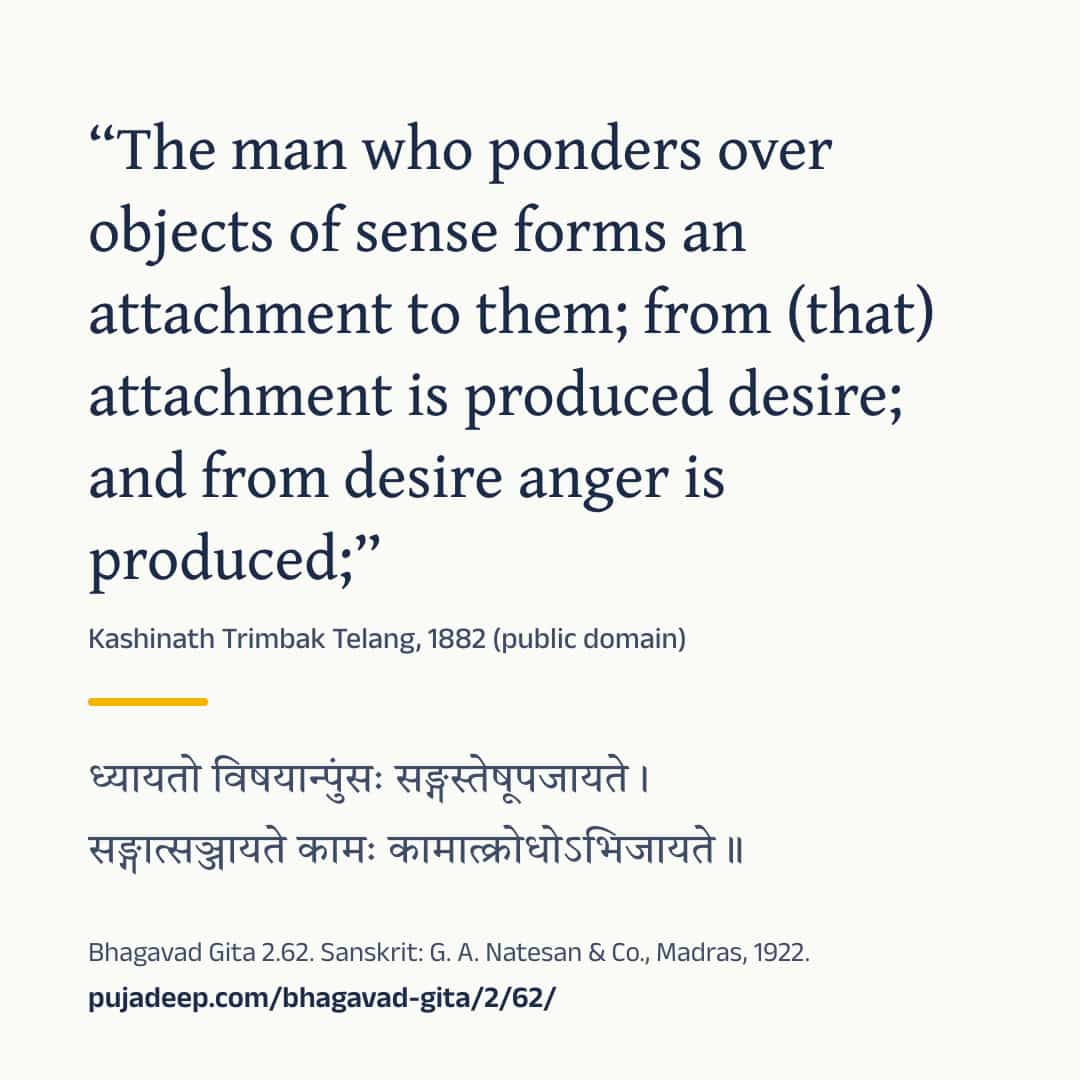
Bhagavad Gita 2.62

ध्यायतो विषयान्पुंसः सङ्गस्तेषूपजायते ।
सङ्गात्सञ्जायते कामः कामात्क्रोधोऽभिजायते ॥

“The man who ponders over objects of sense forms an attachment to them; from (that) attachment is produced desire; and from desire anger is produced;”
(Kashinath Trimbak Telang, 1882, public domain)

“If man, musing on the objects of sense, conceiveth an attachment to these, from attachment ariseth desire; from desire anger cometh forth;”
(Annie Besant, 1895, public domain)

“Thinking of objects, attachment to them is formed in a man. From attachment longing, and from longing anger grows.”
(Swami Swarupananda, 1909 (first printed 1907), public domain)

Sanskrit: G. A. Natesan & Co., Madras, 1922.
https://pujadeep.com/bhagavad-gita/2/62/?s=copy Nothing is sent from this site. Your own app sends it, to the chat you choose. The picture quotes Telang (1882). If you chose another translation above, the text quotes yours and no picture is offered.
Sanskrit text: The Bhagavad-Gita, or The Lord's Song, with the text in Devanagari and an English translation, 1922. Meanings: written for Pujadeep with AI help and reviewed. Source and changes
Questions families ask
Who speaks Bhagavad Gita 2.62?
Krishna speaks this verse, in chapter 2 (Sankhya Yoga).
Where does the Sanskrit text come from?
Sanskrit text: The Bhagavad-Gita, or The Lord's Song, with the text in Devanagari and an English translation, 1922. Meanings: written for Pujadeep with AI help and reviewed. See the source
Is the meaning on this page a translation?
Explanation written for this site with AI help from the sources listed here, and reviewed. It is not a translation and not the only way to read the text. Free to quote with credit.
Source and licence
- Sanskrit text
- The Bhagavad-Gita, or The Lord's Song, with the text in Devanagari and an English translation (Annie Besant, G. A. Natesan & Co., Madras, 1922). Public domain. The Sanskrit on these pages was read from this printing’s page images.
- Translation
- The Bhagavadgîtâ with the Sanatsugâtîya and the Anugîtâ, translated by Kâshinâth Trimbak Telang (The Sacred Books of the East, vol. VIII, ed. F. Max Müller) (Kashinath Trimbak Telang, F. Max Müller, Clarendon Press, Oxford, 1882). Public domain. Shown verbatim, as printed.
- Translation
- The Bhagavad Gîtâ, or The Lord's Song, translated by Annie Besant (Annie Besant, Theosophical Publishing Society, London, 1895). Public domain. Shown verbatim, as printed.
- Sanskrit text
- Srimad-Bhagavad-Gita, with Sanskrit Text; Paraphrase with Word-by-word Literal Translation; English Rendering and Comments, Index, &c., by the Swami Swarupananda (Himalayan Series, No. XX) (Swami Swarupananda, The Editors and Publishers, Advaita Ashrama, Mayavati, Prabuddha Bharata Press, Mayavati, Almora, Himalayas, 1909). Public domain. Used only to date the text. The Devanagari on this page is a reading text and is not copied from this printing.
- Common wording
- In this text, 32 words follow today's common wording, checked against sanskritdocuments.org; Sanskrit Wikisource; Gita Press, Gorakhpur; GRETIL, Göttingen and Bhaktivedanta Book Trust.
- Our explanation
- Explanation written for this site with AI help from the sources listed here, and reviewed. It is not a translation and not the only way to read the text. Free to quote with credit.
- Review
- AI review: 2 independent reviews against the cited edition, October 15, 2026.