Bhagavad Gita · Chapter 2: Sankhya Yoga · Speaker: Krishna
Bhagavad Gita 2.63: Krodhadbhavati sammohah
Krishna goes on with the chain.
Bhagavad Gita 2.63
क्रोधाद्भवति सम्मोहः सम्मोहात्स्मृतिविभ्रमः ।स्मृतिभ्रंशाद्बुद्धिनाशो बुद्धिनाशात्प्रणश्यति ॥
Krodhadbhavati sammohah sammohatsmritivibhramah
Smritibhranshadbuddhinasho buddhinashatpranashyati
krodhādbhavati sammohaḥ sammohātsmṛtivibhramaḥ |
smṛtibhraṃśādbuddhināśo buddhināśātpraṇaśyati ||
Our meaning Krishna goes on with the chain. He says that from anger comes confusion, and confusion clouds memory; when memory fails, judgement is lost, and when judgement is lost, the person is ruined.
हिंदी अर्थ कृष्ण आगे कहते हैं कि क्रोध से मोह (भ्रम) होता है, मोह से स्मृति भ्रमित हो जाती है, स्मृति के भ्रष्ट होने से बुद्धि का नाश होता है, और बुद्धि के नाश से मनुष्य नष्ट हो जाता है।
Word by word
Every word, with its dictionary page
Word by word
- क्रोधात् krodhāt from anger (noun (masculine), ablative singular) Dictionary: krodha, Monier-Williams 1899, p. 322, col. 1
anger, wrath, passion
- भवति bhavati comes (present, 3rd person singular) Dictionary: 1. bhū, Monier-Williams 1899, p. 760, col. 2
arise, come into being, exist
- सम्मोहः sammohaḥ delusion (noun (masculine), nominative singular) Dictionary: sam-moha, Monier-Williams 1899, p. 1181, col. 1
stupefaction, bewilderment, confusion
- सम्मोहात् sammohāt from delusion (noun (masculine), ablative singular) Dictionary: sam-moha, Monier-Williams 1899, p. 1181, col. 1
stupefaction, bewilderment, confusion
- स्मृतिविभ्रमः smṛtivibhramaḥ confusion of memory (compound (masculine), nominative singular) Dictionary: smṛti-vibhrama, Monier-Williams 1899, p. 1272, col. 3
confusion of m°
- स्मृतिभ्रंशात् smṛtibhraṃśāt from loss of memory (compound (masculine), ablative singular) Dictionary: smṛti-bhraṃśa, Monier-Williams 1899, p. 1272, col. 3
loss of m°
- बुद्धिनाशः buddhināśaḥ loss of understanding (compound (masculine), nominative singular) Dictionary: buddhi, Monier-Williams 1899, p. 733, col. 3
intelligence, reason, intellect, mind, discernment, judgment
; 2. nāśa, Monier-Williams 1899, p. 538, col. 1the being lost, loss, disappearance, destruction, annihilation, ruin
- बुद्धिनाशात् buddhināśāt from loss of understanding (compound (masculine), ablative singular) Dictionary: buddhi, Monier-Williams 1899, p. 733, col. 3
intelligence, reason, intellect, mind, discernment, judgment
; 2. nāśa, Monier-Williams 1899, p. 538, col. 1the being lost, loss, disappearance, destruction, annihilation, ruin
- प्रणश्यति praṇaśyati is lost, perishes (present, 3rd person singular) Dictionary: pra-ṇaś, Monier-Williams 1899, p. 659, col. 3
Public-domain translations
Kashinath Trimbak Telang, 1882. Public domain. Page 50–51.
from anger results want of discrimination1; from want of discrimination, confusion of the memory; from confusion of the memory, loss of reason; and in consequence of loss of reason he is utterly ruined.
Footnotes (the translator’s own) - I. e. between right and wrong. Confusion of memory=forgetfulness of Sâstras and rules prescribed in them. ↩
Compare 3 translations
Kashinath Trimbak Telang, 1882. Public domain. Page 50–51.
from anger results want of discrimination1; from want of discrimination, confusion of the memory; from confusion of the memory, loss of reason; and in consequence of loss of reason he is utterly ruined.
Footnotes (the translator’s own) - I. e. between right and wrong. Confusion of memory=forgetfulness of Sâstras and rules prescribed in them. ↩
You are reading this one
Annie Besant, 1895. Public domain. Page 37.
From anger proceedeth delusion; from delusion wandering memory; from wandering memory the destruction of Buddhi; from destruction of Buddhi, he perishes.
You are reading this one
Swami Swarupananda, 1909 (first printed 1907). Public domain. Page 120.
From anger comes delusion, and from delusion loss of memory. From loss of memory, the ruin of discrimination, and from the ruin of discrimination he perishes.
You are reading this one
Share
Send one picture or the text to one chat. The picture names its source and the address of this page.
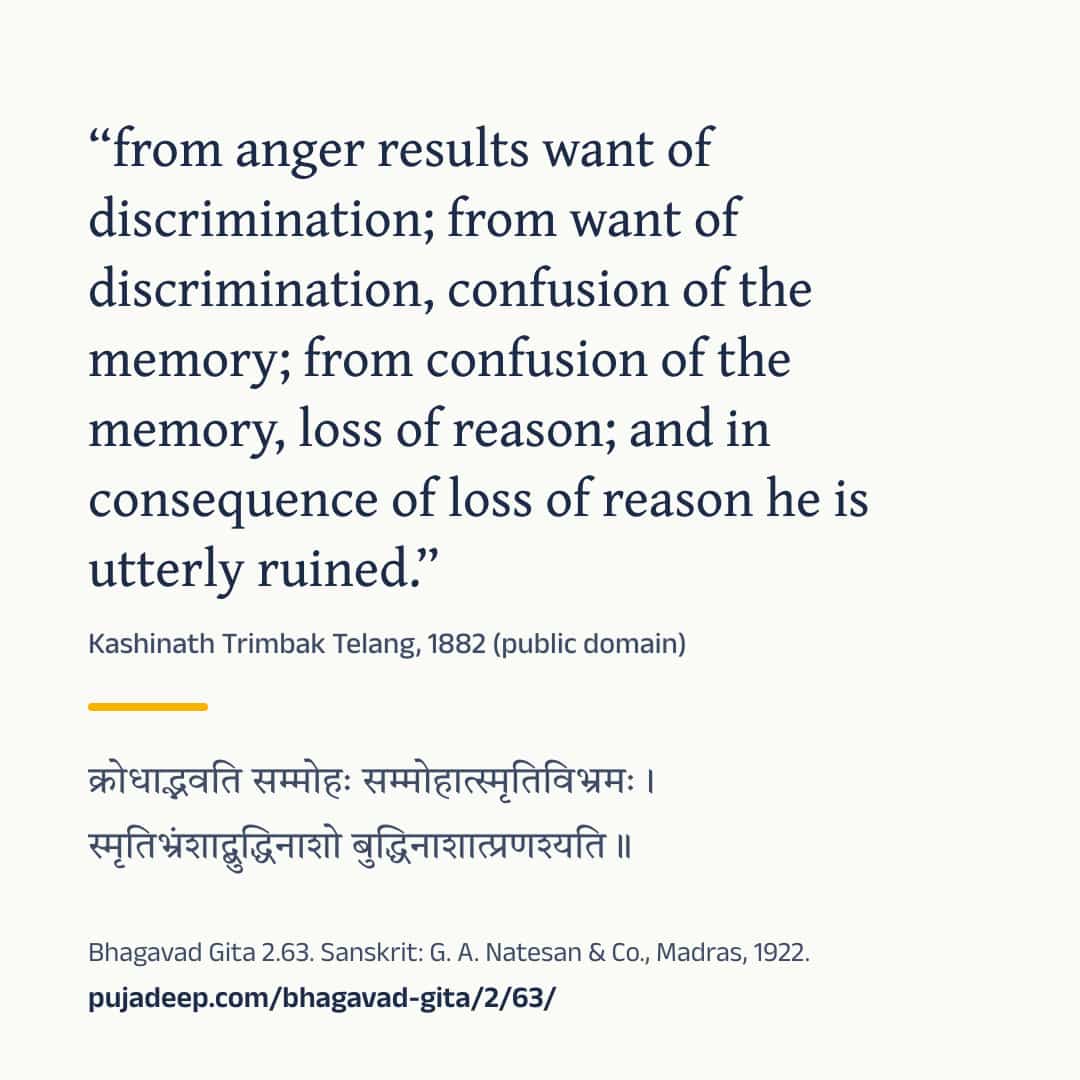
Send as text
The words and the link only. Many elders prefer this.
Bhagavad Gita 2.63

क्रोधाद्भवति सम्मोहः सम्मोहात्स्मृतिविभ्रमः ।
स्मृतिभ्रंशाद्बुद्धिनाशो बुद्धिनाशात्प्रणश्यति ॥

“from anger results want of discrimination; from want of discrimination, confusion of the memory; from confusion of the memory, loss of reason; and in consequence of loss of reason he is utterly ruined.”
(Kashinath Trimbak Telang, 1882, public domain)

“From anger proceedeth delusion; from delusion wandering memory; from wandering memory the destruction of Buddhi; from destruction of Buddhi, he perishes.”
(Annie Besant, 1895, public domain)

“From anger comes delusion, and from delusion loss of memory. From loss of memory, the ruin of discrimination, and from the ruin of discrimination he perishes.”
(Swami Swarupananda, 1909 (first printed 1907), public domain)

Sanskrit: G. A. Natesan & Co., Madras, 1922.
https://pujadeep.com/bhagavad-gita/2/63/?s=copy Nothing is sent from this site. Your own app sends it, to the chat you choose. The picture quotes Telang (1882). If you chose another translation above, the text quotes yours and no picture is offered.
Sanskrit text: The Bhagavad-Gita, or The Lord's Song, with the text in Devanagari and an English translation, 1922. Meanings: written for Pujadeep with AI help and reviewed. Source and changes
Questions families ask
Who speaks Bhagavad Gita 2.63?
Krishna speaks this verse, in chapter 2 (Sankhya Yoga).
Where does the Sanskrit text come from?
Sanskrit text: The Bhagavad-Gita, or The Lord's Song, with the text in Devanagari and an English translation, 1922. Meanings: written for Pujadeep with AI help and reviewed. See the source
Is the meaning on this page a translation?
Explanation written for this site with AI help from the sources listed here, and reviewed. It is not a translation and not the only way to read the text. Free to quote with credit.
Source and licence
- Sanskrit text
- The Bhagavad-Gita, or The Lord's Song, with the text in Devanagari and an English translation (Annie Besant, G. A. Natesan & Co., Madras, 1922). Public domain. The Sanskrit on these pages was read from this printing’s page images.
- Translation
- The Bhagavadgîtâ with the Sanatsugâtîya and the Anugîtâ, translated by Kâshinâth Trimbak Telang (The Sacred Books of the East, vol. VIII, ed. F. Max Müller) (Kashinath Trimbak Telang, F. Max Müller, Clarendon Press, Oxford, 1882). Public domain. Shown verbatim, as printed.
- Translation
- The Bhagavad Gîtâ, or The Lord's Song, translated by Annie Besant (Annie Besant, Theosophical Publishing Society, London, 1895). Public domain. Shown verbatim, as printed.
- Sanskrit text
- Srimad-Bhagavad-Gita, with Sanskrit Text; Paraphrase with Word-by-word Literal Translation; English Rendering and Comments, Index, &c., by the Swami Swarupananda (Himalayan Series, No. XX) (Swami Swarupananda, The Editors and Publishers, Advaita Ashrama, Mayavati, Prabuddha Bharata Press, Mayavati, Almora, Himalayas, 1909). Public domain. Used only to date the text. The Devanagari on this page is a reading text and is not copied from this printing.
- Common wording
- In this text, 32 words follow today's common wording, checked against sanskritdocuments.org; Sanskrit Wikisource; Gita Press, Gorakhpur; GRETIL, Göttingen and Bhaktivedanta Book Trust.
- Our explanation
- Explanation written for this site with AI help from the sources listed here, and reviewed. It is not a translation and not the only way to read the text. Free to quote with credit.
- Review
- AI review: 2 independent reviews against the cited edition, October 15, 2026.