Bhagavad Gita · Chapter 2: Sankhya Yoga · Speaker: Krishna
Bhagavad Gita 2.59: Vishaya vinivartante
Krishna says that when a person stops feeding the senses, their objects fall away, but the taste for them remains.
Bhagavad Gita 2.59
विषया विनिवर्तन्ते निराहारस्य देहिनः ।रसवर्जं रसोऽप्यस्य परं दृष्ट्वा निवर्तते ॥
Vishaya vinivartante niraharasya dehinah
Rasavarjam rasopyasya param drishtva nivartate
viṣayā vinivartante nirāhārasya dehinaḥ |
rasavarjaṃ raso’pyasya paraṃ dṛṣṭvā nivartate ||
Our meaning Krishna says that when a person stops feeding the senses, their objects fall away, but the taste for them remains. Even that taste goes, he says, once the person has seen the Highest.
हिंदी अर्थ कृष्ण कहते हैं कि जो व्यक्ति विषयों को ग्रहण नहीं करता, उससे विषय तो छूट जाते हैं, पर उनका रस (उनकी चाह) बना रहता है। वे कहते हैं कि परम को देख लेने पर यह रस भी छूट जाता है।
Word by word
Every word, with its dictionary page
Word by word
- विषयाः viṣayāḥ sense objects (noun (masculine), nominative plural) Dictionary: viṣaya, Monier-Williams 1899, p. 997, col. 1
sphere (of influence or activity)
- विनिवर्तन्ते vinivartante turn away (present, 3rd person plural) Dictionary: vi-ni-vṛt, Monier-Williams 1899, p. 971, col. 2
to turn back, return
- निराहारस्य nirāhārasya of one who abstains (adjective (masculine), genitive singular) Dictionary: nir-āhāra, Monier-Williams 1899, p. 540, col. 2
having no food or abstaining from it
- देहिनः dehinaḥ of the embodied one (noun (masculine), genitive singular) Dictionary: dehin, Monier-Williams 1899, p. 497, col. 1
m. the spirit, soul
- रसवर्जम् rasavarjam except the taste for them (compound, used as adverb) Dictionary: rasa, Monier-Williams 1899, p. 869, col. 2 ; varjam, Monier-Williams 1899, p. 924, col. 1
excluding, excepting, except, without
- रसः rasaḥ taste, longing (noun (masculine), nominative singular) Dictionary: rasa, Monier-Williams 1899, p. 869, col. 2
- अपि api even (indeclinable) Dictionary: api, Monier-Williams 1899, p. 55, col. 1
in the sense of even, also, very
- अस्य asya his (pronoun (masculine), genitive singular) Dictionary: 1. idam, Monier-Williams 1899, p. 165, col. 2
- परम् param the Supreme (noun (neuter), accusative singular) Dictionary: 1. para, Monier-Williams 1899, p. 586, col. 1
highest, supreme, chief
- दृष्ट्वा dṛṣṭvā having seen (absolutive (having done)) Dictionary: 1. dṛś, Monier-Williams 1899, p. 491, col. 2
to see, behold, look at, regard, consider
- निवर्तते nivartate turns away (present, 3rd person singular) Dictionary: ni-vṛt, Monier-Williams 1899, p. 560, col. 1
to turn away, retreat, flee, escape, abstain or desist from
Public-domain translations
Kashinath Trimbak Telang, 1882. Public domain. Page 50.
Objects of sense draw back from a person who is abstinent; not so the taste (for those objects). But even the taste departs from him, when he has seen the Supreme1.
Footnotes (the translator’s own) - See on this, Wilson's Essays on Sanskrit Literature, vol. iii, p. 130. ↩
Compare 3 translations
Kashinath Trimbak Telang, 1882. Public domain. Page 50.
Objects of sense draw back from a person who is abstinent; not so the taste (for those objects). But even the taste departs from him, when he has seen the Supreme1.
Footnotes (the translator’s own) - See on this, Wilson's Essays on Sanskrit Literature, vol. iii, p. 130. ↩
You are reading this one
Annie Besant, 1895. Public domain. Page 36.
The objects of sense, save those of flavour, turn away from an abstemious Dweller in the body; and even flavour turneth away from him after the Supreme is seen.
You are reading this one
Swami Swarupananda, 1909 (first printed 1907). Public domain. Page 120.
Objects fall away from the abstinent man, leaving the longing behind. But his longing also ceases, who sees the Supreme.
You are reading this one
Share
Send one picture or the text to one chat. The picture names its source and the address of this page.
Send as text
The words and the link only. Many elders prefer this.
Bhagavad Gita 2.59

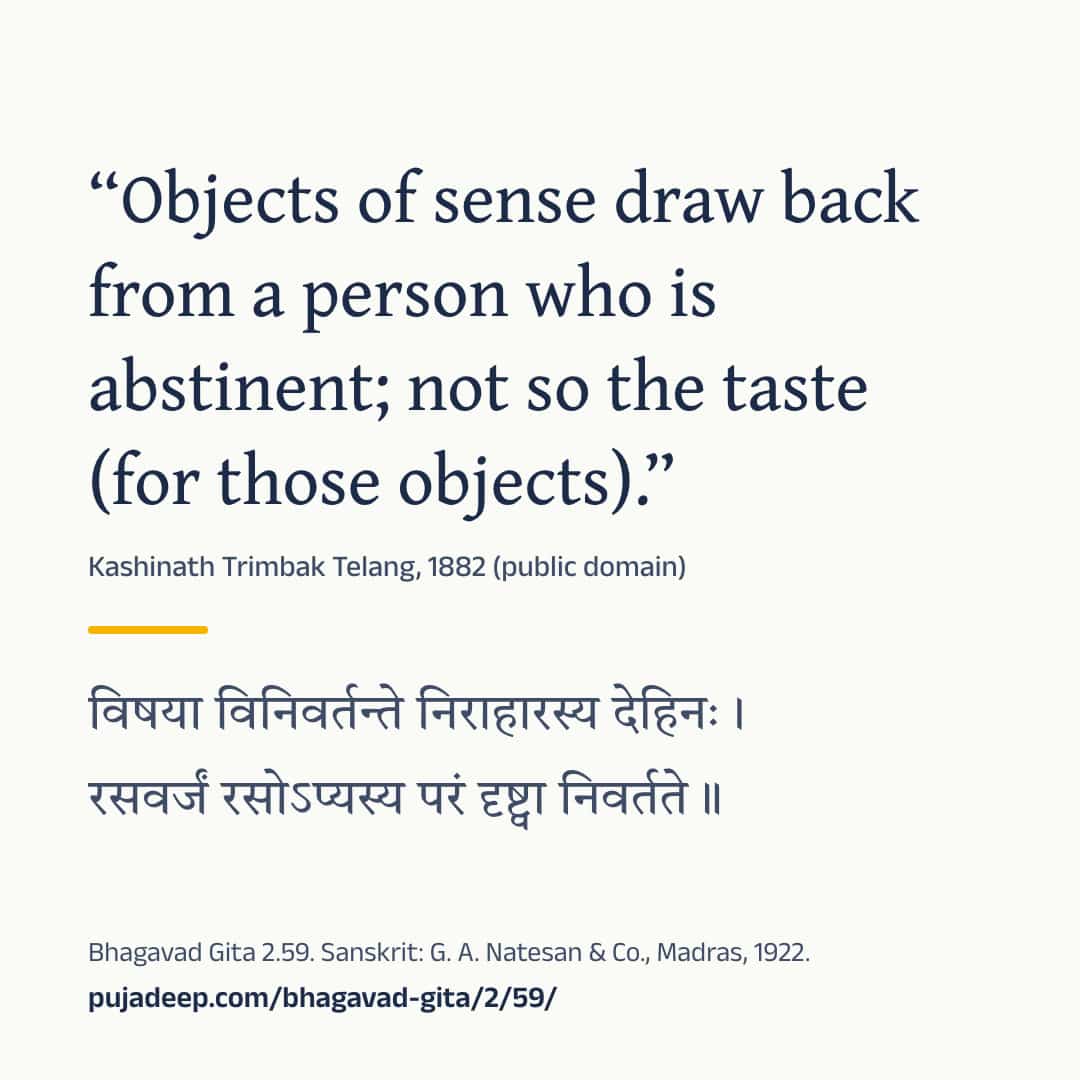
विषया विनिवर्तन्ते निराहारस्य देहिनः ।
रसवर्जं रसोऽप्यस्य परं दृष्ट्वा निवर्तते ॥

“Objects of sense draw back from a person who is abstinent; not so the taste (for those objects). But even the taste departs from him, when he has seen the Supreme.”
(Kashinath Trimbak Telang, 1882, public domain)

“The objects of sense, save those of flavour, turn away from an abstemious Dweller in the body; and even flavour turneth away from him after the Supreme is seen.”
(Annie Besant, 1895, public domain)

“Objects fall away from the abstinent man, leaving the longing behind. But his longing also ceases, who sees the Supreme.”
(Swami Swarupananda, 1909 (first printed 1907), public domain)

Sanskrit: G. A. Natesan & Co., Madras, 1922.
https://pujadeep.com/bhagavad-gita/2/59/?s=copy Nothing is sent from this site. Your own app sends it, to the chat you choose. The picture quotes Telang (1882). If you chose another translation above, the text quotes yours and no picture is offered.
Sanskrit text: The Bhagavad-Gita, or The Lord's Song, with the text in Devanagari and an English translation, 1922. Meanings: written for Pujadeep with AI help and reviewed. Source and changes
Questions families ask
Who speaks Bhagavad Gita 2.59?
Krishna speaks this verse, in chapter 2 (Sankhya Yoga).
Where does the Sanskrit text come from?
Sanskrit text: The Bhagavad-Gita, or The Lord's Song, with the text in Devanagari and an English translation, 1922. Meanings: written for Pujadeep with AI help and reviewed. See the source
Is the meaning on this page a translation?
Explanation written for this site with AI help from the sources listed here, and reviewed. It is not a translation and not the only way to read the text. Free to quote with credit.
Source and licence
- Sanskrit text
- The Bhagavad-Gita, or The Lord's Song, with the text in Devanagari and an English translation (Annie Besant, G. A. Natesan & Co., Madras, 1922). Public domain. The Sanskrit on these pages was read from this printing’s page images.
- Translation
- The Bhagavadgîtâ with the Sanatsugâtîya and the Anugîtâ, translated by Kâshinâth Trimbak Telang (The Sacred Books of the East, vol. VIII, ed. F. Max Müller) (Kashinath Trimbak Telang, F. Max Müller, Clarendon Press, Oxford, 1882). Public domain. Shown verbatim, as printed.
- Translation
- The Bhagavad Gîtâ, or The Lord's Song, translated by Annie Besant (Annie Besant, Theosophical Publishing Society, London, 1895). Public domain. Shown verbatim, as printed.
- Sanskrit text
- Srimad-Bhagavad-Gita, with Sanskrit Text; Paraphrase with Word-by-word Literal Translation; English Rendering and Comments, Index, &c., by the Swami Swarupananda (Himalayan Series, No. XX) (Swami Swarupananda, The Editors and Publishers, Advaita Ashrama, Mayavati, Prabuddha Bharata Press, Mayavati, Almora, Himalayas, 1909). Public domain. Used only to date the text. The Devanagari on this page is a reading text and is not copied from this printing.
- Common wording
- In this text, 32 words follow today's common wording, checked against sanskritdocuments.org; Sanskrit Wikisource; Gita Press, Gorakhpur; GRETIL, Göttingen and Bhaktivedanta Book Trust.
- Our explanation
- Explanation written for this site with AI help from the sources listed here, and reviewed. It is not a translation and not the only way to read the text. Free to quote with credit.
- Review
- AI review: 2 independent reviews against the cited edition, October 15, 2026.