Bhagavad Gita · Chapter 2: Sankhya Yoga · Speaker: Krishna
Bhagavad Gita 2.60: Yatato hyapi kaunteya
Krishna points out that the senses are strong.
Bhagavad Gita 2.60
यततो ह्यपि कौन्तेय पुरुषस्य विपश्चितः ।इन्द्रियाणि प्रमाथीनि हरन्ति प्रसभं मनः ॥
Yatato hyapi kaunteya purushasya vipashchitah
Indriyani pramathini haranti prasabham manah
yatato hyapi kaunteya puruṣasya vipaścitaḥ |
indriyāṇi pramāthīni haranti prasabhaṃ manaḥ ||
Our meaning Krishna points out that the senses are strong. Even when a wise person is trying hard, the restless senses can drag the mind away by force.
हिंदी अर्थ कृष्ण बताते हैं कि इंद्रियाँ बहुत बलवान हैं। प्रयत्न करते हुए विवेकी पुरुष के मन को भी ये चंचल इंद्रियाँ बलपूर्वक खींच ले जाती हैं।
Word by word
Every word, with its dictionary page
Word by word
- यततः yatataḥ of one who strives (present participle (masculine), genitive singular) Dictionary: yat, Monier-Williams 1899, p. 840, col. 3
to exert one's self, take pains, endeavour, make effort
- हि hi for (indeclinable) Dictionary: 2. hi, Monier-Williams 1899, p. 1297, col. 3
for, because, on account of
- अपि api even (indeclinable) Dictionary: api, Monier-Williams 1899, p. 55, col. 1
in the sense of even, also, very
- कौन्तेय kaunteya O son of Kunti (noun (masculine), vocative singular) Dictionary: kaunteya, Monier-Williams 1899, p. 316, col. 2
metron. fr. Kuntī
- पुरुषस्य puruṣasya of a person (noun (masculine), genitive singular) Dictionary: puruṣa, Monier-Williams 1899, p. 637, col. 1
a person
- विपश्चितः vipaścitaḥ wise (adjective (masculine), genitive singular) Dictionary: vipaś-cit, Monier-Williams 1899, p. 972, col. 3
inspired, wise, learned
- इन्द्रियाणि indriyāṇi the senses (noun (neuter), nominative plural) Dictionary: indriya, Monier-Williams 1899, p. 167, col. 2
faculty of sense, sense, organ of sense
- प्रमाथीनि pramāthīni turbulent (adjective (neuter), nominative plural) Dictionary: pra-māthin, Monier-Williams 1899, p. 685, col. 2
stirring about, tearing, rending, troubling, harassing
- हरन्ति haranti carry away (present, 3rd person plural) Dictionary: hṛ, Monier-Williams 1899, p. 1302, col. 1
to take away, carry off, seize
- प्रसभम् prasabham by force (indeclinable) Dictionary: pra-sabha, Monier-Williams 1899, p. 697, col. 1
forcibly, violently
- मनः manaḥ the mind (noun (neuter), accusative singular) Dictionary: manas, Monier-Williams 1899, p. 783, col. 3
mind (in its widest sense as applied to all the mental powers)
2 printings differ
Public-domain translations
Kashinath Trimbak Telang, 1882. Public domain. Page 50.
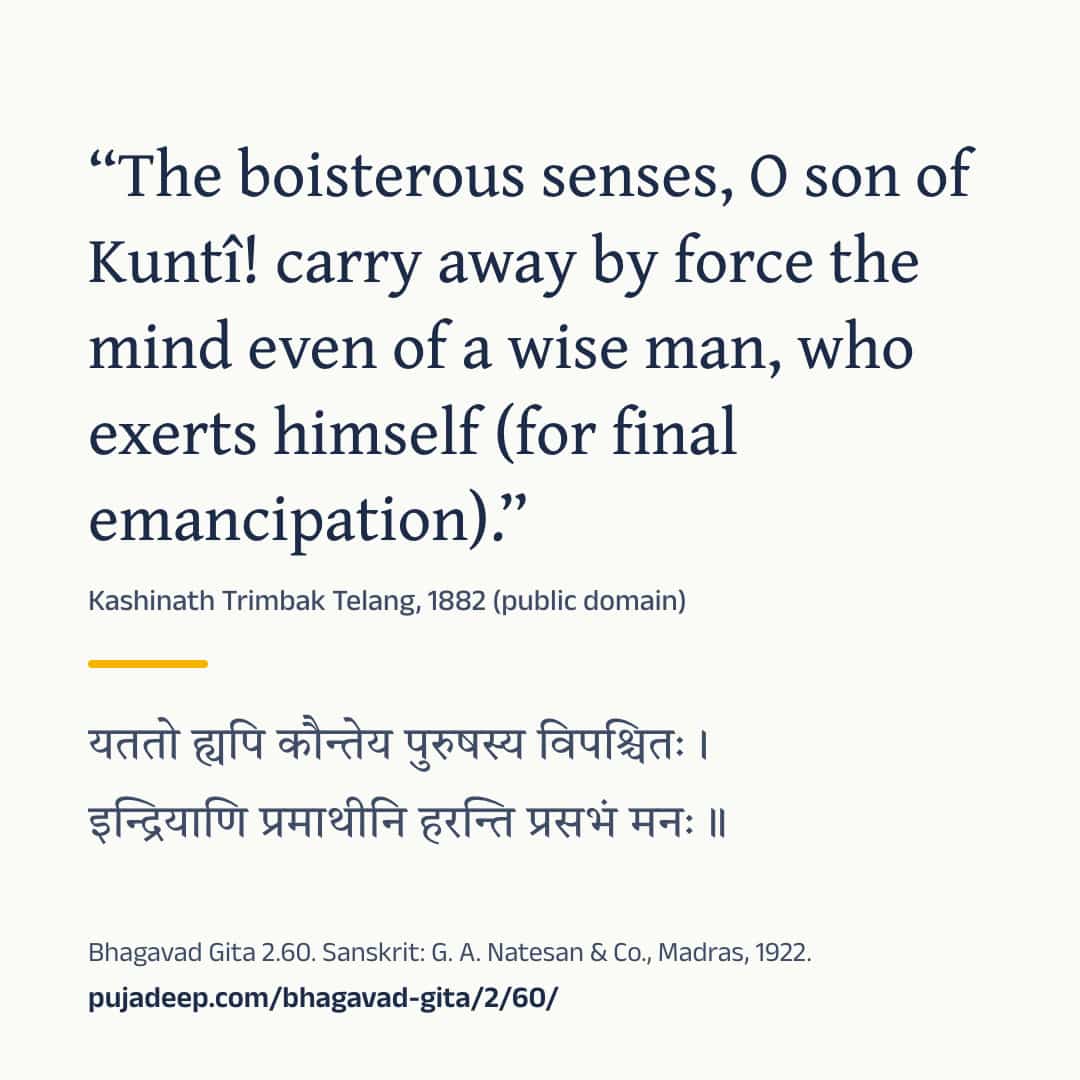
The boisterous senses, O son of Kuntî! carry away by force the mind even of a wise man, who exerts himself (for final emancipation).
Compare 3 translations
Kashinath Trimbak Telang, 1882. Public domain. Page 50.
The boisterous senses, O son of Kuntî! carry away by force the mind even of a wise man, who exerts himself (for final emancipation).
You are reading this one
Annie Besant, 1895. Public domain. Page 36.
O son of Kuntî, the aroused senses of (even) a wise man, though careful, impetuously carry away his Manas.
You are reading this one
Swami Swarupananda, 1909 (first printed 1907). Public domain. Page 120.
The turbulent senses, O son of Kunti, do violently snatch away the mind of even a wise man, striving after perfection.
You are reading this one
Share
Send one picture or the text to one chat. The picture names its source and the address of this page.
Send as text
The words and the link only. Many elders prefer this.
Bhagavad Gita 2.60

यततो ह्यपि कौन्तेय पुरुषस्य विपश्चितः ।
इन्द्रियाणि प्रमाथीनि हरन्ति प्रसभं मनः ॥

“The boisterous senses, O son of Kuntî! carry away by force the mind even of a wise man, who exerts himself (for final emancipation).”
(Kashinath Trimbak Telang, 1882, public domain)

“O son of Kuntî, the aroused senses of (even) a wise man, though careful, impetuously carry away his Manas.”
(Annie Besant, 1895, public domain)

“The turbulent senses, O son of Kunti, do violently snatch away the mind of even a wise man, striving after perfection.”
(Swami Swarupananda, 1909 (first printed 1907), public domain)

Sanskrit: G. A. Natesan & Co., Madras, 1922.
https://pujadeep.com/bhagavad-gita/2/60/?s=copy Nothing is sent from this site. Your own app sends it, to the chat you choose. The picture quotes Telang (1882). If you chose another translation above, the text quotes yours and no picture is offered.
Sanskrit text: The Bhagavad-Gita, or The Lord's Song, with the text in Devanagari and an English translation, 1922. Meanings: written for Pujadeep with AI help and reviewed. Source and changes
Questions families ask
Who speaks Bhagavad Gita 2.60?
Krishna speaks this verse, in chapter 2 (Sankhya Yoga).
Where does the Sanskrit text come from?
Sanskrit text: The Bhagavad-Gita, or The Lord's Song, with the text in Devanagari and an English translation, 1922. Meanings: written for Pujadeep with AI help and reviewed. See the source
Is the meaning on this page a translation?
Explanation written for this site with AI help from the sources listed here, and reviewed. It is not a translation and not the only way to read the text. Free to quote with credit.
Source and licence
- Sanskrit text
- The Bhagavad-Gita, or The Lord's Song, with the text in Devanagari and an English translation (Annie Besant, G. A. Natesan & Co., Madras, 1922). Public domain. The Sanskrit on these pages was read from this printing’s page images.
- Translation
- The Bhagavadgîtâ with the Sanatsugâtîya and the Anugîtâ, translated by Kâshinâth Trimbak Telang (The Sacred Books of the East, vol. VIII, ed. F. Max Müller) (Kashinath Trimbak Telang, F. Max Müller, Clarendon Press, Oxford, 1882). Public domain. Shown verbatim, as printed.
- Translation
- The Bhagavad Gîtâ, or The Lord's Song, translated by Annie Besant (Annie Besant, Theosophical Publishing Society, London, 1895). Public domain. Shown verbatim, as printed.
- Sanskrit text
- Srimad-Bhagavad-Gita, with Sanskrit Text; Paraphrase with Word-by-word Literal Translation; English Rendering and Comments, Index, &c., by the Swami Swarupananda (Himalayan Series, No. XX) (Swami Swarupananda, The Editors and Publishers, Advaita Ashrama, Mayavati, Prabuddha Bharata Press, Mayavati, Almora, Himalayas, 1909). Public domain. Used only to date the text. The Devanagari on this page is a reading text and is not copied from this printing.
- Common wording
- In this text, 32 words follow today's common wording, checked against sanskritdocuments.org; Sanskrit Wikisource; Gita Press, Gorakhpur; GRETIL, Göttingen and Bhaktivedanta Book Trust.
- Our explanation
- Explanation written for this site with AI help from the sources listed here, and reviewed. It is not a translation and not the only way to read the text. Free to quote with credit.
- Review
- AI review: 2 independent reviews against the cited edition, October 15, 2026.