Bhagavad Gita · Chapter 2: Sankhya Yoga · Speaker: Krishna
Bhagavad Gita 2.69: Ya nisha sarvabhutanam tasyam
Krishna uses an image of night and day.
Bhagavad Gita 2.69
या निशा सर्वभूतानां तस्यां जागर्ति संयमी ।यस्यां जाग्रति भूतानि सा निशा पश्यतो मुनेः ॥
Ya nisha sarvabhutanam tasyam jagarti sanyami
Yasyam jagrati bhutani sa nisha pashyato muneh
yā niśā sarvabhūtānāṃ tasyāṃ jāgarti saṃyamī |
yasyāṃ jāgrati bhūtāni sā niśā paśyato muneḥ ||
Our meaning Krishna uses an image of night and day. What is night for ordinary beings is where the self-controlled person stays awake. And what ordinary beings are awake to is night for the sage who truly sees.
हिंदी अर्थ कृष्ण रात और दिन का उदाहरण देते हैं। जो साधारण प्राणियों के लिए रात है, उसमें संयमी जागता रहता है। और साधारण प्राणी जिसके प्रति जागे रहते हैं, वह सच को देखने वाले मुनि के लिए रात है।
Word by word
Every word, with its dictionary page
Word by word
- या yā what (pronoun (feminine), nominative singular) Dictionary: yad, Monier-Williams 1899, p. 844, col. 2
who, which, what, whichever, whatever, that
- निशा niśā night (noun (feminine), nominative singular) Dictionary: niśā, Monier-Williams 1899, p. 560, col. 2
night
- सर्वभूतानाम् sarvabhūtānām of all beings (compound (neuter), genitive plural) Dictionary: sarva-bhūta, Monier-Williams 1899, p. 1186, col. 2
all beings
- तस्याम् tasyām in that (pronoun (feminine), locative singular) Dictionary: tad, Monier-Williams 1899, p. 434, col. 1
m. he, f. she, n. it, that, this
- जागर्ति jāgarti is awake (present, 3rd person singular) Dictionary: jāgṛ, Monier-Williams 1899, p. 417, col. 1
to be awake or watchful
- संयमी saṃyamī the self-controlled one (noun (masculine), nominative singular) Dictionary: saṃ-yamin, Monier-Williams 1899, p. 1112, col. 1
one who subdues his passions, self-controlled
- यस्याम् yasyām in which (pronoun (feminine), locative singular) Dictionary: yad, Monier-Williams 1899, p. 844, col. 2
who, which, what, whichever, whatever, that
- जाग्रति jāgrati are awake (present, 3rd person plural) Dictionary: jāgṛ, Monier-Williams 1899, p. 417, col. 1
to be awake or watchful
- भूतानि bhūtāni beings (noun (neuter), nominative plural) Dictionary: bhūta, Monier-Williams 1899, p. 761, col. 3
that which is or exists, any living being
- सा sā that (pronoun (feminine), nominative singular) Dictionary: tad, Monier-Williams 1899, p. 434, col. 1
m. he, f. she, n. it, that, this
- निशा niśā night (noun (feminine), nominative singular) Dictionary: niśā, Monier-Williams 1899, p. 560, col. 2
night
- पश्यतः paśyataḥ who sees (present participle (masculine), genitive singular) Dictionary: 1. paś, Monier-Williams 1899, p. 611, col. 2
behold, look at, observe, perceive, notice
- मुनेः muneḥ of the sage (noun (masculine), genitive singular) Dictionary: muni, Monier-Williams 1899, p. 823, col. 1
a saint, sage, seer, ascetic, monk, devotee, hermit
Public-domain translations
Kashinath Trimbak Telang, 1882. Public domain. Page 51.
The self-restrained man is awake, when it is night for all beings; and when all beings are awake, that is the night of the right-seeing sage1.
Footnotes (the translator’s own) - Spiritual matters are dark as night to the common run of men, while they are wide awake in all worldly pursuits. With the sage the case is exactly the reverse. ↩
Compare 3 translations
Kashinath Trimbak Telang, 1882. Public domain. Page 51.
The self-restrained man is awake, when it is night for all beings; and when all beings are awake, that is the night of the right-seeing sage1.
Footnotes (the translator’s own) - Spiritual matters are dark as night to the common run of men, while they are wide awake in all worldly pursuits. With the sage the case is exactly the reverse. ↩
You are reading this one
Annie Besant, 1895. Public domain. Page 38.
That which is the night of all beings, for the disciplined man is the time of waking; when other beings are waking, then is night for the Muni who seeth.1
Footnotes (the translator’s own) - The sage is awake to things over which the ordinary man sleeps, and vice versâ; the eyes of the sage are open to truths shut out from the common vision, while that which is real for the masses is illusion for the sage. ↩
You are reading this one
Swami Swarupananda, 1909 (first printed 1907). Public domain. Page 60.
That which is night to all beings, in that the self-controlled man wakes. That in which all beings wake, is night to the self-seeing Muni.
You are reading this one
Share
Send one picture or the text to one chat. The picture names its source and the address of this page.
Send as text
The words and the link only. Many elders prefer this.
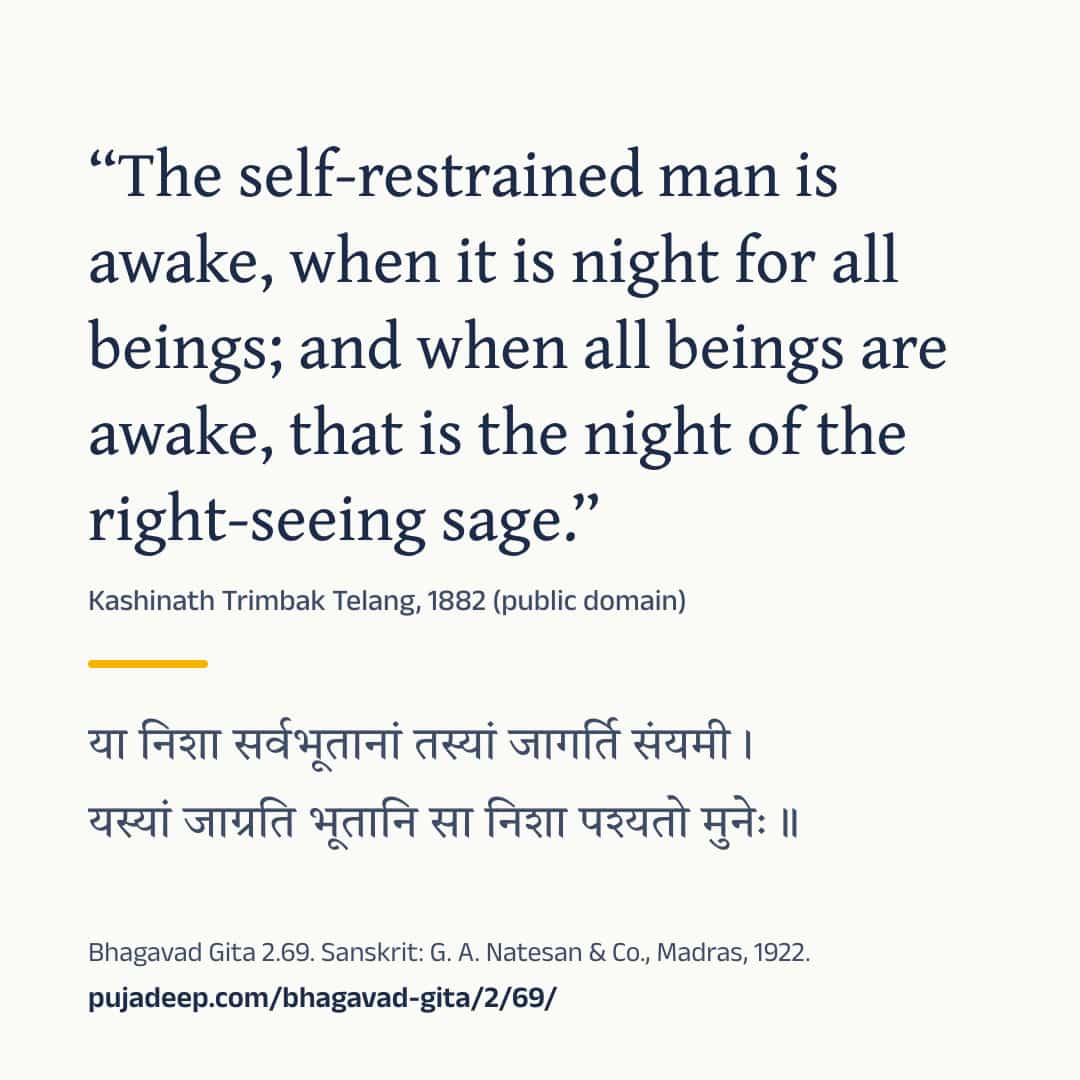
Bhagavad Gita 2.69

या निशा सर्वभूतानां तस्यां जागर्ति संयमी ।
यस्यां जाग्रति भूतानि सा निशा पश्यतो मुनेः ॥

“The self-restrained man is awake, when it is night for all beings; and when all beings are awake, that is the night of the right-seeing sage.”
(Kashinath Trimbak Telang, 1882, public domain)

“That which is the night of all beings, for the disciplined man is the time of waking; when other beings are waking, then is night for the Muni who seeth.”
(Annie Besant, 1895, public domain)

“That which is night to all beings, in that the self-controlled man wakes. That in which all beings wake, is night to the self-seeing Muni.”
(Swami Swarupananda, 1909 (first printed 1907), public domain)

Sanskrit: G. A. Natesan & Co., Madras, 1922.
https://pujadeep.com/bhagavad-gita/2/69/?s=copy Nothing is sent from this site. Your own app sends it, to the chat you choose. The picture quotes Telang (1882). If you chose another translation above, the text quotes yours and no picture is offered.
Sanskrit text: The Bhagavad-Gita, or The Lord's Song, with the text in Devanagari and an English translation, 1922. Meanings: written for Pujadeep with AI help and reviewed. Source and changes
Questions families ask
Who speaks Bhagavad Gita 2.69?
Krishna speaks this verse, in chapter 2 (Sankhya Yoga).
Where does the Sanskrit text come from?
Sanskrit text: The Bhagavad-Gita, or The Lord's Song, with the text in Devanagari and an English translation, 1922. Meanings: written for Pujadeep with AI help and reviewed. See the source
Is the meaning on this page a translation?
Explanation written for this site with AI help from the sources listed here, and reviewed. It is not a translation and not the only way to read the text. Free to quote with credit.
Source and licence
- Sanskrit text
- The Bhagavad-Gita, or The Lord's Song, with the text in Devanagari and an English translation (Annie Besant, G. A. Natesan & Co., Madras, 1922). Public domain. The Sanskrit on these pages was read from this printing’s page images.
- Translation
- The Bhagavadgîtâ with the Sanatsugâtîya and the Anugîtâ, translated by Kâshinâth Trimbak Telang (The Sacred Books of the East, vol. VIII, ed. F. Max Müller) (Kashinath Trimbak Telang, F. Max Müller, Clarendon Press, Oxford, 1882). Public domain. Shown verbatim, as printed.
- Translation
- The Bhagavad Gîtâ, or The Lord's Song, translated by Annie Besant (Annie Besant, Theosophical Publishing Society, London, 1895). Public domain. Shown verbatim, as printed.
- Sanskrit text
- Srimad-Bhagavad-Gita, with Sanskrit Text; Paraphrase with Word-by-word Literal Translation; English Rendering and Comments, Index, &c., by the Swami Swarupananda (Himalayan Series, No. XX) (Swami Swarupananda, The Editors and Publishers, Advaita Ashrama, Mayavati, Prabuddha Bharata Press, Mayavati, Almora, Himalayas, 1909). Public domain. Used only to date the text. The Devanagari on this page is a reading text and is not copied from this printing.
- Common wording
- In this text, 32 words follow today's common wording, checked against sanskritdocuments.org; Sanskrit Wikisource; Gita Press, Gorakhpur; GRETIL, Göttingen and Bhaktivedanta Book Trust.
- Our explanation
- Explanation written for this site with AI help from the sources listed here, and reviewed. It is not a translation and not the only way to read the text. Free to quote with credit.
- Review
- AI review: 2 independent reviews against the cited edition, October 15, 2026.