श्रीमद्भगवद्गीता · अध्याय 2: सांख्ययोग · वक्ता: कृष्ण
श्रीमद्भगवद्गीता 2.69 का अर्थ
श्रीमद्भगवद्गीता (Bhagavad Gita) 2.69: कृष्ण रात और दिन का उदाहरण देते हैं।
श्रीमद्भगवद्गीता 2.69
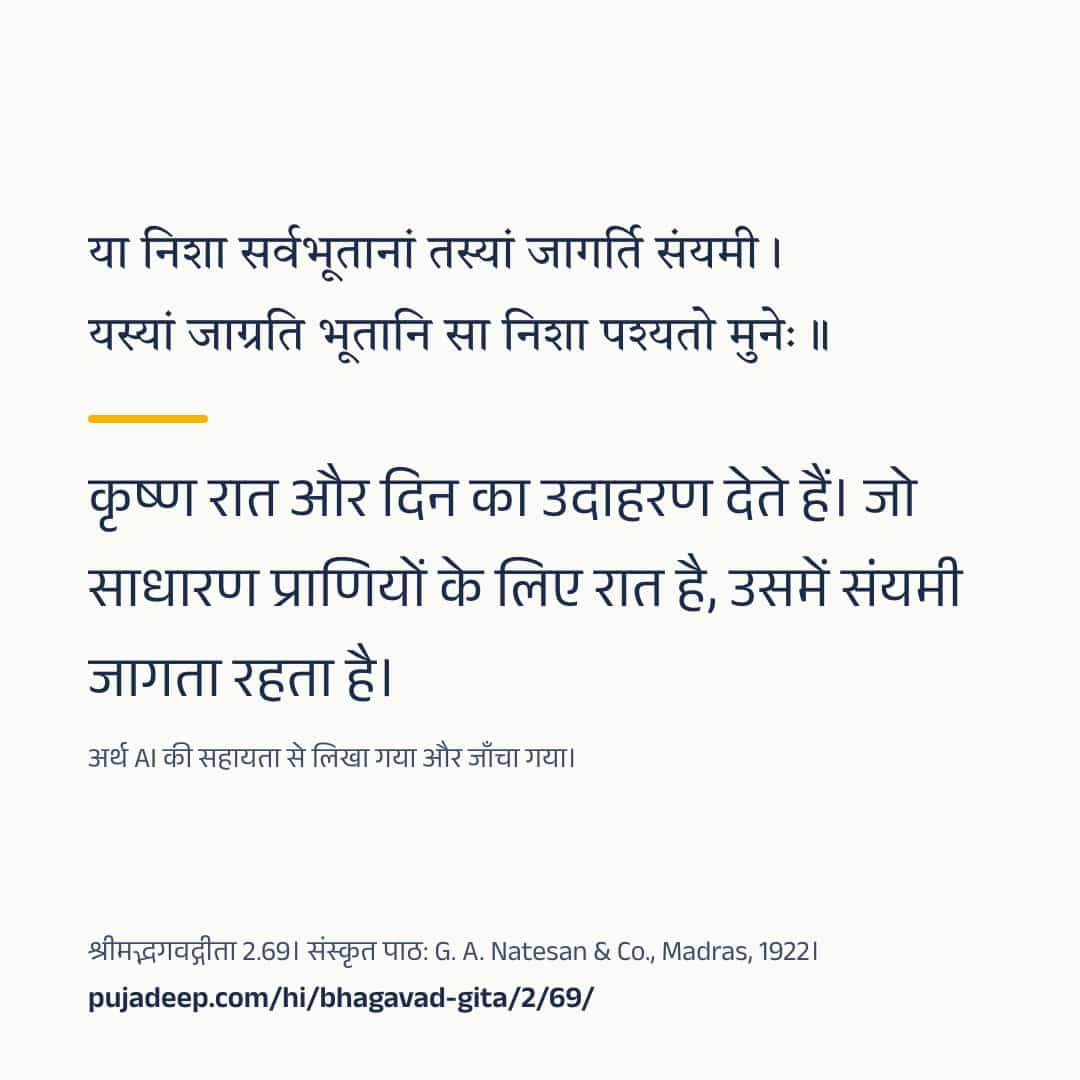
या निशा सर्वभूतानां तस्यां जागर्ति संयमी ।यस्यां जाग्रति भूतानि सा निशा पश्यतो मुनेः ॥
Ya nisha sarvabhutanam tasyam jagarti sanyami
Yasyam jagrati bhutani sa nisha pashyato muneh
yā niśā sarvabhūtānāṃ tasyāṃ jāgarti saṃyamī |
yasyāṃ jāgrati bhūtāni sā niśā paśyato muneḥ ||
हमारा अर्थ कृष्ण रात और दिन का उदाहरण देते हैं। जो साधारण प्राणियों के लिए रात है, उसमें संयमी जागता रहता है। और साधारण प्राणी जिसके प्रति जागे रहते हैं, वह सच को देखने वाले मुनि के लिए रात है।
English meaning Krishna uses an image of night and day. What is night for ordinary beings is where the self-controlled person stays awake. And what ordinary beings are awake to is night for the sage who truly sees.
शब्दार्थ
हर शब्द, शब्दकोश के पृष्ठ के साथ
शब्दार्थ
- या yā जो (सर्वनाम (स्त्रीलिंग), प्रथमा एकवचन) शब्दकोश: yad, मोनियर-विलियम्स 1899, पृ. 844, स्तंभ 2
who, which, what, whichever, whatever, that
- निशा niśā रात (संज्ञा (स्त्रीलिंग), प्रथमा एकवचन) शब्दकोश: niśā, मोनियर-विलियम्स 1899, पृ. 560, स्तंभ 2
night
- सर्वभूतानाम् sarvabhūtānām सब प्राणियों की (समास (नपुंसकलिंग), षष्ठी बहुवचन) शब्दकोश: sarva-bhūta, मोनियर-विलियम्स 1899, पृ. 1186, स्तंभ 2
all beings
- तस्याम् tasyām उसमें (सर्वनाम (स्त्रीलिंग), सप्तमी एकवचन) शब्दकोश: tad, मोनियर-विलियम्स 1899, पृ. 434, स्तंभ 1
m. he, f. she, n. it, that, this
- जागर्ति jāgarti जागता है (वर्तमान काल (लट्), प्रथम पुरुष एकवचन) शब्दकोश: jāgṛ, मोनियर-विलियम्स 1899, पृ. 417, स्तंभ 1
to be awake or watchful
- संयमी saṃyamī संयमी (संज्ञा (पुंलिंग), प्रथमा एकवचन) शब्दकोश: saṃ-yamin, मोनियर-विलियम्स 1899, पृ. 1112, स्तंभ 1
one who subdues his passions, self-controlled
- यस्याम् yasyām जिसमें (सर्वनाम (स्त्रीलिंग), सप्तमी एकवचन) शब्दकोश: yad, मोनियर-विलियम्स 1899, पृ. 844, स्तंभ 2
who, which, what, whichever, whatever, that
- जाग्रति jāgrati जागते हैं (वर्तमान काल (लट्), प्रथम पुरुष बहुवचन) शब्दकोश: jāgṛ, मोनियर-विलियम्स 1899, पृ. 417, स्तंभ 1
to be awake or watchful
- भूतानि bhūtāni प्राणी (संज्ञा (नपुंसकलिंग), प्रथमा बहुवचन) शब्दकोश: bhūta, मोनियर-विलियम्स 1899, पृ. 761, स्तंभ 3
that which is or exists, any living being
- सा sā वह (सर्वनाम (स्त्रीलिंग), प्रथमा एकवचन) शब्दकोश: tad, मोनियर-विलियम्स 1899, पृ. 434, स्तंभ 1
m. he, f. she, n. it, that, this
- निशा niśā रात (संज्ञा (स्त्रीलिंग), प्रथमा एकवचन) शब्दकोश: niśā, मोनियर-विलियम्स 1899, पृ. 560, स्तंभ 2
night
- पश्यतः paśyataḥ देखने वाले (वर्तमान कृदन्त (पुंलिंग), षष्ठी एकवचन) शब्दकोश: 1. paś, मोनियर-विलियम्स 1899, पृ. 611, स्तंभ 2
behold, look at, observe, perceive, notice
- मुनेः muneḥ मुनि की (संज्ञा (पुंलिंग), षष्ठी एकवचन) शब्दकोश: muni, मोनियर-विलियम्स 1899, पृ. 823, स्तंभ 1
a saint, sage, seer, ascetic, monk, devotee, hermit
सार्वजनिक डोमेन (कॉपीराइट-मुक्त) के अनुवाद
Kashinath Trimbak Telang, 1882। सार्वजनिक डोमेन (कॉपीराइट-मुक्त)। पृष्ठ 51।
The self-restrained man is awake, when it is night for all beings; and when all beings are awake, that is the night of the right-seeing sage1.
पाद-टिप्पणियाँ (अनुवादक की अपनी) - Spiritual matters are dark as night to the common run of men, while they are wide awake in all worldly pursuits. With the sage the case is exactly the reverse. ↩
3 अनुवादों की तुलना करें
Kashinath Trimbak Telang, 1882। सार्वजनिक डोमेन (कॉपीराइट-मुक्त)। पृष्ठ 51।
The self-restrained man is awake, when it is night for all beings; and when all beings are awake, that is the night of the right-seeing sage1.
पाद-टिप्पणियाँ (अनुवादक की अपनी) - Spiritual matters are dark as night to the common run of men, while they are wide awake in all worldly pursuits. With the sage the case is exactly the reverse. ↩
आप यही पढ़ रहे हैं
Annie Besant, 1895। सार्वजनिक डोमेन (कॉपीराइट-मुक्त)। पृष्ठ 38।
That which is the night of all beings, for the disciplined man is the time of waking; when other beings are waking, then is night for the Muni who seeth.1
पाद-टिप्पणियाँ (अनुवादक की अपनी) - The sage is awake to things over which the ordinary man sleeps, and vice versâ; the eyes of the sage are open to truths shut out from the common vision, while that which is real for the masses is illusion for the sage. ↩
आप यही पढ़ रहे हैं
Swami Swarupananda, 1909 (पहली बार 1907 में छपा)। सार्वजनिक डोमेन (कॉपीराइट-मुक्त)। पृष्ठ 60।
That which is night to all beings, in that the self-controlled man wakes. That in which all beings wake, is night to the self-seeing Muni.
आप यही पढ़ रहे हैं
भेजें
एक तस्वीर या पाठ एक चैट में भेजें। तस्वीर पर उसका स्रोत और इस पृष्ठ का पता लिखा है।
पाठ के रूप में भेजें
केवल शब्द और लिंक। कई बड़े-बुज़ुर्ग यही पसंद करते हैं।
श्रीमद्भगवद्गीता 2.69

या निशा सर्वभूतानां तस्यां जागर्ति संयमी ।
यस्यां जाग्रति भूतानि सा निशा पश्यतो मुनेः ॥

“The self-restrained man is awake, when it is night for all beings; and when all beings are awake, that is the night of the right-seeing sage.”
(Kashinath Trimbak Telang, 1882, public domain)

“That which is the night of all beings, for the disciplined man is the time of waking; when other beings are waking, then is night for the Muni who seeth.”
(Annie Besant, 1895, public domain)

“That which is night to all beings, in that the self-controlled man wakes. That in which all beings wake, is night to the self-seeing Muni.”
(Swami Swarupananda, 1909 (first printed 1907), public domain)

संस्कृत पाठ: G. A. Natesan & Co., Madras, 1922।
https://pujadeep.com/hi/bhagavad-gita/2/69/?s=copy
इस साइट से कुछ नहीं भेजा जाता। आपका अपना ऐप उसे आपकी चुनी हुई चैट में भेजता है। तस्वीर में तेलंग (1882) का अनुवाद है। अगर आपने ऊपर कोई और अनुवाद चुना है, तो पाठ में वही आता है और तस्वीर नहीं दी जाती।
संस्कृत पाठ: The Bhagavad-Gita, or The Lord's Song, with the text in Devanagari and an English translation, 1922। अर्थ: पूजादीप के लिए AI की सहायता से लिखे और जाँचे गए। स्रोत और बदलाव
परिवार जो प्रश्न पूछते हैं
गीता 2.69 कौन कहता है?
यह श्लोक कृष्ण कहते हैं, अध्याय 2 (सांख्ययोग) में।
संस्कृत पाठ कहाँ से लिया गया है?
संस्कृत पाठ: The Bhagavad-Gita, or The Lord's Song, with the text in Devanagari and an English translation, 1922। अर्थ: पूजादीप के लिए AI की सहायता से लिखे और जाँचे गए। स्रोत देखें
क्या इस पृष्ठ का अर्थ अनुवाद है?
इस साइट के लिए यहाँ दिए स्रोतों के आधार पर AI की सहायता से लिखी और जाँची गई व्याख्या। यह अनुवाद नहीं है, और पाठ को पढ़ने का एकमात्र तरीका भी नहीं है। श्रेय देकर उद्धृत करने के लिए स्वतंत्र।
स्रोत और लाइसेंस
- संस्कृत पाठ
- The Bhagavad-Gita, or The Lord's Song, with the text in Devanagari and an English translation (Annie Besant, G. A. Natesan & Co., Madras, 1922). सार्वजनिक डोमेन (कॉपीराइट-मुक्त)। इन पृष्ठों का संस्कृत पाठ इसी मुद्रण के पृष्ठ-चित्रों से पढ़ा गया है।
- अनुवाद
- The Bhagavadgîtâ with the Sanatsugâtîya and the Anugîtâ, translated by Kâshinâth Trimbak Telang (The Sacred Books of the East, vol. VIII, ed. F. Max Müller) (Kashinath Trimbak Telang, F. Max Müller, Clarendon Press, Oxford, 1882). सार्वजनिक डोमेन (कॉपीराइट-मुक्त)। जैसा छपा है, वैसा ही दिखाया गया।
- अनुवाद
- The Bhagavad Gîtâ, or The Lord's Song, translated by Annie Besant (Annie Besant, Theosophical Publishing Society, London, 1895). सार्वजनिक डोमेन (कॉपीराइट-मुक्त)। जैसा छपा है, वैसा ही दिखाया गया।
- संस्कृत पाठ
- Srimad-Bhagavad-Gita, with Sanskrit Text; Paraphrase with Word-by-word Literal Translation; English Rendering and Comments, Index, &c., by the Swami Swarupananda (Himalayan Series, No. XX) (Swami Swarupananda, The Editors and Publishers, Advaita Ashrama, Mayavati, Prabuddha Bharata Press, Mayavati, Almora, Himalayas, 1909). सार्वजनिक डोमेन (कॉपीराइट-मुक्त)। केवल यह दिखाने के लिए कि पाठ कितना पुराना है। इस पृष्ठ का देवनागरी पाठ एक पठन-पाठ है, इस मुद्रण से नहीं लिया गया।
- प्रचलित पाठ
- इस पाठ में 32 शब्द आज के प्रचलित रूप में हैं; इन्हें sanskritdocuments.org; संस्कृत विकिस्रोत; गीता प्रेस, गोरखपुर; ग्रेटिल, गॉटिंगेन और भक्तिवेदांत बुक ट्रस्ट के पाठ से मिलाकर जाँचा गया।
- हमारी व्याख्या
- इस साइट के लिए यहाँ दिए स्रोतों के आधार पर AI की सहायता से लिखी और जाँची गई व्याख्या। यह अनुवाद नहीं है, और पाठ को पढ़ने का एकमात्र तरीका भी नहीं है। श्रेय देकर उद्धृत करने के लिए स्वतंत्र।
- समीक्षा
- AI समीक्षा: उद्धृत संस्करण के विरुद्ध 2 स्वतंत्र समीक्षाएँ, 15 अक्टूबर 2026।