Arjuna Sees the Universal Form
ages 11-14
After hearing Krishna teach, Arjuna asks to see him as he truly is. Krishna gives him divine sight, and Arjuna sees the whole universe in one form, bright as a thousand suns, until, overwhelmed, he asks to see his friend again.
Written for Pujadeep and checked against the sources listed.
The story
On the field of Kurukshetra, Krishna had been teaching Arjuna for a long time: about the Self that never dies, about doing one's duty without clinging to the reward, and about how everything in the world comes from God and returns to God. In the tenth chapter of the Gita, Krishna named some of his glories: among lights he is the sun, among rivers the Ganga, among things that never move, the Himalaya.
Arjuna listened, and then he said: "My confusion has gone. I have heard you speak of your greatness. Now, if you think it is possible for me, I wish to see that form of yours with my own eyes."
"See my forms by the hundred and the thousand," said Krishna, "of every colour and shape. See the whole universe, everything that moves and everything that does not, gathered in one place in my body. But you cannot see me with these ordinary eyes. I will give you divine sight."
Sanjaya, describing the scene to the blind king, could hardly find words. If a thousand suns rose in the sky at once, he said, their light might be like the light of that form. Arjuna saw countless faces and eyes, countless arms, divine garlands and jewels, and inside that one body, the whole universe in all its parts.
Arjuna's hair stood on end. He folded his hands and bowed. "I see the gods in your body," he said, "and Brahma on his lotus, and all the sages. I see no end to you, no middle and no beginning. The sun and the moon are your eyes."
But the form was also terrible. Arjuna saw time itself in it, the time that brings every life to its end, and he saw the warriors of both armies streaming into it like rivers rushing to the sea. He was afraid. "Who are you, in this fierce form?" he asked. Krishna answered that he was Time, which ends all things, and that what was coming would come whether Arjuna fought or not; Arjuna should be only the instrument.
Arjuna bowed again and again. "Forgive me," he said, "for every time I called you 'Krishna' or 'friend' without knowing who you were, joking with you, sitting and eating with you. Forgive me as a father forgives a son, a friend a friend. I am glad I have seen this, but my heart is shaking. Please show me your gentle form again."
So Krishna became gentle again, first with four arms, holding the mace and the discus, and then simply himself, Arjuna's friend and charioteer. "Do not be afraid," he said. "No one has seen this form through study of the Vedas, or sacrifices, or gifts, or hard penance. It can be known only through loving devotion."
Teachers of different schools have read this chapter in their own ways: as showing that the whole world is God's body, or that all forms are one reality appearing as many, or that God is far greater than the world he holds. The Gita itself leaves Arjuna where many readers find themselves: amazed, a little afraid, and glad to see his friend's face again. Families who read it together often take from it that the One beyond all imagining can also be close enough to call a friend.
Something to do together
On a clear night, or with a picture of the Milky Way, try to imagine "the light of a thousand suns". Then make a family vishvarupa: each person draws one thing from the world they love, and you put all the drawings together inside one big outline.
Gita Jayanti: the festival this story belongs to
More stories
For grown-ups
The story ends above. Here, for grown-ups: how families tell it in other ways, and the books it comes from.
How the story differs, and where it comes from
How the story differs
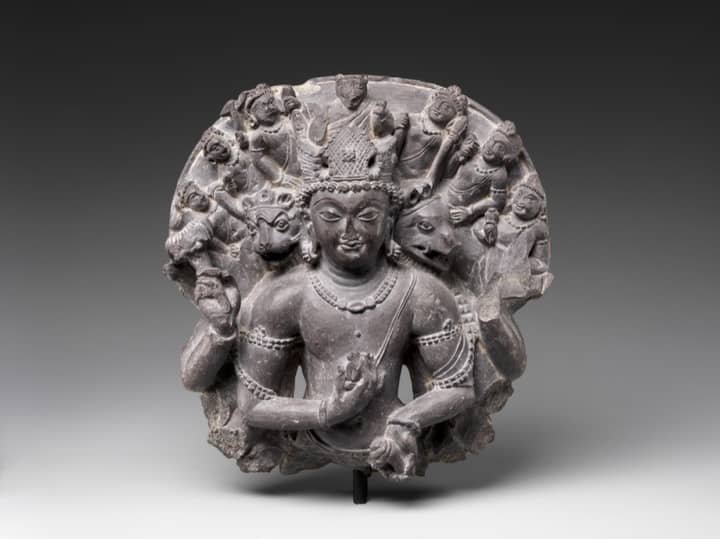
Paintings and temple carvings across India show the vishvarupa, the universal form, with many heads and arms. In the Mahabharata, Krishna shows a similar form at the Kaurava court in the Udyoga Parva, when he goes as a messenger of peace. Shankara, Ramanuja and Madhva each comment on this chapter, and their readings differ; none is given here as the chapter's only sense.
Where the story comes from
- Bhagavad Gita (Mahabharata, Bhishma Parva), chapter 11, with the end of chapter 10 (10.19–42 (Krishna's glories); 11.1–8 (Arjuna's request and the divine eye); 11.9–31 (the form described by Sanjaya and Arjuna); 11.32–34 (Time); 11.35–46 (Arjuna's plea for pardon); 11.47–55 (the gentle form, and devotion))
- The Bhagavadgîtâ with the Sanatsugâtîya and the Anugîtâ, translated by Kâshinâth Trimbak Telang (The Sacred Books of the East, vol. VIII, ed. F. Max Müller) (Chapter X, pp. 86–91 (leaves n99–n104); chapter XI, pp. 92–98 (leaves n105–n111))
Sources
- The Bhagavadgîtâ with the Sanatsugâtîya and the Anugîtâ, translated by Kâshinâth Trimbak Telang (The Sacred Books of the East, vol. VIII, ed. F. Max Müller) (Chapters X–XI, pp. 86–98 (leaves n99–n111))
- The Mahabharata of Krishna-Dwaipayana Vyasa, translated into English prose (K. M. Ganguli), published by Protap Chandra Roy: Virata Parva and Udyoga Parva (Calcutta: Bharata Press, 1886) (Udyoga Parva (Bhagavat-yana Parva), Section CXXX, pp. 379–381 (leaves n598–n600): Krishna laughs, gods no bigger than a thumb issue from his body, and he gives celestial sight to Drona, Bhishma, Vidura, Sanjaya and the sages; 5.129 in the Critical Edition)
Source and licence
- Our explanation
- Written for this site from the sources listed here, and checked against them. Free to quote with credit.
- Checked
- Checked against the sources listed, October 15, 2026.