Ekalavya and His Teacher
ages 11-14
Turned away by the great teacher Drona because of his birth, the young archer Ekalavya makes a clay image of Drona and teaches himself until he outshines the princes. When Drona asks for his right thumb as the teacher's fee, Ekalavya gives it without a word of complaint.
Written for Pujadeep and checked against the sources listed.
The story
In the days when the Pandava and Kaurava princes were boys, they were taught archery by the great teacher Drona. Of all his pupils, Arjuna practised hardest. He practised even in the dark, until Drona hugged him and promised, "I will make sure that no archer in the world is your equal."
Princes came from many lands to learn from Drona. Among them came Ekalavya, the son of Hiranyadhanu, king of the Nishadas, a forest people. Drona refused to take him as a pupil. The Mahabharata gives the reason plainly: Ekalavya was a Nishada, and Drona thought that in time he might surpass the high-born princes.
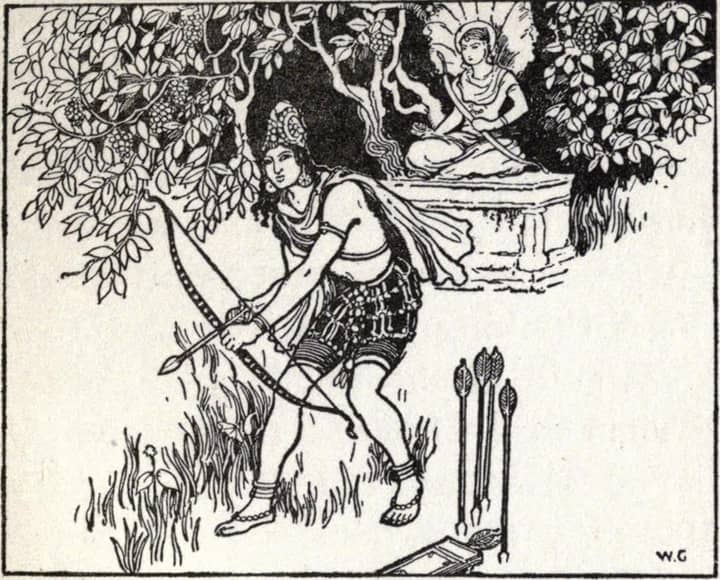
Ekalavya did not argue. He touched Drona's feet, bowed his head, and went back into the forest. There he made an image of Drona out of clay, honoured it as if it were his real teacher, and practised in front of it every day with great discipline. Because of his reverence for his teacher and his own determination, fitting an arrow, aiming and letting go all became easy for him.
One day the princes went hunting in that forest, with a servant and a dog. The dog wandered off, found Ekalavya, a stranger dressed in black with matted hair, and began to bark. Before it could close its mouth, Ekalavya had sent seven arrows into its mouth, so fast and so precisely that the dog came running back to the princes unable to bark. Many tellings today add that the arrows did not hurt the dog.
The princes were amazed, and a little ashamed of their own skill. They searched the forest and found the archer. "Who are you?" they asked. "I am the son of Hiranyadhanu, king of the Nishadas," he answered, "and a pupil of Drona."
Arjuna could not stop thinking about it. He went to Drona in private. "You promised that no pupil of yours would equal me," he said. "So why is there a pupil of yours, the Nishada king's son, who is better than me?"
Drona thought for a moment. Then he took Arjuna with him to the forest. When Ekalavya saw Drona coming, he ran to meet him, touched his feet and stood before him with joined hands, ready to obey. "If you are truly my pupil," said Drona, "give me my teacher's fee." "Command me," said Ekalavya. "There is nothing I would not give my teacher." Drona said, "Give me the thumb of your right hand."
The Mahabharata itself calls these cruel words. Ekalavya, true to his word, cut off his thumb with a cheerful face and an untroubled heart, and gave it to Drona. When he took up his bow again, he found he had lost his old speed. Arjuna's jealousy was gone, and he went on to become the greatest archer of his time.
People read this story in more than one way. Many remember Ekalavya on Guru Purnima as the greatest example of devotion to a teacher: he learned from a teacher who had turned him away, and gave him everything when asked. Many others read it as a story of injustice, in which a gifted young man was refused because of his birth and then made to pay so that a prince could stay first. The Mahabharata tells it without hiding either side, and both readings are honest ones. Families who tell it often take from it both a reverence for those who teach us and a question about what a teacher owes in return.
Something to do together
Write a thank-you note together to a teacher who has helped you, at school, in music, in sport or at the temple. Then talk about Ekalavya: was Drona right or wrong, and what would a good teacher have done? Let everyone give their own answer.
Guru Purnima: the festival this story belongs to
More stories
For grown-ups
The story ends above. Here, for grown-ups: how families tell it in other ways, and the books it comes from.
How the story differs, and where it comes from
How the story differs
Guru Purnima is also called Vyasa Purnima, after Vyasa, the teacher who is said to have arranged the Vedas and composed the Mahabharata, and families honour their own teachers on that day. Many tribal communities, for example Bhil communities in western and central India, hold Ekalavya up as their own hero.
Where the story comes from
- Mahabharata, Book 1 (Adi Parva), Sambhava Parva: Drona's pupils and Ekalavya (Section 134 in Ganguli's translation (Adi Parva 1.123 in the Pune Critical Edition))
- The Mahabharata of Krishna-Dwaipayana Vyasa, translated into English prose (K. M. Ganguli), published by Protap Chandra Roy: Adi Parva (Calcutta: Bharata Press, 1884) (Adi Parva, Section CXXXIV, pp. 392–395 (leaves n425–n428))
Sources
- The Mahabharata of Krishna-Dwaipayana Vyasa, translated into English prose (K. M. Ganguli), published by Protap Chandra Roy: Adi Parva (Calcutta: Bharata Press, 1884) (Adi Parva, Section CXXXIV, pp. 392–395 (leaves n425–n428))
Source and licence
- Our explanation
- Written for this site from the sources listed here, and checked against them. Free to quote with credit.
- Checked
- Checked against the sources listed, October 15, 2026.
- Updated
- October 25, 2026