The Dance under the Autumn Moon
ages 11-14
On a bright autumn night Krishna plays his flute, and the gopis of Vraja leave everything to come to him. When they grow proud, he vanishes; they search the forest and sing for him; and when he returns, he dances with them in a great circle in which each one feels him beside her.
Written for Pujadeep and checked against the sources listed.
The story
It was autumn in Vraja. The jasmine was in flower, and the nights were cool and clear. One evening the full moon rose in the east, round and golden-red, and filled the forest with soft light. Krishna looked at the moonlit woods and began to play his flute.
The gopis, the women of the cowherd village, heard the music, and they could not stay still. One was milking a cow and left the pail. One had milk on the fire and left it there. One was feeding her family, one was putting kohl on her eyes, one was dressing. They left everything and ran through the night to the place where the flute was playing, each one hardly noticing the others. Their families tried to hold them back, but they did not turn back; they could think only of Krishna.
Krishna welcomed them, but then he told them to go home. The night was dark, he said, their families would be looking for them, and they could show their love by hearing about him and thinking of him. In tears, the gopis answered that they had left everything for him, because he was the dearest one, the Self within every being. Then Krishna smiled, and they sang and walked together in the moonlight. But soon each gopi began to think, "Krishna is here for me. Surely I am the most fortunate of all." When Krishna saw that their joy had turned into pride, he suddenly vanished.
The gopis were lost without him. They wandered from tree to tree, asking: "Ashvattha, banyan, have you seen him pass? Tulasi, you who love his feet, have you seen him? Gentle deer, did he come this way?" They thought of him so hard that they began to walk like him, talk like him and play the way he played.
At last they sat together on the bank of the Yamuna and sang to him, pouring out their longing in a song that families still sing today, called the Gopi Gita. They had stopped thinking about themselves at all. They only wanted him.
Then Krishna appeared again among them, smiling, in his yellow robe and his garland. The gopis rose up all at once, like a body when life comes back into it. "Why did you leave us?" they asked. Krishna answered that he had gone away only so that their love would grow deeper, the way a poor man who loses a treasure thinks of nothing else. "No one could repay a love like yours," he said.
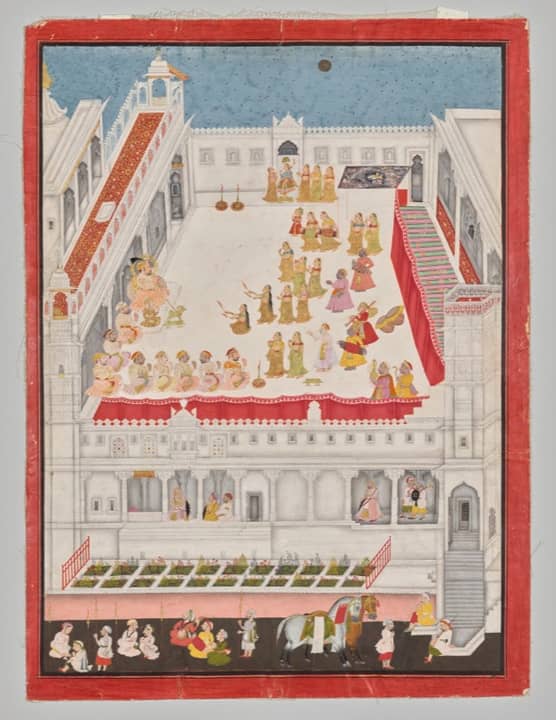
Then, on the smooth white sand of the Yamuna, the rasa dance began. The gopis joined hands in a great circle, and Krishna, by his wonderful power, was there between every two of them, so that each one felt he was dancing at her side. Their bangles and anklets rang, they sang his praises, and the gods came in their chariots to watch and showered flowers from the sky. The moon and the stars, it is said, stood still in wonder.
The Bhagavata itself says that Krishna is the witness who lives within the gopis, within their husbands and within every living being, and that no one else should do what he did here, even in thought. Many Vaishnava teachers read the gopis as the picture of a soul that loves God with its whole heart, forgets itself and wants nothing else. Families who stay up on Sharad Purnima to sit in the moonlight often take from it that pride pushes the beloved away, and humble longing brings him near.
Something to do together
On the night of Sharad Purnima, sit outside or by a window together and look at the moon. Make kheer and set a bowl in the moonlight. Then talk it over: when has pride pushed someone away from you, and what brought you back together?
Sharad Purnima: the festival this story belongs to
More stories
For grown-ups
The story ends above. Here, for grown-ups: how families tell it in other ways, and the books it comes from.
How the story differs, and where it comes from
How the story differs
Sharad Purnima, the full moon after the rains, is kept in Braj as the night of the rasa, which is danced and sung there. In Bengal, Assam and Mithila the same full moon is Kojagari Lakshmi Puja, when families stay awake for the goddess; in Odisha it is Kumar Purnima; and in Gujarat many dance garba under the moon. Many families leave a bowl of kheer out in the moonlight overnight and eat it in the morning.
Where the story comes from
- Bhagavata Purana, Book 10 (Dashama Skandha), chapters 29–33 (the Rasa-panchadhyayi) (10.29 (the autumn night, the flute, the gopis leaving their work, his vanishing at their pride); 10.30 (the search among the trees); 10.31 (the Gopi Gita); 10.32 (his return and his answer); 10.33 (the rasa circle, the gods' flowers, the moon and stars standing still, and Parikshit's question on how to understand it))
- Le Bhâgavata Purâna ou Histoire poétique de Krïchna, tome quatrième (Livre X, première partie), traduit par M. Hauvette-Besnault (Paris: Imprimerie nationale, 1884) (Livre X, chapitres XXIX–XXXIII, pp. 139–161 (leaves n161–n183))
Sources
- Le Bhâgavata Purâna ou Histoire poétique de Krïchna, tome quatrième (Livre X, première partie), traduit par M. Hauvette-Besnault (Paris: Imprimerie nationale, 1884) (Livre X, chapitres XXIX–XXXIII, pp. 139–161 (leaves n161–n183))
- Brâhmanism and Hindûism; or, Religious Thought and Life in India, by Sir Monier Monier-Williams, fourth edition (New York: Macmillan, 1891) ('Vallabha sect', p. 136 (leaf n171): in the higher Vaishnava creed the gopis' love for Krishna symbolizes the longing of the soul for union with the Supreme)
Source and licence
- Our explanation
- Written for this site from the sources listed here, and checked against them. Free to quote with credit.
- Checked
- Checked against the sources listed, October 15, 2026.