Dhruva, the Pole Star
ages 3-6
Little Prince Dhruva is told he may not sit on his father's lap. He goes to the forest and prays to Vishnu with all his heart, and Vishnu gives him a place in the sky that never moves.
Written for Pujadeep and checked against the sources listed.
The story
Long ago there was a king called Uttanapada. He had two queens, Suniti and Suruchi. Suniti's son was Dhruva. Suruchi's son was Uttama.
One day the king sat on his throne with Uttama on his lap. Little Dhruva was only five years old. He wanted to sit on his father's lap too, so he went up to the king.
But Queen Suruchi said, "This lap is not for you, Dhruva." The king said nothing at all. Dhruva's eyes filled with tears, and he ran to his mother.
Suniti held him close. "Do not be sad, my darling," she said. "Be kind and good to everyone. And pray to Lord Vishnu, who cares for us all."
So Dhruva set off for the forest. On the way he met the kind sage Narada. Narada taught him a prayer: "Om namo bhagavate vasudevaya."
Dhruva sat by the river Yamuna, in a forest called Madhuvana. He sat very, very still. He said his prayer and thought only of Vishnu. Days went by, and weeks went by, and still Dhruva prayed.
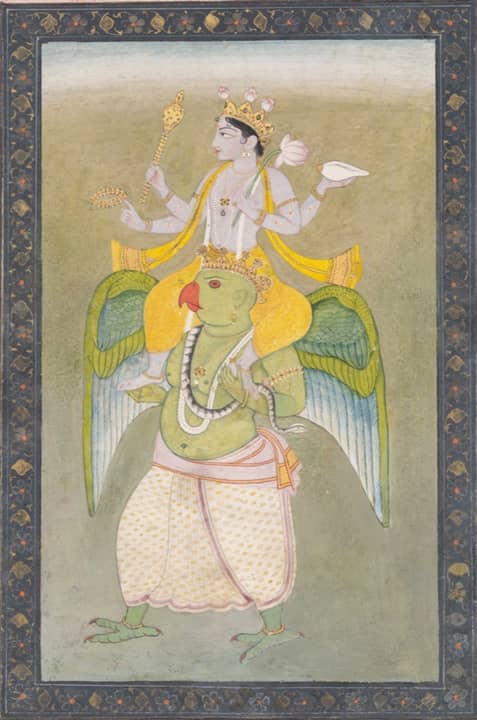
Then Vishnu came. He stood before Dhruva, shining and smiling. Dhruva opened his eyes, but he could not find any words. So Vishnu gently touched Dhruva's cheek with his conch shell. At once, beautiful words of praise came pouring out of the little boy.
Vishnu said, "Dhruva, you will have a place in the sky that never moves. All the stars will turn around you."
Dhruva went home. His father ran to meet him and hugged him tight. Dhruva grew up to be a good king. And at last he went to his place in the sky.
Look up on a clear night. The stars move slowly round the sky, but one of them stays still. People call it Dhruva Tara, the Pole Star.
Something to do together
On a clear night, look north together for the Pole Star. First find the seven stars of the Saptarishi, which some call the Big Dipper, then follow the two stars at the end of its bowl to Dhruva. If you live south of the equator, in Australia, New Zealand or Fiji, the Pole Star stays below the horizon, so draw it instead, with the other stars circling round it.
More stories
For grown-ups
The story ends above. Here, for grown-ups: how families tell it in other ways, and the books it comes from.
How the story differs, and where it comes from
How the story differs
The Vishnu Purana and the Bhagavata tell Dhruva's story a little differently. In the Vishnu Purana, the seven sages teach him how to pray, and his mother Suniti also becomes a bright star near him. In the Bhagavata, the sage Narada teaches him the prayer "Om namo bhagavate vasudevaya". In Sanskrit and many Indian languages, dhruva means steady, firm and fixed. In Braj, near Mathura, pilgrims on the walk round the forests of Braj still visit Madhuvan, which they remember as the forest where Dhruva prayed.
Where the story comes from
- Bhagavata Purana, Book 4 (Chaturtha Skandha), chapters 8–9 (4.8 (Suruchi's words, Suniti's advice, Narada's teaching, the prayer at Madhuvana); 4.9 (Vishnu appears, touches Dhruva's cheek with his conch, Dhruva returns home))
- A Prose English Translation of Srimadbhagabatam, Books I–VI, edited and published by Manmatha Nath Dutt (Calcutta: Elysium Press, 1895–96) (Book IV, chapters VIII–IX, pp. 33–48 (leaves n336–n351))
- Vishnu Purana, Book 1, chapters 11–12 (1.11 (Dhruva's grief, his mother's advice, the seven sages); 1.12 (his prayer, Vishnu's conch, the pole star))
- The Vishnu Purana, a system of Hindu mythology and tradition, translated by H. H. Wilson (London: John Murray, 1840) (Book I, chapters XI–XII, pp. 86–97 (leaves n184–n195))
Sources
- A Prose English Translation of Srimadbhagabatam, Books I–VI, edited and published by Manmatha Nath Dutt (Calcutta: Elysium Press, 1895–96) (Book IV, chapters VIII–IX, pp. 33–48 (leaves n336–n351))
- The Vishnu Purana, a system of Hindu mythology and tradition, translated by H. H. Wilson (London: John Murray, 1840) (Book I, chapters XI–XII, pp. 86–97 (leaves n184–n195))
Source and licence
- Our explanation
- Written for this site from the sources listed here, and checked against them. Free to quote with credit.
- Checked
- Checked against the sources listed, October 12, 2026.
- Updated
- October 15, 2026