Ganesha Goes Round the World
ages 3-6
Shiva and Parvati set their two sons a race round the whole world. Kartikeya flies off on his peacock, but Ganesha walks round his parents, because to him they are the whole world.
Written for Pujadeep and checked against the sources listed.
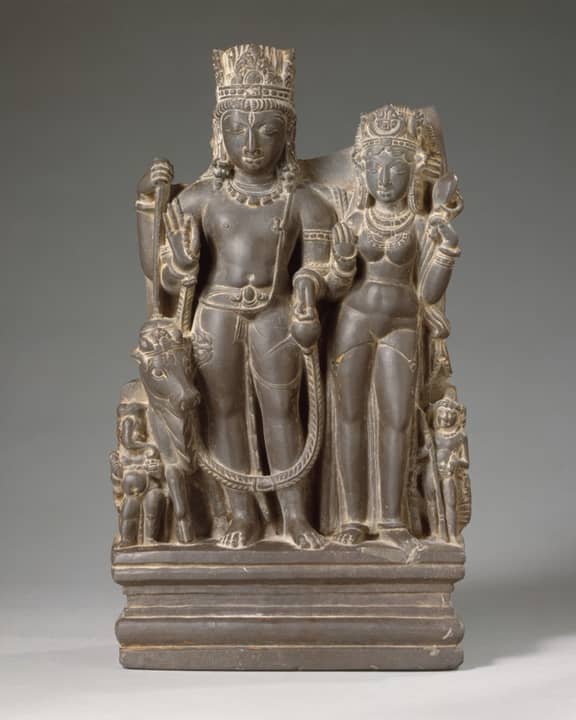
The story
Lord Shiva and Goddess Parvati had two sons. Kartikeya was quick and strong, and he rode a peacock. Ganesha was round and wise, and he rode a little mouse.
One day the sage Narada came to Mount Kailasa with a very special fruit. Both brothers wanted it. "There is only one fruit," said Shiva with a smile. "So let us have a race."
"Whoever goes all the way round the world and comes back first will get the fruit," said Parvati.
Kartikeya jumped on his peacock. Whoosh! Off he flew, over the mountains, over the rivers, over the wide blue sea.
Ganesha looked at his little mouse. The mouse looked at Ganesha. The world was very big, and the mouse was very small. So Ganesha sat down and thought.
Then Ganesha smiled. He asked his mother and father to sit side by side. He folded his hands and walked round them, slowly and carefully. Then he bowed to them.
"Why did you walk round us?" asked Shiva. "You and Mother are my whole world," said Ganesha. "So I have gone round the whole world."
Shiva and Parvati laughed with joy, and they gave the fruit to Ganesha.
When Kartikeya flew home, tired and dusty, he felt sad, and he went off to sit on a hill by himself. Shiva and Parvati went after him. They hugged him and said, "You are our fruit, our sweet one."
Families who tell this story often take from it that, to a child, a mother and father are the whole world.
Something to do together
Ask everyone at home to sit together in a circle. Let the child walk slowly round the whole family, then give each person a hug. Or draw a big circle on paper and fill it with the people and things that are your child's whole world.
More stories
For grown-ups
The story ends above. Here, for grown-ups: how families tell it in other ways, and the books it comes from.
How the story differs, and where it comes from
How the story differs
This race is told in different ways. In the Shiva Purana the prize is not a fruit: the son who comes back first will be married first, Ganesha wins and marries Siddhi and Buddhi (many families today name them Riddhi and Siddhi), and Kartikeya goes to live on the Krauncha mountain. There Shiva and Parvati go to see him, and Shiva is worshipped as Mallikarjuna, the name of the shrine at Srisailam in Andhra Pradesh. In tellings from Tamil Nadu, the sage Narada brings a single fruit to Kailasa: in some it is a mango, and in others it is the jnana pazham, the fruit of knowledge. There, Kartikeya, called Murugan, goes to the hill of Palani, and Shiva and Parvati tell him, "Pazham nee", "you are the fruit"; families say the name Palani comes from these words, though old Tamil (Sangam) poems call the town Pothini, a name that later became Palani. This story follows the Tamil fruit tellings, which come from temple and family tradition, not from the Shiva Purana: the fruit, Narada's visit and the parents' words on the hill are from that tradition.
Where the story comes from
- Shiva Purana, Rudra Samhita, Kumara Khanda (the fourth section), chapters 19–20 in the commonly printed numbering (The race round the earth and Ganesha's circling of his parents (chapter 19); there the prize is the first wedding)
- Śivapurāṇam, Sanskrit text, edited by Panchanan Tarkaratna (Calcutta: Vangavasi Steam Machine Press, Śaka 1812, that is 1890–91); title page, leaf n4, reads 'Śakābdāḥ 1812' (Jnana Samhita, chapters 35–37 in this printing, leaves n75–n77: the parents plan their sons' weddings; whoever goes round the earth first marries first; Ganesha seats and worships his parents and walks round them; he marries Siddhi and Buddhi, daughters of Vishvarupa; Skanda goes to the Krauncha mountain, where Shiva follows and is worshipped as Mallikarjuna)
- Tamil temple and family tradition of Palani (Pazhani), the hill shrine of Murugan (Kartikeya) (The fruit brought by Narada and Shiva and Parvati's words to Murugan on the hill; a living oral and temple tradition with no single text)
Sources
- Shiva Purana, Rudra Samhita, Kumara Khanda, chapters 19–20 (Ganesha's marriage to Siddhi and Buddhi after the race round the earth) (chapter numbers as commonly printed; not checked on a page image. The 1890 printing below has the same episode in another division of the text)
- Śivapurāṇam, Sanskrit text, edited by Panchanan Tarkaratna (Calcutta: Vangavasi Steam Machine Press, Śaka 1812, that is 1890–91). Summarised in our words, never quoted: the editor died in 1940 (Jnana Samhita, chapters 35–37 (colophon of chapter 34 and opening of 35 on leaf n75; the marriage, chapter 36, on leaf n76; Krauncha and Mallikarjuna, chapter 37, on leaf n77))
- Palani (Pazhani) temple tradition: the jnana pazham, the race, and the words 'Pazham nee' (oral and temple tradition, told with variants (mango or fruit of knowledge))
Source and licence
- Our explanation
- Written for this site from the sources listed here, and checked against them. Free to quote with credit.
- Checked
- Checked against the sources listed, October 15, 2026.