How Ganga Came Down to Earth
ages 3-6
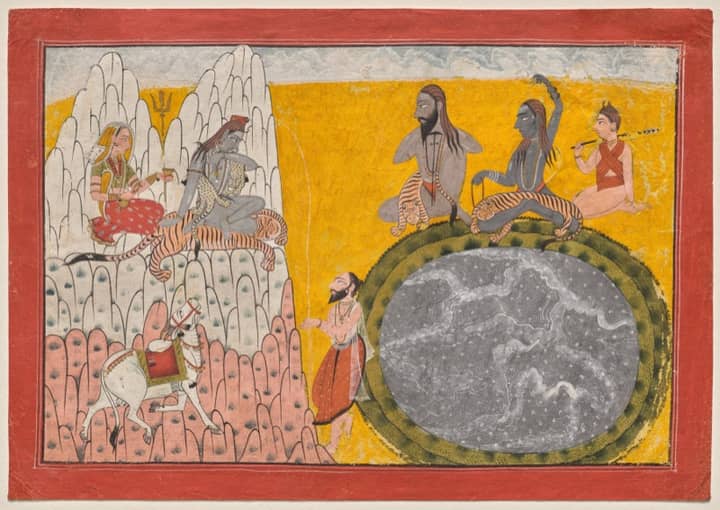
King Bhagiratha prays for years to bring the river Ganga down from heaven. Shiva catches her in his long hair so that her rush does not break the earth, and Ganga follows Bhagiratha all the way to the sea.
Written for Pujadeep and checked against the sources listed.
The story
Long, long ago, the river Ganga did not flow on earth. She flowed only in heaven, bright and pure and sparkling.
On earth there lived a good king called Bhagiratha. His ancestors, the sons of King Sagara, were waiting deep under the earth, near the sea. Only Ganga's holy water could carry them up to heaven.
So Bhagiratha went to the mountains to pray. He prayed in the cold and in the rain. He prayed for years and years. At last Brahma came. "Ganga will come down," said Brahma. "But she is very strong. Only Shiva can catch her."
So Bhagiratha prayed to Shiva. He stood on one toe for a whole year! Then Shiva smiled. "I will catch her on my head," he said.
Ganga came rushing down from the sky, splash, whoosh, roar! She was so big and so fast. But Shiva stood very still. Ganga fell into his long, thick, tangled hair, and she went round and round in it, like a river in a deep forest.
Then Shiva gently let her go, a little at a time. Now Ganga flowed softly down to the earth, sparkling in the morning sun, with fish and dolphins jumping in her waves.
Bhagiratha rode ahead in his chariot, and Ganga followed him, over the plains, past villages and forests, all the way to the great sea. Gods and sages came to watch, and everyone was happy.
At the sea, Ganga's water reached Bhagiratha's ancestors, and they rose up happily to heaven. Because Bhagiratha brought her, Ganga is also called Bhagirathi.
Families who tell this story often take from it that patient, steady effort can bring something wonderful into the world.
Something to do together
Make a little Ganga together. Pour a cup of water slowly through a sponge or a bunch of wool, the way Shiva's hair slowed the river, and watch it come out gently. Then draw the river winding from the mountains all the way to the sea.
Makar Sankranti: the festival this story belongs to
More stories
For grown-ups
The story ends above. Here, for grown-ups: how families tell it in other ways, and the books it comes from.
How the story differs, and where it comes from
How the story differs
At Makar Sankranti, many pilgrims bathe at Gangasagar in West Bengal, where the Ganga meets the sea and where tradition places the hermitage of the sage Kapila. That link with the festival comes from later custom, not from the Ramayana. The Ramayana also tells how the sage Jahnu once drank up the river and let her out again, so she is called Jahnavi too.
Where the story comes from
- Valmiki Ramayana, Book 1 (Bala Kanda), cantos 42–44 in Griffith's numbering (the sage Vishvamitra tells the story to Rama) (Canto 42 (Sagar's sons and Garuda's counsel); 43 (Bhagirath's penance and Brahma's boon); 44 (Shiva holds Ganga in his hair, the river follows Bhagirath to the sea))
- The Rámáyan of Válmíki, translated into English verse by Ralph T. H. Griffith, vol. I: Book I (London: Trübner; Benares: E. J. Lazarus, 1870) (Book I, cantos XLII–XLIV, pp. 184–198 (leaves n219–n233))
Sources
- The Rámáyan of Válmíki, translated into English verse by Ralph T. H. Griffith, vol. I: Book I (London: Trübner; Benares: E. J. Lazarus, 1870) (Book I, cantos XLII–XLIV, pp. 184–198 (leaves n219–n233))
Source and licence
- Our explanation
- Written for this site from the sources listed here, and checked against them. Free to quote with credit.
- Checked
- Checked against the sources listed, October 12, 2026.
- Updated
- October 15, 2026