Jagannath and the Closed Door
ages 3-6
King Indradyumna longs to see the Lord. A mysterious old carpenter offers to carve the holy images behind a closed door, if no one looks in. The king peeks too soon, and that is why Jagannath has big round eyes and no hands or feet.
Written for Pujadeep and checked against the sources listed.
The story
Long ago there was a king called Indradyumna. He loved Lord Vishnu very much. He heard that Vishnu lived in the blue hills of Odisha, by the sea, in a form called Nilamadhava. So the king set off to see him.
But when the king arrived, the Lord had hidden himself away. The king was so sad that he cried. Then a voice spoke from the sky. "Make an image out of wood," it said, "and the Lord will live in it."
Soon an old carpenter came to the king. "I will make the images for you," he said. "But you must shut me inside the room, and no one may look at me until I have finished. If anyone looks, I will stop at once."
The king promised. The door was closed. Inside, the king could hear the carpenter working: tap, tap, tap. Day after day, tap, tap, tap.
The king waited and waited, for fifteen whole days. Then he could not wait any longer. "What is happening in there?" he wondered. And he opened the door and peeked in.
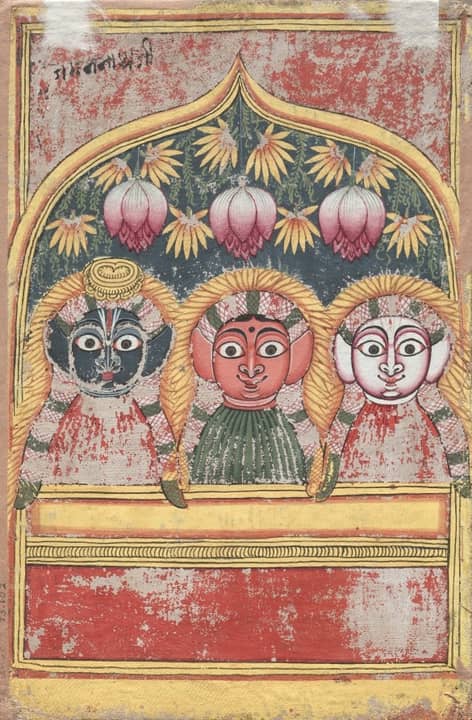
The carpenter had stopped work at once, just as he had said. The images were not finished. They had big, round, wide-open eyes, but no hands and no feet. The king was very sorry. He had broken his promise.
So the king went to Brahma, and Brahma comforted him. "Do not be sad," he said. "I will make this image famous, just as it is." Brahma gave life to the images, and the king put them in a great temple by the sea. There were three of them: Jagannath, the Lord of the World, his brother Balabhadra and his sister Subhadra.
Many people say the old carpenter was Vishvakarma, the builder of the gods, and some say he was Vishnu himself. And every year, at Rath Yatra, Jagannath and his brother and sister come out of the temple and ride through the streets on huge chariots, so that everyone can see those big round eyes.
Families who pull the chariot ropes at Rath Yatra often take from this story that the Lord comes out to meet everyone, just as he is.
Something to do together
Make a little chariot from a shoebox with bottle-top wheels and a string to pull it. Draw Jagannath's big round eyes on a paper circle and set him inside. Then take turns pulling the chariot round the house, singing as you go.
Rath Yatra: the festival this story belongs to
More stories
For grown-ups
The story ends above. Here, for grown-ups: how families tell it in other ways, and the books it comes from.
How the story differs, and where it comes from
How the story differs
The story is told in several ways. One telling, from the Ain-i-Akbari, says the image came from a log of wood that floated in from the sea. Others say the old carpenter was Vishvakarma, or Vishnu himself in disguise. In the telling W. W. Hunter heard in Odisha in 1872, Vishnu comes as an aged carpenter and is sealed in the temple for twenty-one days, and the queen persuades the king to open the door early. At Puri, the images are carved again from new wood once in many years, in a ceremony called Nabakalebara. Rath Yatra is now held in many cities around the world.
Where the story comes from
- Temple tradition of Jagannath at Puri, as recorded in English before 1931 from a Bengali account, from William Ward's account, and in Odisha by W. W. Hunter (Indradyumna, Nilamadhava hidden, the voice from the sky, the carpenter's condition, the king looking after fifteen days, the image left unfinished, Brahma giving it eyes and a soul)
- Hindu Mythology, Vedic and Puranic, by W. J. Wilkins (Calcutta: Thacker, Spink; London: W. Thacker, 1882) ('Jagannath', pp. 208–211 (leaves n227–n230))
- Orissa, by W. W. Hunter, vol. I (London: Smith, Elder, 1872) ('The Legend of Jagannath', pp. 89–93 (leaves n111–n115))
Sources
- Hindu Mythology, Vedic and Puranic, by W. J. Wilkins (Calcutta: Thacker, Spink; London: W. Thacker, 1882) ('Jagannath', pp. 208–211 (leaves n227–n230))
- Orissa, by W. W. Hunter, vol. I (London: Smith, Elder, 1872) ('The Legend of Jagannath', pp. 89–93 (leaves n111–n115))
Source and licence
- Our explanation
- Written for this site from the sources listed here, and checked against them. Free to quote with credit.
- Checked
- Checked against the sources listed, October 13, 2026.
- Updated
- October 15, 2026