Krishna Lifts Govardhan Hill
ages 3-6
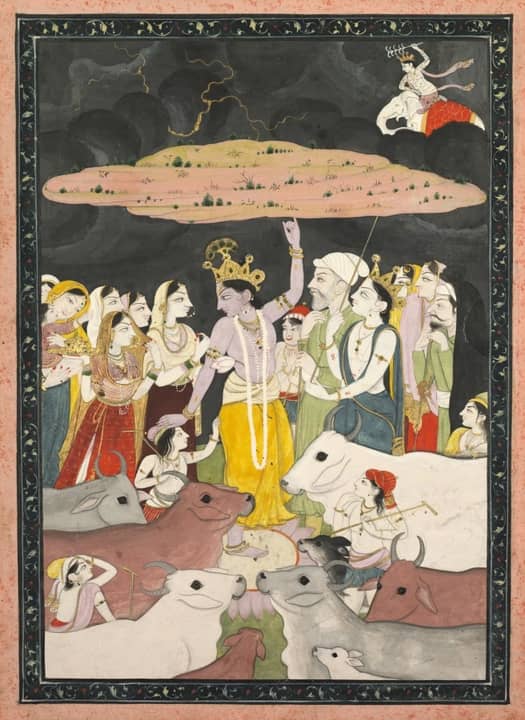
Krishna asks the cowherd families to thank Govardhan Hill and their cows instead of Indra. When Indra sends a great storm, Krishna lifts the whole hill on one hand and everyone shelters underneath.
Written for Pujadeep and checked against the sources listed.
The story
In Vrindavan, the cowherd families were busy getting ready for a big feast. It was for Indra, the king of the clouds and the rain. They were cooking sweets and rice and many good things.
"Father, who is the feast for?" asked young Krishna. "For Indra," said Nanda. "He sends the rain for our grass and our cows."
Krishna thought for a moment. "Our cows live on Govardhan Hill," he said. "The hill gives us grass and water and shade. Let us give our feast to the hill, to the cows and to the priests."
So everyone piled up food of every kind for the hill. They gave fresh grass to the cows. Then they put on their best clothes and walked all the way round the hill, singing.
Indra saw this and was cross. "No feast for me?" he grumbled. He sent huge grey clouds. The rain poured down, and the wind blew and blew.
The cows mooed. The children held their mothers' hands. "Krishna, help us!" everyone called.
Krishna smiled. He walked up to Govardhan Hill. With one hand he lifted the whole hill high, as easily as a child picks up a mushroom. Many tellings say he held it up on just his little finger.
"Come in, Mother! Come in, Father! Bring the cows and the calves!" called Krishna. Everyone came under the hill. It was dry and cosy there, like being under a giant umbrella.
Krishna held up the hill for seven days. At last the rain stopped and the sun came out. Everyone went out with their cows, and Krishna put the hill gently back in its place.
Then everyone hugged Krishna, and the women gave him curd and roasted grain. Later, Indra came too, and said sorry. Families who tell this story often take from it a big thank-you to the hills, the cows and the earth that look after us.
Something to do together
Build a little Govardhan Hill together from playdough, clay or a heap of rice, and put toy cows and people underneath. Lift a small bowl over them like Krishna's umbrella. You can also make a tiny Annakut plate of different foods and share it.
Govardhan Puja: the festival this story belongs to
More stories
For grown-ups
The story ends above. Here, for grown-ups: how families tell it in other ways, and the books it comes from.
How the story differs, and where it comes from
How the story differs
Many families in North and West India keep Govardhan Puja just after Diwali. They make Annakut, a "mountain of food", for Krishna, and some shape a small Govardhan Hill from cow dung or clay in the courtyard. In Braj, near Mathura, pilgrims walk all the way round the real Govardhan Hill. In Gujarat the new year, Bestu Varas, usually begins on the same day; in some years it begins the next day. In Maharashtra and Karnataka, Govardhan Puja's day is kept as Bali Pratipada.
Where the story comes from
- Bhagavata Purana, Book 10 (Dashama Skandha), chapters 24–25 (10.24 (Krishna turns the offering from Indra to the hill, the cows and the Brahmins); 10.25 (the storm, the hill held up for seven days); Indra's apology follows in 10.27)
- Le Bhâgavata Purâna ou Histoire poétique de Krïchna, tome quatrième (Livre X, première partie), traduit par M. Hauvette-Besnault (Paris: Imprimerie nationale, 1884) (Livre X, chapitre XXIV, pp. 122–125 (leaves n144–n147); chapitre XXV, pp. 126–129 (leaves n148–n151); chapitre XXVII, p. 133 (leaf n155))
- The Vishnu Purana, a system of Hindu mythology and tradition, translated by H. H. Wilson (London: John Murray, 1840) (Book V, chapters X–XII, pp. 522–530 (leaves n620–n628), the same story in the Vishnu Purana)
Sources
- Le Bhâgavata Purâna ou Histoire poétique de Krïchna, tome quatrième (Livre X, première partie), traduit par M. Hauvette-Besnault (Paris: Imprimerie nationale, 1884) (Livre X, chapitres XXIV–XXV, pp. 122–129 (leaves n144–n151); chapitre XXVII, p. 133 (leaf n155))
- The Vishnu Purana, a system of Hindu mythology and tradition, translated by H. H. Wilson (London: John Murray, 1840) (Book V, chapters X–XII, pp. 522–530 (leaves n620–n628))
Source and licence
- Our explanation
- Written for this site from the sources listed here, and checked against them. Free to quote with credit.
- Checked
- Checked against the sources listed, October 15, 2026.
- Updated
- October 28, 2026