The Day Rama Was Born
ages 3-6
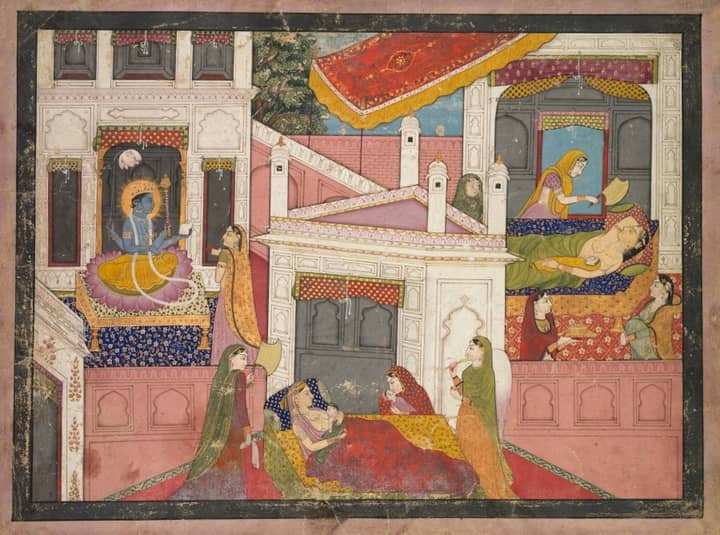
King Dasharatha of Ayodhya longs for children. A shining being rises from the sacred fire with a golden bowl of heavenly drink, and soon four princes are born: Rama, Bharata, Lakshmana and Shatrughna.
Written for Pujadeep and checked against the sources listed.
The story
Long ago, in the beautiful city of Ayodhya, there lived a good king called Dasharatha. He had three queens, Kausalya, Kaikeyi and Sumitra. The king was kind and his people were happy. But the king was sad, because he had no children.
So the king asked a wise sage to hold a great prayer at the sacred fire. Everyone gathered round. The sage sang the holy words, and the fire burned bright and high.
Then something wonderful happened. Out of the fire rose a tall, shining being, dressed in red. In his arms he held a big golden bowl, full of a sweet heavenly drink. "The gods are pleased with you," he said to the king. "Give this to your queens, and you will have sons."
The king carried the golden bowl on his head, full of joy. He gave half of the drink to Queen Kausalya. He gave some to Queen Sumitra, and some to Queen Kaikeyi, and the last little bit to Sumitra again. The queens drank it, and they were very happy.
Then, in spring, on the ninth day of the month of Chaitra, Queen Kausalya had a baby boy. He was Rama. Queen Kaikeyi had a baby boy called Bharata. And Queen Sumitra had twin boys, Lakshmana and Shatrughna.
All of Ayodhya celebrated. Music played in the streets, people danced and sang, and flowers fell like rain from the sky. When the babies were twelve days old, the sage Vasishtha gave them their names.
The four brothers grew up together, loving and kind. Lakshmana loved Rama so much that he would not even eat or sleep without him. And Shatrughna loved Bharata just as much.
Families who keep Ram Navami often take from this story the joy of welcoming a child who is longed for and loved.
Something to do together
Make a small cradle from a box and a cloth and rock it together at midday on Ram Navami, singing any simple song you know. Then make four little paper crowns, one for each prince, and talk about which brother loved which.
Ram Navami: the festival this story belongs to
More stories
For grown-ups
The story ends above. Here, for grown-ups: how families tell it in other ways, and the books it comes from.
How the story differs, and where it comes from
How the story differs
Ram Navami is kept on the ninth day of the bright half of Chaitra, in spring; Valmiki himself names the ninth day of Chaitra for Rama's birth. Many temples rock a small cradle at midday, the hour many families keep as the hour of his birth, and some families read the Ramayana for the nine days before. In North India many families know the story best from Tulsidas's Ramcharitmanas, in which the baby first appears to Kausalya in a four-armed form and then, at her request, becomes a little child.
Where the story comes from
- Valmiki Ramayana, Book 1 (Bala Kanda), cantos 14–19 in Griffith's numbering (Canto 14 (the sacrifice for sons); 15 (the being from the fire with the vessel of nectar, shared among the queens); 19 (the birth of the four princes on the ninth of Chaitra, the naming, their love for one another))
- The Rámáyan of Válmíki, translated into English verse by Ralph T. H. Griffith, vol. I: Book I (London: Trübner; Benares: E. J. Lazarus, 1870) (Book I, canto XIV, p. 82 (leaf n117); canto XV, pp. 88–91 (leaves n123–n126); canto XIX, pp. 105–109 (leaves n140–n144))
Sources
- The Rámáyan of Válmíki, translated into English verse by Ralph T. H. Griffith, vol. I: Book I (London: Trübner; Benares: E. J. Lazarus, 1870) (Book I, cantos XIV–XIX, pp. 82–109 (leaves n117–n144))
- The Rámáyana of Tulsi Dás, translated from the original Hindi by F. S. Growse, sixth edition, revised and corrected (Allahabad: Ram Narain Lal, 1914) (Book I (Childhood), Chhand 24–27 and Doha 204, pp. 122–123 (leaves n151–n152): the regional note's four-armed form)
Source and licence
- Our explanation
- Written for this site from the sources listed here, and checked against them. Free to quote with credit.
- Checked
- Checked against the sources listed, October 13, 2026.
- Updated
- October 15, 2026