Hanuman Finds Sita
ages 7-10
Hanuman leaps across the ocean to Lanka, searches the city by moonlight and finds Sita in a garden of ashoka trees. He gives her Rama's ring, carries her jewel back to Rama, and tells him the words everyone has been waiting for: "I have seen Sita."
Written for Pujadeep and checked against the sources listed.
The story
Ravana, the ten-headed king of Lanka, had carried Sita away across the sea. Rama and his brother Lakshmana had searched for her everywhere. Now a great army of vanaras, the brave monkey people of the forest, was helping them, led by King Sugriva, and the bravest of them all was Hanuman.
Standing on a mountain by the sea, Hanuman bowed to the Sun, to the Wind his father, to Indra and to Brahma. "Swift as an arrow from Rama's bow, I will go to Lanka," he said. Then he crouched, and sprang. Trees were pulled up behind him by the force of his leap, and their flowers drifted down onto the waves like rain.
Halfway across, a golden mountain rose out of the sea. It was Mainaka. "Rest on my peak, friend of Rama," said the mountain, "and eat my sweet fruits." Hanuman thanked the mountain and touched it with his hand, but he flew on. He would not rest until he had found Sita.
He landed on the shore of Lanka as the sun went down. The city glittered with golden towers and bright lamps. To slip in without being seen, Hanuman made himself as small as a cat. All night, by moonlight, he crept from palace to palace. He saw sleeping guards and the great hall of Ravana, but he did not see Sita anywhere.
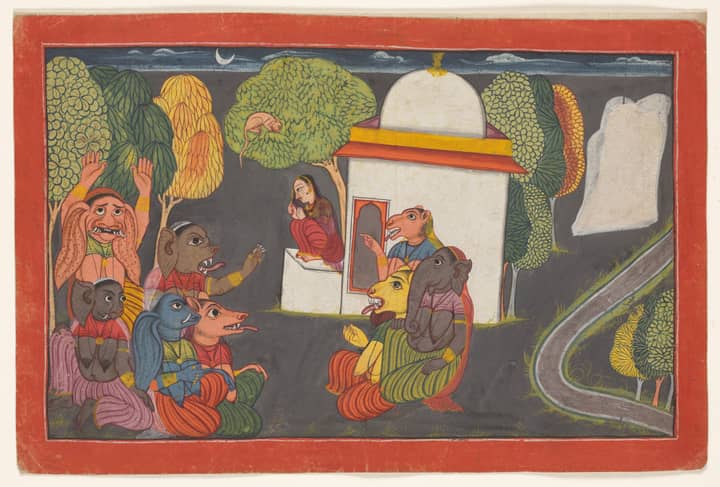
Hanuman began to lose hope. Then he remembered one place he had not looked: a garden of ashoka trees. He climbed into a tall shimshapa tree and peered down through the leaves. There, sitting on the bare ground, was a lady in a faded yellow cloth, thin and sad, her hair in a single braid. It was Sita.
Guards stood all around her. In the morning Ravana came and told her to forget Rama and become his queen. Sita turned her face away. "Rama is my husband," she said, "and he will come for me." Ravana stormed off, and the guards went back to watching her.
Hanuman did not want to frighten Sita by jumping down in front of her. So he chose plain, everyday words, so that she would not take him for one of Ravana's tricks, and softly, from the tree, he began to tell Rama's story: how King Dasharatha's son had gone to the forest, how Sita had been taken, how Rama had searched and made friends with the vanaras, and how Hanuman had leapt across the sea. Sita looked up, amazed.
Hanuman climbed down and bowed. At first Sita wondered if this was another trick. So Hanuman held out a golden ring with Rama's name carved on it. Sita took the ring and held it as if she were holding Rama's hand. Tears of joy ran down her face.
"Climb on my back," said Hanuman. "I will carry you across the sea to Rama right now." But Sita shook her head. "Rama himself should come and take me home," she said. Instead, she took a jewel from her hair and gave it to Hanuman. She also told him a memory that only Rama would know, about a crow at Chitrakuta, so that Rama would be sure the message came from her.
Before leaving, Hanuman wanted Ravana to know that Rama's friends had found Lanka. He shook the trees of the garden until the guards came running. Ravana's warriors rushed at him, but Hanuman sent them flying. At last Ravana's son Indrajit caught him with a magic weapon and brought him before the king.
Ravana was furious. "Set his tail on fire!" he ordered. His men wrapped Hanuman's tail in cloth soaked in oil and lit it. When Sita heard, she prayed to Agni, the god of fire: "If I have always been true, be cool to Hanuman." The flames leapt up bright, but Hanuman felt no heat at all.
Hanuman made himself small, slipped out of his ropes and leapt onto the rooftops, his tail blazing like a torch. From roof to roof he ran, and Lanka's golden houses caught fire behind him. Only the house of Vibhishana, Ravana's good brother, was spared. Then Hanuman stopped. "What if the fire has reached Sita?" He hurried back to the ashoka garden, and there she was, safe and unharmed. He bowed to her once more, put out his tail in the sea, and leapt for home.
On the other shore the vanaras were waiting. When they saw Hanuman's happy face, they shouted and danced. They all hurried to Rama, and Hanuman put Sita's jewel in his hand. "I have seen Sita," he said. Rama pressed the jewel to his heart. Families who read this part of the Ramayana often take from it that a friend who never gives up can carry hope across an ocean.
Something to do together
Play a find-and-deliver game. One person hides a small toy somewhere in the house as "Sita". The other searches, room by room, and brings back a token, such as a paper ring with a loved one's name written on it, to prove the toy was found.
More stories
For grown-ups
The story ends above. Here, for grown-ups: how families tell it in other ways, and the books it comes from.
How the story differs, and where it comes from
How the story differs
In North India, Tulsidas's Ramcharitmanas is the best-known telling. Its Sundarkand, the fifth of its seven books, tells this journey in Awadhi verse. There, Hanuman meets Vibhishana in Lanka before he finds Sita.
Where the story comes from
- Valmiki Ramayana, Book 5 (Sundara Kanda), cantos 1–66 in Griffith's numbering (Canto 1 (the leap, Mainaka); 2–14 (Lanka by night, the ashoka garden); 30–38 (Hanuman speaks, the ring, the jewel and the crow); 53–55 (the burning tail, Sita's prayer to Agni, the fear for Sita); 65–66 (the tidings and Rama's speech))
- The Rámáyan of Válmíki, translated into English verse by Ralph T. H. Griffith, vol. IV: Books IV and V (London: Trübner; Benares: E. J. Lazarus, 1873) (Book V, cantos I (pp. 279–288, leaves n290–n299), XXX–XXXVIII (pp. 348–370, leaves n359–n381), LIII–LV (pp. 396–402, leaves n407–n413), LXV–LXVI (pp. 410–413, leaves n421–n424))
Sources
- The Rámáyan of Válmíki, translated into English verse by Ralph T. H. Griffith, vol. IV: Books IV and V (London: Trübner; Benares: E. J. Lazarus, 1873) (Book V, cantos I–LXVI, pp. 279–413 (leaves n290–n424))
Source and licence
- Our explanation
- Written for this site from the sources listed here, and checked against them. Free to quote with credit.
- Checked
- Checked against the sources listed, October 16, 2026.
- Updated
- October 27, 2026