Krishna, Satyabhama and King Naraka
ages 7-10
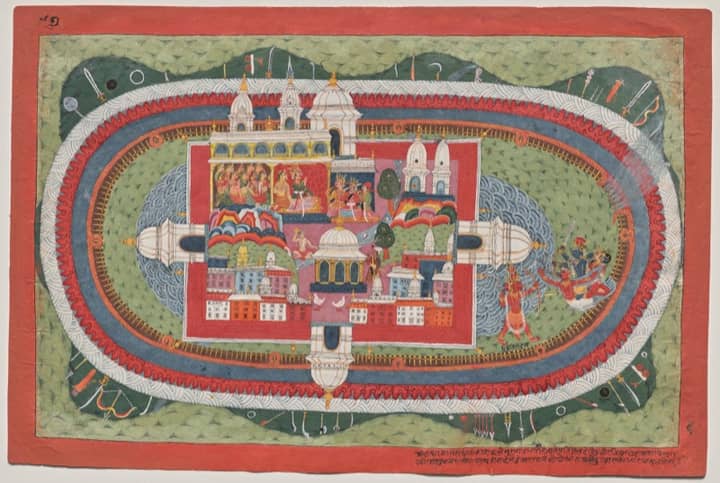
The tyrant Naraka has stolen the earrings of Aditi, the mother of the gods, and locked up thousands of princesses. Krishna flies on Garuda with Queen Satyabhama to his city, overcomes him, sets the captives free and returns the earrings.
Written for Pujadeep and checked against the sources listed.
The story
One day Indra, the king of the gods, came riding on his white elephant to Krishna's city of Dvaraka. "Krishna," he said, "you have helped the world so many times. Now we need you again."
He told Krishna about Naraka, a powerful king who ruled the city of Pragjyotisha. Naraka had carried off the daughters of gods, sages and kings and shut them up in his palace. He had taken the great umbrella of Varuna, the god of the waters, and a jewelled mountain-peak, and even the shining earrings of Aditi, the mother of the gods. Now he wanted Indra's elephant too.
Krishna smiled, stood up and took Indra's hand. Then he called Garuda, the great eagle. First he helped his queen Satyabhama onto Garuda's back, then he climbed up himself, and they flew off together towards Naraka's city.
The city was guarded by nets of sharp ropes, set by a demon called Muru. Krishna threw his spinning discus, Sudarshana, and the nets fell apart. Muru rushed out, but Krishna overcame him, and then he came to the gates of the city.
Naraka's army came out to fight, and Naraka himself rushed at Krishna, hurling every kind of weapon. But Krishna stood firm, and with his discus he overcame the tyrant king. Naraka fell, and his power was gone.
Then the Earth goddess came, holding Aditi's earrings. Naraka had been her son. "Take these earrings," she said, "and forgive the wrong that my son did. Please look after his child." Krishna agreed, and he was gentle with her.
Inside the palace Krishna found sixteen thousand one hundred princesses, locked away. He set them all free and sent them safely to Dvaraka. He took back Varuna's umbrella and the jewelled mountain-peak.
Then Krishna and Satyabhama flew up to heaven on Garuda, and Krishna gave the shining earrings back to Aditi. The mother of the gods was overjoyed, and she sang Krishna's praises.
Families who rise early on Naraka Chaturdashi, bathe and light lamps often take from this story that light comes when those who are locked away are set free.
Something to do together
On Naraka Chaturdashi morning, get up early together, light one small lamp before sunrise, and name one thing that makes people feel "locked away", like loneliness or unkindness. Then think of one small way to help someone feel free and included.
Naraka Chaturdashi: the festival this story belongs to
More stories
For grown-ups
The story ends above. Here, for grown-ups: how families tell it in other ways, and the books it comes from.
How the story differs, and where it comes from
How the story differs
Naraka Chaturdashi usually falls on the day before Lakshmi Puja (Diwali). In many homes in South and West India, families wake before dawn for an oil bath and light lamps, and in the South the day is itself called Deepavali. Many South Indian tellings say that Satyabhama herself defeated Naraka, as the Earth goddess come again; the Vishnu Purana says that Satyabhama rode with Krishna and that Krishna overcame him.
Where the story comes from
- Vishnu Purana, Book 5, chapters 29–30 (5.29 (Indra's report, Krishna and Satyabhama on Garuda, Muru's nooses, Naraka's fall, the Earth's plea, the freed princesses); 5.30 (the earrings returned to Aditi); the Bhagavata tells the same story in Book 10, chapter 59, which was not checked here)
- The Vishnu Purana, a system of Hindu mythology and tradition, translated by H. H. Wilson (London: John Murray, 1840) (Book V, chapters XXIX–XXX, pp. 581–585 (leaves n679–n683))
Sources
- The Vishnu Purana, a system of Hindu mythology and tradition, translated by H. H. Wilson (London: John Murray, 1840) (Book V, chapters XXIX–XXX, pp. 581–585 (leaves n679–n683))
Source and licence
- Our explanation
- Written for this site from the sources listed here, and checked against them. Free to quote with credit.
- Checked
- Checked against the sources listed, October 13, 2026.
- Updated
- October 15, 2026