Rama Comes Home
ages 7-10
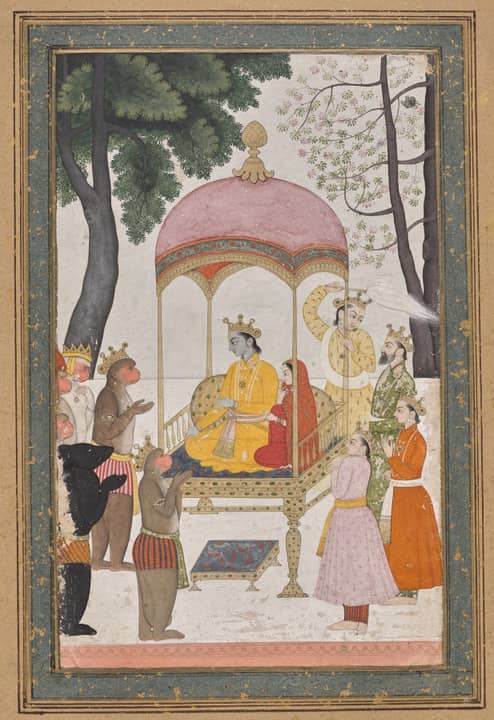
After fourteen years away, Rama flies home to Ayodhya with Sita, Lakshmana and his friends. His brother Bharata, who has kept Rama's sandals on the throne all that time, leads the whole city out to welcome him, and Rama is crowned king.
Written for Pujadeep and checked against the sources listed.
The story
The long fight in Lanka was over. Ravana had fallen, Sita was free, and Vibhishana, Ravana's good brother, was now king of Lanka. Fourteen years had passed since Rama had left Ayodhya for the forest. It was time to go home.
Vibhishana brought the Pushpaka, a flying chariot as bright as the sun, decked with swans and silver wings. Rama began to say goodbye to his friends, but they all cried out, "Take us with you! We want to see Ayodhya and be there when you are crowned." Rama's heart filled with joy. "Come, all of you," he said. Sugriva, Hanuman, Vibhishana and the chiefs of the vanaras, the monkey people who had helped Rama, climbed aboard, and the chariot rose into the sky.
As they flew north, Rama pointed things out to Sita: the city of Lanka on its mountain, the shore where the vanaras had slept, the great ocean, and the golden mountain that had risen from the sea so that Hanuman could rest.
They stopped at the hermitage of the sage Bharadvaja, his quiet home in the forest. "Your brother Bharata is well," the sage told Rama. "He wears his hair matted like a hermit, keeps your sandals before him, and waits only for you." Bharadvaja gave Rama a blessing, and all along the road to Ayodhya the trees burst into fruit and flower for the hungry vanaras.
Rama sent Hanuman ahead. "Go to Bharata," he said. "Tell him that I am coming, and watch his face." Hanuman flew to Nandigrama, the village where Bharata lived like a hermit, and told him everything: the forest, the search, the battle and the rescue.
Bharata was overjoyed. "Let every shrine be decked with flowers," he ordered. "Let music play! Let the roads be smoothed and sprinkled with cool water, and let flags fly from every tower!" The whole city poured out to welcome Rama: the queens in their litters, the priests singing, the soldiers, elephants, horses and chariots, and crowds and crowds of people.
Bharata walked in front, carrying Rama's sandals on his head. For fourteen years he had kept them on the throne and ruled only in Rama's name.
Then the shining chariot came down. Bharata climbed up and bowed at Rama's feet, and Rama lifted him up and held him close. Rama bowed to his mothers, Kausalya, Sumitra and Kaikeyi, and the crowds cried, "Welcome, Rama! Welcome home!" Bharata put the sandals back on Rama's feet. "Your kingdom is yours again," he said.
Rama's long matted hair was trimmed, and he bathed and put on royal clothes. Sita was dressed in shining robes. Vanara messengers flew to the four oceans and brought back water for the crowning. Then the sage Vasishtha seated Rama and Sita on a jewelled throne, and the priests sprinkled the sacred water over Rama and set the golden crown of his ancestors on his head.
Music played, the sky rang with cheers, and the fields filled with golden grain. Rama gave gifts to everyone who had helped him. Sita took off her own pearl necklace and, with a glance at Rama, gave it to Hanuman, her faithful friend.
Valmiki's Ramayana fills that day with flowers, flags, music and cheering crowds. The rows of little lamps that many families light at Diwali to welcome Rama home come from later tradition, which joined his homecoming to the festival of lights. Families who light those lamps often take from the story the simple joy of welcoming someone dear back home.
Something to do together
Make a welcome-home path. Line your doorway with paper flowers or a rangoli, or, with a grown-up, a row of diyas, and take turns being Rama coming home and the family welcoming him. You can also make a simple pair of paper sandals and carry them on your head, the way Bharata did.
Diwali: the festival this story belongs to
More stories
For grown-ups
The story ends above. Here, for grown-ups: how families tell it in other ways, and the books it comes from.
How the story differs, and where it comes from
How the story differs
In much of North India, Diwali remembers Rama's return to Ayodhya. In South India, many families link Deepavali with Krishna and Satyabhama's victory over Narakasura, and in Bengal the same night is Kali Puja. In most traditions Lakshmi Puja, the worship of the goddess of good fortune, falls on the Diwali new moon. Valmiki's account of Rama's return does not describe the lamps of Diwali; they come from later tradition.
Where the story comes from
- Valmiki Ramayana, Book 6 (Yuddha Kanda), cantos 124–130 in Griffith's numbering (the closing chapters of the Yuddha Kanda) (The departure in the Pushpaka, the flight home, Bharadvaja's hermitage, Hanuman's message to Bharata, the meeting at Nandigrama, the consecration)
- The Rámáyan of Válmíki, translated into English verse by Ralph T. H. Griffith, vol. V: Book VI and an outline of Book VII (London: Trübner; Benares: E. J. Lazarus, 1874) (Book VI, cantos CXXIV–CXXX, pp. 290–314 (leaves n301–n325))
Sources
- The Rámáyan of Válmíki, translated into English verse by Ralph T. H. Griffith, vol. V: Book VI and an outline of Book VII (London: Trübner; Benares: E. J. Lazarus, 1874) (Book VI, cantos CXXIV–CXXX, pp. 290–314 (leaves n301–n325))
Source and licence
- Our explanation
- Written for this site from the sources listed here, and checked against them. Free to quote with credit.
- Checked
- Checked against the sources listed, October 12, 2026.
- Updated
- October 27, 2026