Savitri and Satyavan
ages 7-10
Princess Savitri chooses Satyavan, knowing he has only one year to live. When Yama, the lord of death, comes for him, she follows Yama and speaks so wisely that he grants her gifts, until the last one brings Satyavan back.
Written for Pujadeep and checked against the sources listed.
The story
Long ago, the good king Ashvapati of Madra had no children. For eighteen years he lived simply, prayed to the goddess Savitri and made offerings at the sacred fire. At last the goddess appeared from the fire and blessed him with a daughter. He named her Savitri, after the goddess.
Savitri grew up so bright and so lovely that no prince dared to ask for her hand. So her father said, "Go out and choose a husband for yourself." Savitri set out in a golden chariot with her father's old advisers, visiting the forest homes of sages far and wide.
When she came home, the sage Narada was sitting with her father. "In a forest," Savitri said, "lives a king named Dyumatsena. He lost his eyesight, and an enemy took his kingdom, so he lives in a hermitage, a simple home in the forest, with his wife and son. The son is Satyavan. I have chosen him."
Narada's face grew grave. "Satyavan is truthful, brave, kind and wise," he said. "He has only one fault, and it cannot be changed. One year from today, Satyavan will die."
Her father begged her to choose someone else. But Savitri was steady. "A daughter chooses only once," she said. "Whether his life is long or short, I have chosen him." Narada saw how firm she was, and he gave his blessing.
So Savitri and Satyavan were married in the forest. Savitri put away her jewels and wore simple bark-cloth like everyone in the hermitage. She cared for Satyavan's blind father and his mother, and she was gentle and cheerful with everyone. But she never forgot Narada's words. Quietly, she counted the days.
When only three days were left, Savitri began a fast. She ate nothing for three days and nights and stood in prayer. On the last morning, Satyavan picked up his axe to go and gather wood and fruit in the forest. "Let me come with you today," said Savitri. Satyavan's parents agreed.
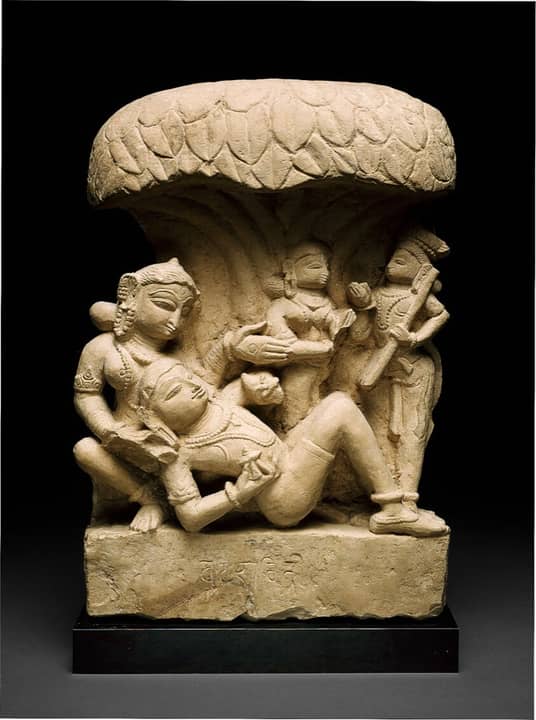
They walked under flowering trees, and Satyavan pointed out the peacocks and the rivers. Savitri smiled at him, but her heart was heavy. Then, as he was chopping branches, Satyavan said, "My head aches. I must lie down." Savitri sat on the ground and laid his head in her lap.
At that moment a tall, shining figure appeared, dressed in red, with a crown on his head and a rope in his hand. "Who are you?" asked Savitri. "I am Yama, the lord of death," he said. "Satyavan's days are over. Because he is so good, I have come for him myself." Gently, Yama drew out Satyavan's life, a small light no bigger than a thumb, and set off towards the south.
Savitri followed him. "Go back," said Yama. "You have come as far as anyone can." "Where my husband goes, I go," said Savitri, and she spoke to Yama about goodness and friendship so wisely that he was pleased. "Ask me for a gift," he said, "anything except Satyavan's life."
"Let my husband's father see again, and be strong," said Savitri. "It is done," said Yama. "Now go back." But Savitri walked on and kept speaking, and Yama gave her a second gift: Dyumatsena would have his kingdom back. Then a third: her own father would have many sons. Each time Yama said, "Now go back," and each time Savitri walked on.
"No one has ever spoken to me like this," said Yama. "Ask a fourth gift, but not his life." Savitri said, "Let Satyavan and me have many children, strong and good." "It shall be so," said Yama. "Now go back. You have come too far already."
But Savitri walked on, and she spoke about how good people help others without asking for anything back. Yama was so pleased that he said, "Now ask for one more gift, any gift at all." Savitri said softly, "You have promised me children with Satyavan, but that gift cannot come true without him. So this is my wish: let Satyavan live." Yama smiled, and he untied his rope. "Your husband is free," he said. "He will live a long life with you." And Yama went on his way.
Savitri hurried back to where Satyavan lay. He opened his eyes as if waking from a deep sleep. "I slept so long," he said. "It is night already!" Savitri helped him up, carried his axe for him, and the two of them walked home through the forest by moonlight.
At the hermitage, everyone was overjoyed. Dyumatsena could see again. The next morning, people came from his old city with the news that his kingdom was his once more. Savitri told everyone what had happened, and the sages said that her steady heart had turned a great sorrow into joy. Families who tell this story often take from it that love, patience and wise words can do what strength cannot.
Something to do together
Play "gifts for others". Each person names three gifts they would ask for, not for themselves but for other people in the family, the way Savitri asked first for her husband's father and her own father. Then talk about which gift was the cleverest.
More stories
For grown-ups
The story ends above. Here, for grown-ups: how families tell it in other ways, and the books it comes from.
How the story differs, and where it comes from
How the story differs
Many families keep Vat Savitri, a day of prayer at a banyan tree, in Savitri's honour: in many parts of North and East India, such as Bihar, Jharkhand and Odisha, on the new moon of the month of Jyeshtha, and in Maharashtra, Goa and Gujarat as Vat Purnima, on the full moon. In Tamil Nadu, Karadaiyan Nombu remembers her too. The Mahabharata does not name the tree where Satyavan rested; the banyan comes from these later customs. In many tellings today, Savitri wins Satyavan's life with the fourth gift itself, by asking how she can have children without him; the Mahabharata tells it with a fifth gift, as here.
Where the story comes from
- Mahabharata, Book 3 (Vana Parva), Pativrata-mahatmya: the story of Savitri, told by the sage Markandeya to Yudhishthira (Sections 292–298 in Ganguli's translation (3.277–283 in the Pune Critical Edition))
- The Mahabharata of Krishna-Dwaipayana Vyasa, translated into English prose (K. M. Ganguli), published by Protap Chandra Roy: Sabha Parva and Vana Parva (Calcutta: Bharata Press, 1884) (Vana Parva, Sections CCXCII–CCXCVIII (printed CCLXLII–CCLXLVIII), pp. 864–888 (leaves n1109–n1133))
Sources
- The Mahabharata of Krishna-Dwaipayana Vyasa, translated into English prose (K. M. Ganguli), published by Protap Chandra Roy: Sabha Parva and Vana Parva (Calcutta: Bharata Press, 1884) (Vana Parva, Sections CCXCII–CCXCVIII, pp. 864–888 (leaves n1109–n1133))
Source and licence
- Our explanation
- Written for this site from the sources listed here, and checked against them. Free to quote with credit.
- Checked
- Checked against the sources listed, October 15, 2026.
- Updated
- October 27, 2026