Shiva and Parvati's Wedding
ages 7-10
The seven great sages go to the Himalaya to ask for Parvati's hand for Shiva. The mountain city is decorated, Shiva's serpents and ashes turn into ornaments, and the gods gather for the most wonderful wedding in the three worlds.
Written for Pujadeep and checked against the sources listed.
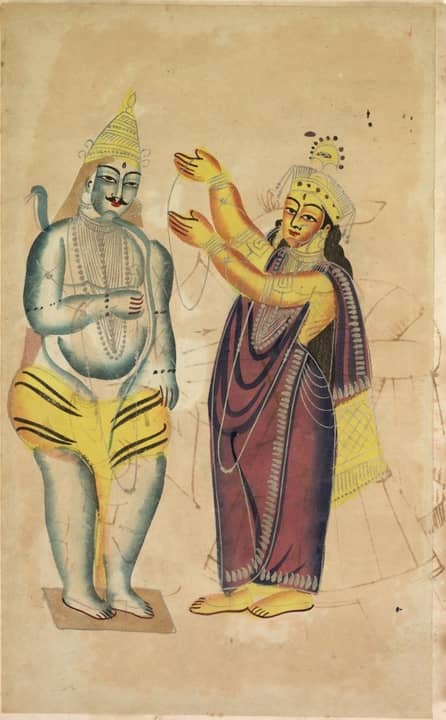
The story
Parvati, also called Uma, was the daughter of Himalaya, the king of the mountains. For a long time she had prayed and lived simply in the forest, hoping to win the heart of Shiva, the great god who sits in meditation on the snowy peaks. At last Shiva came to her and said, "Your devotion has won me."
But Shiva wanted to do things properly. He called the seven great sages, the Saptarishi, who shine as stars in the sky, and with them came Arundhati, the wise wife of the sage Vasishtha. "Go to Himalaya," Shiva said, "and ask him for his daughter's hand."
The sages flew through the sky to Himalaya's city, with its golden towers and the holy Ganga flowing around its walls. The mountain king came striding to meet them, so big that the earth shook. "You are welcome, like rain from a cloudless sky," he said. "What can I do for you?"
The sage Angiras answered for them all: "Shiva, the father of the world, asks for your daughter's hand. She will be the mother of all living things." Parvati was standing nearby. She lowered her head and pretended to count the petals of the lotus in her hand, so that no one would see her blush.
Himalaya hugged his daughter. "Come, my child," he said, "you are to be the bride of Shiva." The sages blessed her, and her mother Mena wept happy tears.
On the wedding day the whole city was decorated. Flowers lay deep in the streets, and silk banners flew over golden gates. The ladies of the palace dressed Parvati in silk, painted her feet, lined her eyes with dark kohl and put flowers in her hair. Her mother lifted her face and, with tears of joy in her eyes, painted the golden wedding mark on her forehead.
And Shiva got ready too. He usually wore ashes, an elephant's hide and snakes. But now his ashes smelled sweet like sandalwood, the hide became a silk robe woven with gold, his snakes curled up like jewels, and the crescent moon on his head glowed brighter than any crown. He rode on his great bull, with the river goddesses Ganga and Yamuna fanning him, and Brahma and Vishnu came along to bless him.
As the procession came through the streets, everyone rushed to the windows to see the bridegroom. One lady ran with only one eye lined with kohl! Then Shiva and Parvati met, and for a moment they were both too shy to look at each other.
They walked three times round the sacred fire, and Parvati offered grain to the flames. Brahma blessed Parvati and said that her children would be heroes. Saraswati, the goddess of speech, blessed them both, and all the gods rejoiced.
Many families who stay awake on Maha Shivaratri say it is the night when Shiva and Parvati were married, and they take from this story the joy of two who belong together at last.
Something to do together
Make a little wedding garland together from paper flowers or real marigolds. Then draw Shiva getting ready, with his snakes curling into jewels and the moon shining on his head, and Parvati counting the petals of her lotus.
Maha Shivaratri: the festival this story belongs to
More stories
For grown-ups
The story ends above. Here, for grown-ups: how families tell it in other ways, and the books it comes from.
How the story differs, and where it comes from
How the story differs
The Kumarasambhava is a poem by Kalidasa, not a Purana, and it tells the wedding with a poet's delight.
Many families say
Maha Shivaratri is the night of this wedding; others say it is the night Shiva appeared as an endless pillar of light, or the night he drank the poison from the ocean. In North India and Maharashtra, many women keep Hartalika Teej in memory of Parvati's long penance before the wedding.
Where the story comes from
- Kalidasa, Kumarasambhava, cantos 6–7 (Canto 6 (the seven sages and Arundhati sent to Himalaya, Angiras's request, Uma counting lotus petals, Himalaya's consent); canto 7 (the decorated city, the bride's adornment, Shiva's ornaments transformed, the procession, the women at the windows, the wedding round the fire, the blessings of Brahma and Saraswati))
- The Birth of the War-God (Kumarasambhava), a poem by Kalidasa, translated into English verse by Ralph T. H. Griffith (London: Wm. H. Allen, 1853) (Canto VI, 'Uma's espousals', pp. 55–65 (leaves n68–n78); canto VII, 'Uma's bridal', pp. 67–80 (leaves n80–n93))
Sources
- The Birth of the War-God (Kumarasambhava), a poem by Kalidasa, translated into English verse by Ralph T. H. Griffith (London: Wm. H. Allen, 1853) (Cantos VI–VII, pp. 55–80 (leaves n68–n93))
Source and licence
- Our explanation
- Written for this site from the sources listed here, and checked against them. Free to quote with credit.
- Checked
- Checked against the sources listed, October 13, 2026.
- Updated
- October 15, 2026