Varaha Lifts the Earth
ages 7-10
At the start of a new age of the world, the Earth lies sunk deep under the waters. Vishnu takes the form of a giant boar, dives down, lifts her up on his tusks and sets her afloat, and then the world is made again.
Written for Pujadeep and checked against the sources listed.
The story
The old stories say that the world has many ages, like days and nights that come round again and again. At the end of one long cosmic night, the great god woke up, the one who creates the world as Brahma and keeps it as Vishnu. He looked out, and all he could see was water. Where was the Earth?
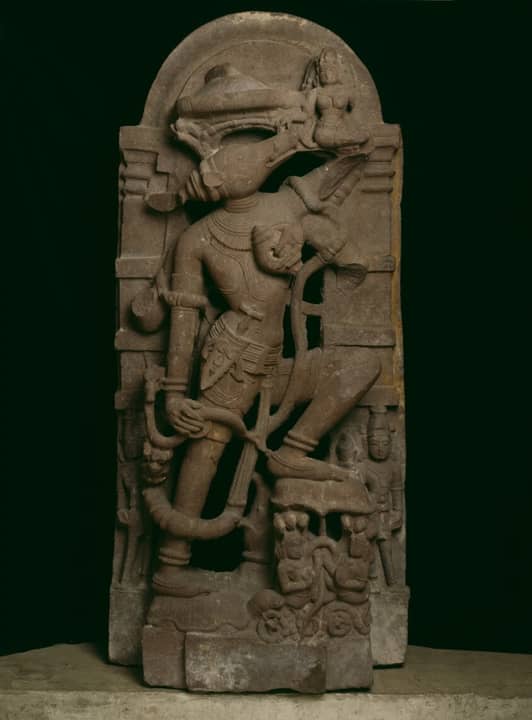
She had sunk to the very bottom of the waters. So the god decided to bring her up. In past ages he had taken the form of a fish and of a tortoise. This time he took the form of a giant boar, Varaha, as big as a mountain and dark in colour, with eyes like lotus flowers and great tusks.
Down, down, down he dived into the deep. When the Earth goddess saw him coming, she bowed to him and prayed, "You lifted me up in days of old. Lift me up again now. Everything comes from you."
Varaha gave a deep, rumbling sound, like the chanting of the Sama Veda. The Vedas are the oldest holy books of the Hindus, and the Sama Veda is the Veda of chants. Then he lifted the whole Earth on the tips of his tusks and rose up through the waters. As he raised his head, the water streaming from his brow washed over the sages who lived high above, and they held on to his bristles, full of delight.
The sages sang his praises: "Your feet are the Vedas, your tongue is the sacred fire, your voice is the chanting of hymns. The Earth sits on the tip of your tusks like a lotus leaf lifted from a pond."
Varaha set the Earth gently on top of the waters, where she floated like a great ship. He made her smooth and level, and he raised up mountains on her. Then, as Brahma, the god began to create again: plants and trees, animals and birds, gods, and people.
Families who keep Ugadi and Gudi Padwa often say that this is the time of year when Brahma began creating the world, and they take from this story the feeling of a fresh start, with the whole world lifted up and made new.
Something to do together
Fill a bowl with water and float a small leaf or a paper boat "Earth" on it. Then try lifting a marble from the bottom of the bowl with a spoon, the way Varaha lifted the Earth. At Ugadi, make a little bowl of six tastes together, such as jaggery, tamarind, a neem leaf, salt, chilli and raw mango, and talk about the sweet and hard things a new year may bring.
Ugadi: the festival this story belongs to
More stories
For grown-ups
The story ends above. Here, for grown-ups: how families tell it in other ways, and the books it comes from.
How the story differs, and where it comes from
How the story differs
Ugadi (in Andhra Pradesh, Telangana and Karnataka) and Gudi Padwa (in Maharashtra) mark the lunar new year on the first day of the bright half of Chaitra. The belief that Brahma began creation on this day comes from a verse of the Brahma Purana that the medieval books on festival rules quote, such as Hemadri and the Nirnayasindhu; the Vishnu Purana chapter told here names no day. Families eat Ugadi pachadi, which mixes sweet, sour, bitter and other tastes for the year ahead, and in Maharashtra they raise a gudi, a pole with a bright cloth, at the door. In the Bhagavata and in many tellings today, Varaha also defeats the demon Hiranyaksha, who had carried the Earth away; the Vishnu Purana chapter told here has no demon.
Where the story comes from
- Vishnu Purana, Book 1, chapter 4 (with the start of chapter 5) (1.4 (Narayana as Brahma wakes, the Earth under the waters, the boar form, the Earth's prayer, the lifting on the tusks, the sages' hymn, the Earth set afloat and shaped); 1.5 (creation renewed))
- The Vishnu Purana, a system of Hindu mythology and tradition, translated by H. H. Wilson (London: John Murray, 1840) (Book I, chapter IV, pp. 27–33 (leaves n125–n131); chapter V, pp. 34–35 (leaves n132–n133))
Sources
- The Vishnu Purana, a system of Hindu mythology and tradition, translated by H. H. Wilson (London: John Murray, 1840) (Book I, chapters IV–V, pp. 27–35 (leaves n125–n133))
- A Prose English Translation of Srimadbhagabatam, Books I–VI, edited and published by Manmatha Nath Dutt (Calcutta: Elysium Press, 1895–96) (Book III, chapters XIII and XVII–XIX, pp. 60, 85–91 by the contents list (Varaha lifts the earth and fights Hiranyaksha): the regional note's other telling)
- Kamalakara Bhatta, Nirnayasindhu, finished in Vikrama Samvat 1668 (1612) by its closing verses (p. 476, leaf n468); Bombay: Nirnaya Sagar Press, catalogued by the Digital Library of India as 1901 (the scan has no title page). Second chapter, opening: the year begins on Chaitra Shukla Pratipada, and the text quotes from Hemadri the Brahma Purana verse that Brahma created the world on that day at sunrise. Cited, not quoted. (Second chapter, first page, p. 62 (leaf n77; the page carries no number, between pp. 61 and 63))
Source and licence
- Our explanation
- Written for this site from the sources listed here, and checked against them. Free to quote with credit.
- Checked
- Checked against the sources listed, October 15, 2026.
- Updated
- October 28, 2026