Bhishma Waits for the Sun
ages 11-14
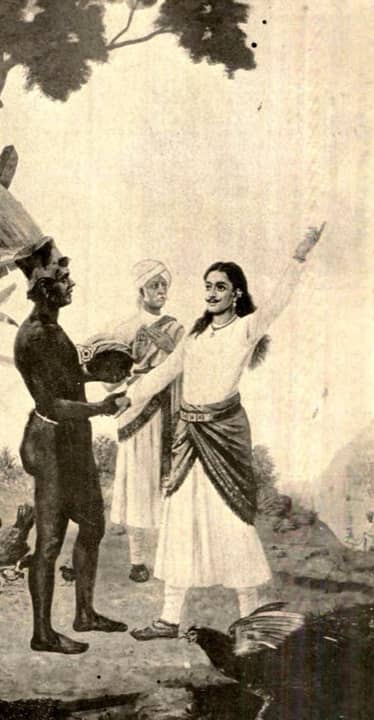
Bhishma, grandfather of both the Pandavas and the Kauravas, falls at Kurukshetra while the sun is still on its southern course. Because of a boon he may choose his own time to leave the world, and he decides to wait, on a bed of arrows, until the sun turns north.
Written for Pujadeep and checked against the sources listed.
The story
Long before the war, Bhishma's name had been Devavrata. He was the son of King Shantanu and the river goddess Ganga, and he was heir to the throne. But to make his father happy, he gave up the throne and vowed never to marry, so that no child of his could ever claim the kingdom. The vow was so terrible and so firm that people called him Bhishma, "the one of the fearsome vow". His grateful father gave him a boon: he would leave this world only when he himself chose to.
Many years later, the Pandavas and the Kauravas met at Kurukshetra. They were the grandsons of his half-brother, and they all called him grandfather. Bhishma loved them all, but he had promised to serve the throne of Hastinapura, so he led the Kaurava army. For ten days no one could stand against him.
On the tenth day, a little before sunset, Bhishma fell from his chariot, struck by so many of Arjuna's arrows that his body rested on them and did not touch the ground. He lay as if on a bed made of arrows. Cries of sorrow rose from both armies, and even the gods, it is said, cried out in the sky.
As he fell, Bhishma noticed that the sun was still on its southern course, the half of the year called dakshinayana. The old teaching held that the northern half, uttarayana, was the auspicious time to leave the world. So he did not let his life go. "I am alive," he said. "I will wait."
His mother Ganga sent great sages to him in the form of swans from the Manasa lake. They circled him and asked one another why so great a soul should leave the world while the sun was in the south. "I will not go while the sun is in the south," Bhishma told them. "When the sun turns north, I will go to my true home. I have the power to choose."
Then something remarkable happened. Both armies stopped fighting. The Kauravas and the Pandavas took off their armour, laid down their weapons, and came together to honour the grandfather of them all, as they had in the days before the quarrel.
"My head hangs down," Bhishma said. "Bring me a pillow." The kings brought soft pillows of fine cloth, but he smiled and refused them. "These are not fit for a warrior's bed," he said. He turned to Arjuna. Arjuna understood. With tears in his eyes, he took three arrows and set them beneath the old man's head. Bhishma was pleased. "That is the right pillow," he said.
Physicians came to help him, but Bhishma thanked them and sent them away with gifts. Each morning kings, women, old people and children came to see him, scattering sandalwood powder, rice and flowers. The Mahabharata goes on to tell how, lying on that bed, Bhishma taught Yudhishthira about duty, kingship and wisdom, and how, when the sun at last turned north, he chose to leave the world in peace.
Families who remember Bhishma at the turning of the sun often take from his story that a promise and a patient mind can hold steady even through great pain, and that enemies can still stand together to honour someone they all love.
Something to do together
Watch the sunrise or sunset from the same window or spot once a week for a month or two around Makar Sankranti, and mark where the sun appears each time. Notice how it moves along the horizon. Then talk together about a promise someone in your family has kept even when it was hard.
Makar Sankranti: the festival this story belongs to
More stories
For grown-ups
The story ends above. Here, for grown-ups: how families tell it in other ways, and the books it comes from.
How the story differs, and where it comes from
How the story differs
Many families mark the start of uttarayana, the sun's northward journey, at Makar Sankranti, when the sun enters Capricorn in the Indian reckoning; astronomers place the turning point itself at the December solstice, a few weeks earlier. Bhishma Ashtami, kept in the month of Magha, remembers the day Bhishma left the world. Bhishma also appears at the very start of the Bhagavad Gita, among the elders Arjuna cannot bear to face.
Where the story comes from
- Mahabharata, Book 6 (Bhishma Parva), Bhishma-vadha Parva: Bhishma's fall and the bed of arrows (Sections 120–123 in Ganguli's translation; his vow and his father's boon are told in the Adi Parva, and his teaching and departure in the Shanti and Anushasana Parvas)
- The Mahabharata of Krishna-Dwaipayana Vyasa, translated into English prose (K. M. Ganguli), published by Protap Chandra Roy: Bhishma Parva (Calcutta: Bharata Press, 1887) (Bhishma Parva, Sections CXX–CXXIII, pp. 444–452 (leaves n471–n479))
Sources
- The Mahabharata of Krishna-Dwaipayana Vyasa, translated into English prose (K. M. Ganguli), published by Protap Chandra Roy: Bhishma Parva (Calcutta: Bharata Press, 1887) (Bhishma Parva, Sections CXX–CXXIII, pp. 444–452 (leaves n471–n479))
- The Mahabharata of Krishna-Dwaipayana Vyasa, translated into English prose (K. M. Ganguli), published by Protap Chandra Roy: Adi Parva (Calcutta: Bharata Press, 1884) (Adi Parva, Section C, pp. 304–305 (leaves n337–n338): the vow, the name Bhishma ('the terrible') and Shantanu's boon that death comes only at his command)
- The Mahabharata of Krishna-Dwaipayana Vyasa, translated into English prose (K. M. Ganguli), published by Protap Chandra Roy: Anusasana Parva (Calcutta: Bharata Press, 1893) (Anushasana Parva, Sections CLXVII–CLXVIII, pp. 774–779 (leaves n789–n794): the sun's northward course, fifty-eight nights on the bed, the month of Magha (p. 776, leaf n791), Krishna's leave and Bhishma's departure by yoga)
Source and licence
- Our explanation
- Written for this site from the sources listed here, and checked against them. Free to quote with credit.
- Checked
- Checked against the sources listed, October 15, 2026.